
- Posts: 1250
- Thank you received: 1203
Max Thrust Riot.
- crash happy
-
 Topic Author
- Offline
- Platinum Member
-

- Oops. did I say that out loud!
Less
More
18 May 2020 10:18 #1
by crash happy
Max Thrust Riot. was created by crash happy
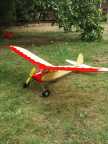
This Riot was purchased second hand & had been fitted with a 60 amp speedo & 1250kv Rimfire motor, as opposed to the original smaller 850kv. Why the previous owner changed it I have no idea, but it was cheap & that's what it came with. So far it has be flown twice & crashed twice, once by my me & once by my flying buddy. Pilot error on both occasions.  After the second crash I was going to replace the whole airframe, but after a bit of cajoling on here, a compromise was reached & just the fuz has been replaced. The old one will get repaired when I have more time during the winter.
The horizontal stab was an easy repair, cut out the damaged bit & inset a new piece.

The wing, bearing in mind it had already been repaired once, was a bit more fiddly. The breaks were mostly at the join of the two halves & around the plastic retaining plates, one of which had snapped in half. After pouring hot water over the areas that had been compressed to get the shape back these were glued back together with epoxy. The retaining plate was glued & covered with glass fibre tissue for some added strength.
 The original spar was a solid aluminium rod inserted into aluminium tubes, that was bent & a bitch to get out because for some reason it had been glued in ! It eventually came out, tubes & all but un-salvageable. Two new 10mm tubes were cut & glued in & a carbon fibre spar (not glued) inserted before the two halves were glued back together. Next was to cut out a piece of the wing leading edge ( probably damaged when it clipped the hedge) insert a new piece & cover it with some self adhesive carbon fibre I had left over to tidy it up.
 In an effort to calm it down a bit we have been experimenting with different prop sizes. For reference the battery packs it came with are 3s 35c 3600 mah. The original prop was 12 X 6 draws 54 amps at wot & is producing 560 watts. The model weighs 3.67 lbs, so that equals 152 watts per lb.
  The recommended prop for that motor on a 3s is 9 X 9. The results for that were; 44 amps & 460 watts = 125 w/p. I would describe it as a bit punchy. The two I am considering are a 10 X 5. 31amps - 335 watts = 91.3 w/p. Or a 10 X 6. 40 amps - 440 watts = 120 w/p.
Any advice ?
After the second crash I was going to replace the whole airframe, but after a bit of cajoling on here, a compromise was reached & just the fuz has been replaced. The old one will get repaired when I have more time during the winter.The horizontal stab was an easy repair, cut out the damaged bit & inset a new piece.
The wing, bearing in mind it had already been repaired once, was a bit more fiddly. The breaks were mostly at the join of the two halves & around the plastic retaining plates, one of which had snapped in half. After pouring hot water over the areas that had been compressed to get the shape back these were glued back together with epoxy. The retaining plate was glued & covered with glass fibre tissue for some added strength.
The recommended prop for that motor on a 3s is 9 X 9. The results for that were; 44 amps & 460 watts = 125 w/p. I would describe it as a bit punchy. The two I am considering are a 10 X 5. 31amps - 335 watts = 91.3 w/p. Or a 10 X 6. 40 amps - 440 watts = 120 w/p.Any advice ?
Thanks: Klipkopwildlife
Please Log in or Create an account to join the conversation.
- paul d
-
- Offline
- Forum Veteran
-

Less
More
- Posts: 2074
- Thank you received: 2292
18 May 2020 10:33 #2
by paul d
balsa is best.
Replied by paul d on topic Max Thrust Riot.
I'm no electric expert but with a glow or diesel I would try a large diameter low pitch prop, got a 12x4 handy?
balsa is best.
Please Log in or Create an account to join the conversation.
- Eric
-

- Offline
- Moderator
-

Less
More
- Posts: 15407
- Thank you received: 14307
18 May 2020 12:54 #3
by Eric
if you are calm and collected when all about you are going berserk - you've missed something important!
Replied by Eric on topic Max Thrust Riot.
Simples - don't fly it flat out!
Use the power to take off, then throttle back, just like full-size!
Fly at around half throttle, until it trains you on how to keep up with it!![[badass]](/media/kunena/emoticons/bad_boys_20.gif "[badass]")
With decent height, find out just how slowly it will safely fly. You will be surprised!
-
If you had been flying with a 4S, I'd have suggested you drop a cell, but I doubt the radio - via the speedo - will be reliable on a 2S, so that won't work.
Use the power to take off, then throttle back, just like full-size!
Fly at around half throttle, until it trains you on how to keep up with it!
With decent height, find out just how slowly it will safely fly. You will be surprised!
-
If you had been flying with a 4S, I'd have suggested you drop a cell, but I doubt the radio - via the speedo - will be reliable on a 2S, so that won't work.
if you are calm and collected when all about you are going berserk - you've missed something important!
Thanks: Klipkopwildlife
Please Log in or Create an account to join the conversation.
- Quorneng
-

- Offline
- Forum Master
-

Less
More
- Posts: 10058
- Thank you received: 19043
18 May 2020 13:10 #4
by Quorneng
Replied by Quorneng on topic Max Thrust Riot.
crash
It really comes down to what type of flying you are looking for.
A 3.67 lbs it is never going to be a 'floater' so it will come down to a trade off between low speed 'pull' (or attitude recovery!) against fast flying along with time to build up speed unless of course you aim for both states using 'absolute' power.
If you want to do any sort of aerobatics low(ish) down then slower speeds and 'pull' are good attributes using a bigger diameter finer pitch prop. For big 'sky writing' manoeuvres then maintaining momentum is key where thrust at speed is important from a prop with a smaller diameter & coarser pitch. You have to remember that with brushless the power falls away very rapidly beyond peak power rpm, almost like an IC with a tuned pipe, so the flying speed for maximum thrust is very pitch dependent.
Although I favour light weight the difference in flying style between my big wing area prop planes and the scale EDFs is dramatic.
I can't say I have a preference but if I fly them one after the other in ideal conditions I tend to prefer whatever I made the last flight with!
It really comes down to what type of flying you are looking for.
A 3.67 lbs it is never going to be a 'floater' so it will come down to a trade off between low speed 'pull' (or attitude recovery!) against fast flying along with time to build up speed unless of course you aim for both states using 'absolute' power.
If you want to do any sort of aerobatics low(ish) down then slower speeds and 'pull' are good attributes using a bigger diameter finer pitch prop. For big 'sky writing' manoeuvres then maintaining momentum is key where thrust at speed is important from a prop with a smaller diameter & coarser pitch. You have to remember that with brushless the power falls away very rapidly beyond peak power rpm, almost like an IC with a tuned pipe, so the flying speed for maximum thrust is very pitch dependent.
Although I favour light weight the difference in flying style between my big wing area prop planes and the scale EDFs is dramatic.
I can't say I have a preference but if I fly them one after the other in ideal conditions I tend to prefer whatever I made the last flight with!
Thanks: Klipkopwildlife
Please Log in or Create an account to join the conversation.
- crash happy
-
Topic Author
- Offline
- Platinum Member
-
- Oops. did I say that out loud!
Less
More
- Posts: 1250
- Thank you received: 1203
18 May 2020 13:56 #5
by crash happy
Replied by crash happy on topic Max Thrust Riot.
Thanks for the advice guys. I haven't got a 12 X 4 prop in stock but I might get one next time I put an order in. Given that the battery is a fairly generous size & should provide a reasonable flight time, I think I will try the 10 X 5 first & if that's a bit lacking the 10 X 6, I have plenty of both. As Eric says, you can always get some altitude throttle back & see how it behaves.
All of my other models have motors between 850 & 950kva, so the higher RPM is a bit new to me.
All of my other models have motors between 850 & 950kva, so the higher RPM is a bit new to me.
Thanks: Klipkopwildlife
Please Log in or Create an account to join the conversation.
- Eric
-
- Offline
- Moderator
-
Less
More
- Posts: 15407
- Thank you received: 14307
18 May 2020 18:09 #6
by Eric
if you are calm and collected when all about you are going berserk - you've missed something important!
Replied by Eric on topic Max Thrust Riot.
Don't forget - putting a bigger prop on will make the motor pull more amps, as it tries to reach it's designed rpm's. (less flight time!)
Putting a smaller one on will still have the motor revving at it's designed rpm's, but won't produce as much draft! (it cannot spin any faster!)
Putting a smaller one on will still have the motor revving at it's designed rpm's, but won't produce as much draft! (it cannot spin any faster!)
if you are calm and collected when all about you are going berserk - you've missed something important!
Please Log in or Create an account to join the conversation.
- crash happy
-
Topic Author
- Offline
- Platinum Member
-
- Oops. did I say that out loud!
Less
More
- Posts: 1250
- Thank you received: 1203
19 May 2020 09:09 #7
by crash happy
I have calculated the approximate flight times on 3s leaving a 20% reserve. A 2200 drawing a constant 15 amps = about 7 minuets. A 3600 at a constant 20 amps = about 9 minuets. Although only a guideline it should be a good starting point. The question now is, do I go for the 10X5 which gives me 91.3 w/p & a longer flight time or 10X6 giving 120 w/p but shorter flight time. To answer my own question, I think it would be prudent to have the extra power in reserve. Any thoughts ?
Replied by crash happy on topic Max Thrust Riot.
Quite, A fact of which I am very much aware. The recommended 9 X 9 prop is drawing 44 amps at WOT, & producing 460 watts of power. According to my test results a 10 X 6 is drawing 40 amps & producing 440 watts. Would this not indicate that the larger prop with a finer pitch is still reaching the motors max RPM ?Eric wrote: Don't forget - putting a bigger prop on will make the motor pull more amps, as it tries to reach it's designed rpm's. (less flight time!)
Putting a smaller one on will still have the motor revving at it's designed rpm's, but won't produce as much draft! (it cannot spin any faster!)
I have calculated the approximate flight times on 3s leaving a 20% reserve. A 2200 drawing a constant 15 amps = about 7 minuets. A 3600 at a constant 20 amps = about 9 minuets. Although only a guideline it should be a good starting point. The question now is, do I go for the 10X5 which gives me 91.3 w/p & a longer flight time or 10X6 giving 120 w/p but shorter flight time. To answer my own question, I think it would be prudent to have the extra power in reserve. Any thoughts ?
Thanks: Klipkopwildlife
Please Log in or Create an account to join the conversation.
- Eric
-
- Offline
- Moderator
-
Less
More
- Posts: 15407
- Thank you received: 14307
19 May 2020 16:43 #8
by Eric
if you are calm and collected when all about you are going berserk - you've missed something important!
Replied by Eric on topic Max Thrust Riot.
To answer that question - you need a tachometer!
The square prop (9 x 9) is probably stalling, so isn't giving a meaningful reading. A square prop is what you would expect to find on a pylon racer, where the faster it goes, the faster it CAN go! (not counting airframe drag)
The 10 x 6, although an inch more in diameter, has 3 inches less pitch, so won't load up the same, and in an I/c model, that would be swung by a 2 st 40 glow.
The square prop (9 x 9) is probably stalling, so isn't giving a meaningful reading. A square prop is what you would expect to find on a pylon racer, where the faster it goes, the faster it CAN go! (not counting airframe drag)
The 10 x 6, although an inch more in diameter, has 3 inches less pitch, so won't load up the same, and in an I/c model, that would be swung by a 2 st 40 glow.
if you are calm and collected when all about you are going berserk - you've missed something important!
Thanks: crash happy
Please Log in or Create an account to join the conversation.
- Klipkopwildlife
-

- Offline
- Administrator
-

- I'm supposed to be retired!
19 May 2020 19:02 #9
by Klipkopwildlife
Do it now, you may never get another chance
Replied by Klipkopwildlife on topic Max Thrust Riot.
Crash, I think 91W/lb is going to be very pedestrian and will get you into trouble very quickly. At 120W/lb you will have much more control especially on approach when the tendency is to be a bit slow, you will get an instant response just when you need it most.
A problem I had for a while was, because these leccy jobs tend to leap into the air very quickly I tended to ignore the fact that my ground control was lacking, because it didn't really matter! It does, of course because it makes you a better pilot! With really excessive power you need the ground control because you now have other forces to contend with, Torque roll, Gyroscopic precession and recession to name but a few. Another thing, have you thought about using a curve on the throttle channel like the Helicopter boys do? Even Expo might help.
A problem I had for a while was, because these leccy jobs tend to leap into the air very quickly I tended to ignore the fact that my ground control was lacking, because it didn't really matter! It does, of course because it makes you a better pilot! With really excessive power you need the ground control because you now have other forces to contend with, Torque roll, Gyroscopic precession and recession to name but a few. Another thing, have you thought about using a curve on the throttle channel like the Helicopter boys do? Even Expo might help.
Do it now, you may never get another chance
Thanks: crash happy
Please Log in or Create an account to join the conversation.
- Quorneng
-
- Offline
- Forum Master
-
Less
More
- Posts: 10058
- Thank you received: 19043
19 May 2020 20:22 #10
by Quorneng
Replied by Quorneng on topic Max Thrust Riot.
Crash
Don't forget the Watts/lb is not the complete solution.
The pitch of the prop will determine at what airspeed that power has an effect.
You are measuring the Watts 'static' at no forward speed. The 9 x 9 is likely just 'absorbing' a proportion of the Watts and developing less thrust compared to the 10 x 6, however as the plane speeds up the 9 x 9 will start to work properly and generate possibly more thrust with very little rise in the revs.
The 10 x 6 on the other hand will more rapidly speed up as the air speed rises producing less thrust (and drawing less amps) the nearer the rpm approaches the motor's no load speed.
Without some telemetry (rpm, Amps and airspeed) it is very hard to say what prop is making the best use of the Watts used.
It really comes down to "suck it and see" to find out what suits you best.
Don't forget the Watts/lb is not the complete solution.
The pitch of the prop will determine at what airspeed that power has an effect.
You are measuring the Watts 'static' at no forward speed. The 9 x 9 is likely just 'absorbing' a proportion of the Watts and developing less thrust compared to the 10 x 6, however as the plane speeds up the 9 x 9 will start to work properly and generate possibly more thrust with very little rise in the revs.
The 10 x 6 on the other hand will more rapidly speed up as the air speed rises producing less thrust (and drawing less amps) the nearer the rpm approaches the motor's no load speed.
Without some telemetry (rpm, Amps and airspeed) it is very hard to say what prop is making the best use of the Watts used.
It really comes down to "suck it and see" to find out what suits you best.
Thanks: Eric, Klipkopwildlife, crash happy
Please Log in or Create an account to join the conversation.
- crash happy
-
Topic Author
- Offline
- Platinum Member
-
- Oops. did I say that out loud!
Less
More
- Posts: 1250
- Thank you received: 1203
20 May 2020 07:29 #11
by crash happy
Replied by crash happy on topic Max Thrust Riot.
Thanks for the useful & interesting information guys. It would appear that " suck it & see" is the acid test, providing it stays in the air long enough to give some useful results of course ! 
Thanks: Flytilbroke
Please Log in or Create an account to join the conversation.
- crash happy
-
Topic Author
- Offline
- Platinum Member
-
- Oops. did I say that out loud!
Less
More
- Posts: 1250
- Thank you received: 1203
22 May 2020 07:53 #12
by crash happy
Replied by crash happy on topic Max Thrust Riot.
As can be seen in "been flying" the Riot was out yesterday & had some very successful flights. The 10X6 prop was used & this gave a good balance of power & flight time. Eight minuets was easily achievable on 3300 pack, leaving a healthy reserve. The new fuz came with a steel ballast block mounted just behind the motor cowl. The previous owner had removed this to compensate for the bigger, heavier motor & larger batteries, I left it in. The result was fractionally nose heavy at the forward CG point, 75 mm from the leading edge. In my opinion it fly's very well in this configuration. Better a tad nose heavy than the alternative eh ! I am looking forward to many hours of fun with it.
Thanks: Klipkopwildlife, paul d
Please Log in or Create an account to join the conversation.
- Klipkopwildlife
-
- Offline
- Administrator
-
- I'm supposed to be retired!
22 May 2020 10:14 #13
by Klipkopwildlife
Do it now, you may never get another chance
Replied by Klipkopwildlife on topic Max Thrust Riot.
Crash said, "The new fuz came with a steel ballast block mounted just behind the motor cowl." I wonder if it's removal caused the CoG to be too far back even with the heavier motor and batteries. This could be the reason for its refusal to fly nicely.
Do it now, you may never get another chance
Please Log in or Create an account to join the conversation.
- Quorneng
-
- Offline
- Forum Master
-
Less
More
- Posts: 10058
- Thank you received: 19043
22 May 2020 15:30 #14
by Quorneng
Replied by Quorneng on topic Max Thrust Riot.
Still cant get my head around the need to add steel blocks as ballast.
I presume the original design must have used a seriously very heavy motor.
I presume the original design must have used a seriously very heavy motor.
Please Log in or Create an account to join the conversation.
- crash happy
-
Topic Author
- Offline
- Platinum Member
-
- Oops. did I say that out loud!
Less
More
- Posts: 1250
- Thank you received: 1203
22 May 2020 17:24 #15
by crash happy
Quorneng. Just the opposite, I think. The original has a ST3511 850kv, weight unknown. The replacement is a Rimfire EF1 Race 35-45-1250kV, weight 7.2 ounces. I presume the block was added in the original due to the fairly short motor & nose. The tail is is quite chunky too, so there is a bit of weight in it. The guy said he took the block out to compensate for the longer motor & larger batteries. All I know is it balances & fly's really well now. If it ain't broke, why fix it!
Replied by crash happy on topic Max Thrust Riot.
I certainly don't think it helped, its a completely different model now.Klipkopwildlife wrote: Crash said, "The new fuz came with a steel ballast block mounted just behind the motor cowl." I wonder if it's removal caused the CoG to be too far back even with the heavier motor and batteries. This could be the reason for its refusal to fly nicely.
Quorneng. Just the opposite, I think. The original has a ST3511 850kv, weight unknown. The replacement is a Rimfire EF1 Race 35-45-1250kV, weight 7.2 ounces. I presume the block was added in the original due to the fairly short motor & nose. The tail is is quite chunky too, so there is a bit of weight in it. The guy said he took the block out to compensate for the longer motor & larger batteries. All I know is it balances & fly's really well now. If it ain't broke, why fix it!
Thanks: Klipkopwildlife
Please Log in or Create an account to join the conversation.
Time to create page: 0.221 seconds