
- Posts: 1768
- Thank you received: 1918
Flying models without a radio
How to choose what balsa you need per application
- alan cantwell
-
 Topic Author
- Offline
- Banned
-

Less
More
26 Jan 2014 12:23 #1
by alan cantwell
i have 2 sides
no you dont,
yes i do,
How to choose what balsa you need per application was created by alan cantwell
Cos not all balsa is the same, it depends where on the tree its cut from, have a look at this lot,
www.dave-cushman.net/aircraft/balsa_selection.html
www.dave-cushman.net/aircraft/balsa_selection.html
i have 2 sides
no you dont,
yes i do,
Thanks: Sarah-Jane Smith, Modelflyer99
Please Log in or Create an account to join the conversation.
- Sarah-Jane Smith
-

- Offline
- Forum Veteran
-

- Gone
Less
More
- Posts: 2510
- Thank you received: 2182
26 Jan 2014 12:40 #2
by Sarah-Jane Smith
I wish I was a glow worm, a glow worm's never glum.
Cos how can you be grumpy when the sun shines out your bum?!
Replied by Sarah-Jane Smith on topic How to choose what balsa you need per application
That'sa brilliant webpage- it has pictures so you can easily correlate to the descriptions which makes it easier for noobs like me.
Thank you Mr Cantwell
Thank you Mr Cantwell
I wish I was a glow worm, a glow worm's never glum.
Cos how can you be grumpy when the sun shines out your bum?!
Please Log in or Create an account to join the conversation.
- Ex-Member
- User
-

Less
More
- Thank you received: 0
26 Jan 2014 12:57 #3
by Ex-Member
Replied by Ex-Member on topic How to choose what balsa you need per application
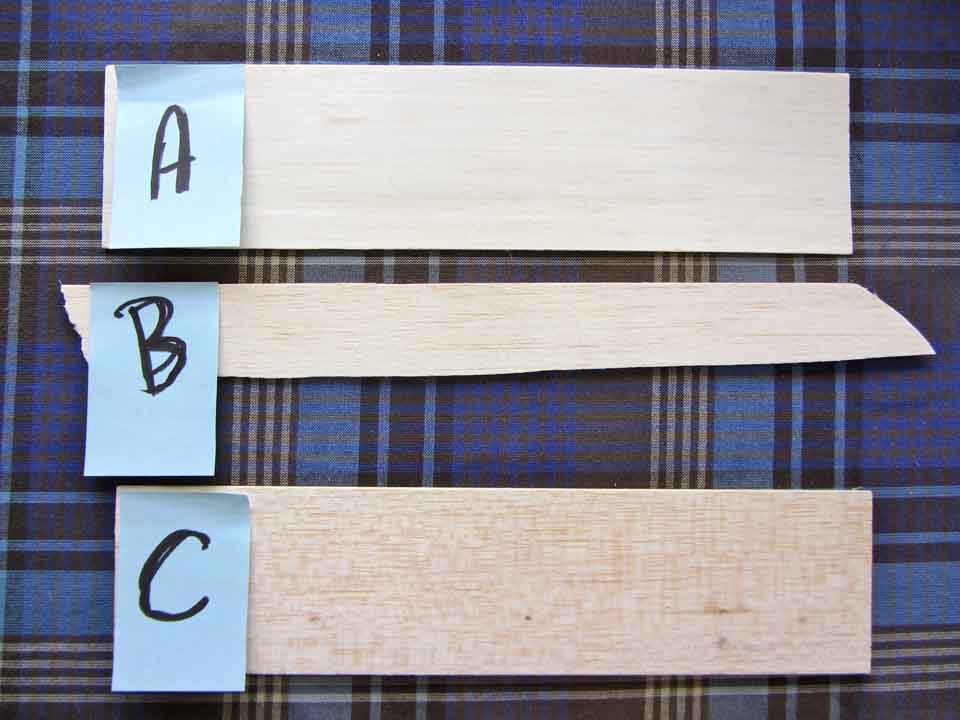
Good starter Alan. I like his descriptions, but the pictures appear to show the same piece of wood in different colours - there doesn't appear to be any change in the grain. So I had a quick look in my wood store and have come up with the following. I put it in one picture so that the relative differences can be clearly seen. Note that the 'A' grain wood is milky in texture with the grain hard to see. The 'B' grain wood is slightly darker with the grain beginning to show. The 'C' grain wood is darker still with a hint of red appearing; also the grain is definitely mottled and shows up well in a pleasing pattern.
Please Log in or Create an account to join the conversation.
- Sarah-Jane Smith
-
- Offline
- Forum Veteran
-
- Gone
Less
More
- Posts: 2510
- Thank you received: 2182
26 Jan 2014 13:13 #4
by Sarah-Jane Smith
I wish I was a glow worm, a glow worm's never glum.
Cos how can you be grumpy when the sun shines out your bum?!
Replied by Sarah-Jane Smith on topic How to choose what balsa you need per application
cant see the colours properly on this lappy but can see a difference better in the grain on those pics,
Thanks Andy
I did "weigh" so to speak my balsa for the fus when I was building them on all my planes so far, but I did it by bending it slightly to test strengh as I had no idea how to weigh it on scales and hung them over the table edge as Andy suggested.
Is there anyway to tell if a piece of wood is a bad un straight away by looking at it?
I wish I was a glow worm, a glow worm's never glum.
Cos how can you be grumpy when the sun shines out your bum?!
Please Log in or Create an account to join the conversation.
- Ex-Member
- User
-
Less
More
- Thank you received: 0
26 Jan 2014 13:29 - 26 Jan 2014 13:33 #5
by Ex-Member
Replied by Ex-Member on topic How to choose what balsa you need per application
It's one of those 'horses for courses' answers to that one S-J. You can tell if a bit of balsa is straight by sighting along it, you can tell it's size by measuring it, you can tell it's weight by weighing it but for the rest, it all comes down to experience. 'A' grain is bendy, but if you bend 'C' grain, you'll break it so you can't use that as a test, esp in a model shop. 'A' grain is best for sheeting areas such as leading edges and fuselages, like on the top of Tony's Lancaster. 'B' grain is good for spars where you need stiffness in all directions - but if you do choose a piece of wood for a spar, make sure the grain runs along the spar on all sides. More often than not, the grain will run off on one side which will make the spar weak. 'C' grain is good for formers and ribs where you need stiffness in a (relatively) large piece of sheet.
The heavier a piece of balsa is, the stronger it is...up to a point. So all weights have their uses. If you need a strong piece of wood in a small area, then high density (hi weight) stuff is good. But if you just need shape, as in a wing tip, then the softer (lighter) the wood the better. The trick is to pick the size, weight and grain of wood that is just strong enough to do the job, but not too strong otherwise it'll be too heavy; that kind of skill can only come with experience.
You can get that experience by building a few Gyminnie Crickets, for example. Before you start building, note the density and grain of wood you're using for each piece. Build the model and weigh it. Then fly it and see where it breaks. For the next model, use heavier wood for the bits that broke and lighter wood for the bits that didn't. You'll probably end up with a lighter model (which will fly for longer). Then do the same again. Eventually, you'll end up with a 'feel' for what wood you need for the various components and also a 'definitive' Gyminnie Cricket.
Now back to the question, when choosing balsa, whether it be 'A', 'B' or 'C' grain, make sure it has an even grain and the grain doesn't run off the sides. That's about all you can do by looking. The rest is measuring - and it's not the first time I've taken a pair of pocket scales into a model shop to weigh the wood before I bought it........
Last edit: 26 Jan 2014 13:33 by Ex-Member. Reason: ANswering the question posed
Please Log in or Create an account to join the conversation.
- Mowerman
-

- Offline
- Elite Member
-

Less
More
- Posts: 218
- Thank you received: 139
26 Jan 2014 14:50 #6
by Mowerman
Replied by Mowerman on topic How to choose what balsa you need per application
I have seen reference to using pocket 'letter scales' to weigh balsa in the LMS.
I also recall many years ago seeing a design published in Aeromodeler for a hadness tester, this consisted of a ring with a coil of wire wound round it (in torroidal fasion) so that when it was pressed edge wise onto the balsa it left a series of small indents, the more indents the softer the wood.The amount of pressure used was set by a small spring in the handle of the device.
I probably havent described it very well but you may get the basic idea.
Thanks: Sarah-Jane Smith
Please Log in or Create an account to join the conversation.
- The Beard
-

- Offline
- Forum Master
-

Less
More
- Posts: 6913
- Thank you received: 2167
26 Jan 2014 15:25 #7
by The Beard
Replied by The Beard on topic How to choose what balsa you need per application
One of the fascinations for me is going to middle wallop and watching the free flight boyos pipe in mouth pouring over balsa when selecting there purchases.
Thanks: Sarah-Jane Smith
Please Log in or Create an account to join the conversation.
- Ex-Member
- User
-
Less
More
- Thank you received: 0
26 Jan 2014 16:01 #8
by Ex-Member
I remember that one Andy and the description is about right. I've got all the old Aeromodellers so if I ever find the article, I'll post it here. It's only a device that can used at home, though; shopkeepers don't take kindly to customers denting the wood with fingernail or mechanical device. :lol:
Replied by Ex-Member on topic How to choose what balsa you need per application
Mowerman wrote: I have seen reference to using pocket 'letter scales' to weigh balsa in the LMS.
I also recall many years ago seeing a design published in Aeromodeler for a hadness tester, this consisted of a ring with a coil of wire wound round it (in torroidal fasion) so that when it was pressed edge wise onto the balsa it left a series of small indents, the more indents the softer the wood.The amount of pressure used was set by a small spring in the handle of the device.
I probably havent described it very well but you may get the basic idea.
I remember that one Andy and the description is about right. I've got all the old Aeromodellers so if I ever find the article, I'll post it here. It's only a device that can used at home, though; shopkeepers don't take kindly to customers denting the wood with fingernail or mechanical device. :lol:
Please Log in or Create an account to join the conversation.
- alan cantwell
-
Topic Author
- Offline
- Banned
-
Less
More
- Posts: 1768
- Thank you received: 1918
26 Jan 2014 16:38 #9
by alan cantwell
i have 2 sides
no you dont,
yes i do,
Replied by alan cantwell on topic How to choose what balsa you need per application
your not kidding, no CCTV then i got away with the nail test by turning my back,!!!
i have 2 sides
no you dont,
yes i do,
Thanks: Sarah-Jane Smith
Please Log in or Create an account to join the conversation.
Time to create page: 1.067 seconds