
- Posts: 15406
- Thank you received: 14306
Kline Fogleman Air-foil
- Eric
-

- Offline
- Moderator
-

Less
More
04 Dec 2020 08:57 #31
by Eric
if you are calm and collected when all about you are going berserk - you've missed something important!
Replied by Eric on topic Kline Fogleman Air-foil
A bit of a contradiction there, Klippy - narrower ailerons, but wider
I presume you mean narrower chord, but wider span?
Bear in mind that an inboard aileron is less effective than an outboard one - think of levers and fulcrums. The inner area creates more drag than roll effect.
I presume you mean narrower chord, but wider span?
Bear in mind that an inboard aileron is less effective than an outboard one - think of levers and fulcrums. The inner area creates more drag than roll effect.
if you are calm and collected when all about you are going berserk - you've missed something important!
Thanks: Klipkopwildlife
Please Log in or Create an account to join the conversation.
- crash happy
-
 Topic Author
- Offline
- Platinum Member
-

- Oops. did I say that out loud!
Less
More
- Posts: 1250
- Thank you received: 1203
04 Dec 2020 09:33 #32
by crash happy
Replied by crash happy on topic Kline Fogleman Air-foil
"I presume you mean narrower chord, but wider span?"
Exactly that, but I understood what Klippy meant. Now I am wondering, what would be the effect of extending the 'chord' of the aileron past the trailing edge of the wing? Would this in effect be similar to a cuff in reverse, or would it be more likely to tip stall ?
Exactly that, but I understood what Klippy meant. Now I am wondering, what would be the effect of extending the 'chord' of the aileron past the trailing edge of the wing? Would this in effect be similar to a cuff in reverse, or would it be more likely to tip stall ?
Thanks: Klipkopwildlife
Please Log in or Create an account to join the conversation.
- Quorneng
-

- Offline
- Forum Master
-

Less
More
- Posts: 10058
- Thank you received: 19043
04 Dec 2020 16:13 #33
by Quorneng
Replied by Quorneng on topic Kline Fogleman Air-foil
Mr Antony Fokker certainly had no qualms about extending the aileron beyond the wing trailing edge. 
To be fair the Triplane wing had a very narrow chord to start with and there were ailerons on only one of them!
I don't think broad chord ailerons themselves alter the stall characteristics (tip or otherwise) of the wing but they are likely to increase the effect of adverse aileron yaw which can promote an entry into an incipient spin that will have a rotation opposite to the bank.
To be fair the Triplane wing had a very narrow chord to start with and there were ailerons on only one of them!
I don't think broad chord ailerons themselves alter the stall characteristics (tip or otherwise) of the wing but they are likely to increase the effect of adverse aileron yaw which can promote an entry into an incipient spin that will have a rotation opposite to the bank.
Thanks: Klipkopwildlife, crash happy
Please Log in or Create an account to join the conversation.
- crash happy
-
Topic Author
- Offline
- Platinum Member
-
- Oops. did I say that out loud!
Less
More
- Posts: 1250
- Thank you received: 1203
28 Dec 2020 14:30 #34
by crash happy
Replied by crash happy on topic Kline Fogleman Air-foil
The weather is diabolical, so no flying for the next few days! I thought I may as well resurrect this project, which got sidelined for the Viggen build. I decided to ditch the idea of being able to convert it to a KFM 3 & get the ailerons as close to the wing I am comparing it against. Both halves are now covered & ailerons cut to size, with a simple tape top hinge. The control horn is deliberately set 5 mm back from the hinge pivot point, & the servo arm centred slightly forward in order to give some mechanical differential.

 Rather than a flat plate, the wing has a profile that resembles a proper KFM 2.
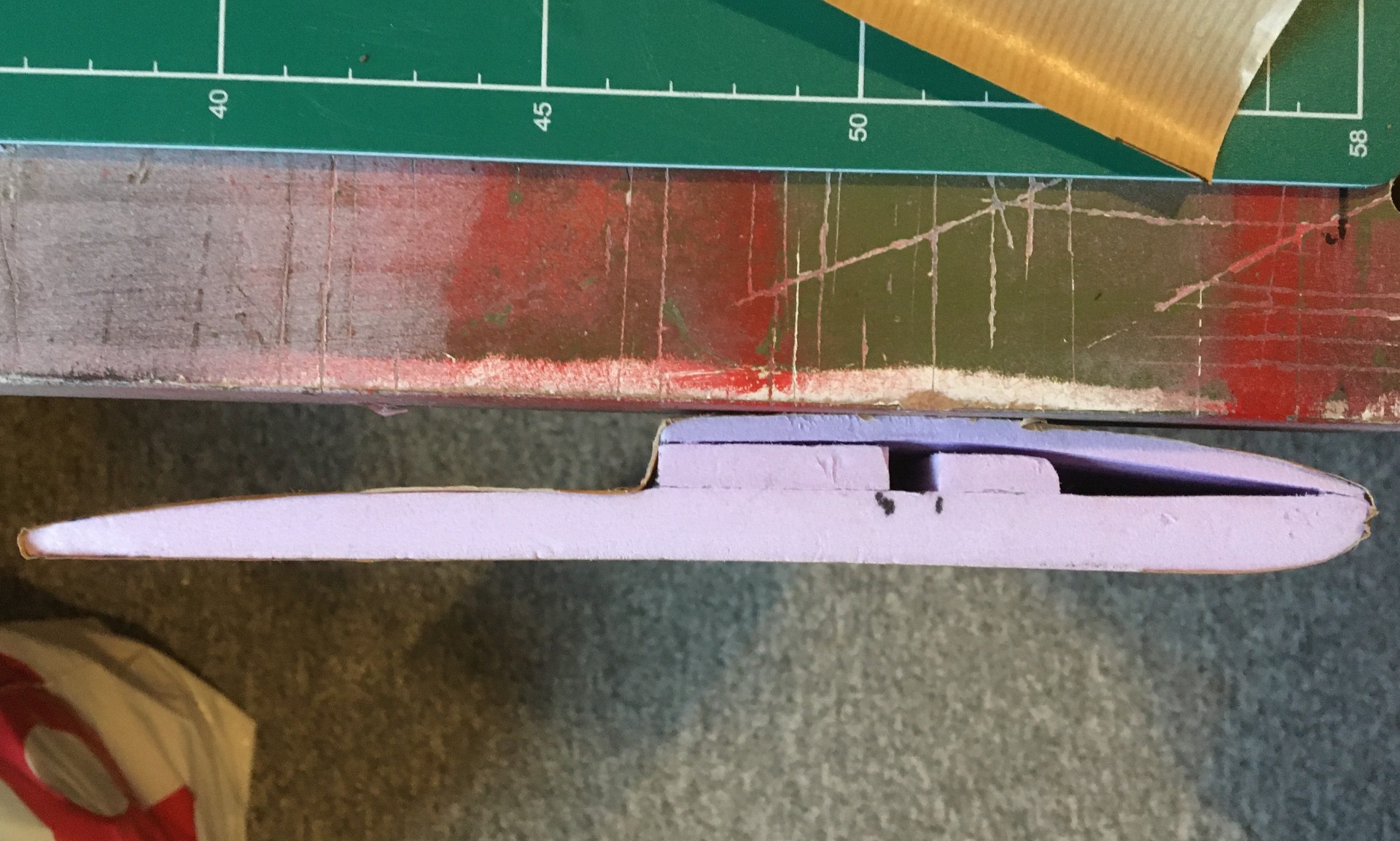 The centre joint looks a bit scruffy at the moment, but once the two halves are glued in place this will be capped.

Attachments:
Thanks: Klipkopwildlife, Quorneng
Please Log in or Create an account to join the conversation.
- Eric
-
- Offline
- Moderator
-
Less
More
- Posts: 15406
- Thank you received: 14306
28 Dec 2020 17:21 #35
by Eric
if you are calm and collected when all about you are going berserk - you've missed something important!
Replied by Eric on topic Kline Fogleman Air-foil
Putting the surface horn back from the hinge-line does nothing for differential, it merely strains the hinge!
For best mechanical advantage, the hole in the horn should be directly above the hinge.
With a servo mounted below the wing, the servo horn raked forward gives you differential, not much down, but lots of up, because the 'down' is mostly rotation and not much pull.
You need a small kink in the push-rod so it doesn't crush the edge of the servo hole.
For best mechanical advantage, the hole in the horn should be directly above the hinge.
With a servo mounted below the wing, the servo horn raked forward gives you differential, not much down, but lots of up, because the 'down' is mostly rotation and not much pull.
You need a small kink in the push-rod so it doesn't crush the edge of the servo hole.
if you are calm and collected when all about you are going berserk - you've missed something important!
Thanks: Klipkopwildlife
Please Log in or Create an account to join the conversation.
- crash happy
-
Topic Author
- Offline
- Platinum Member
-
- Oops. did I say that out loud!
Less
More
- Posts: 1250
- Thank you received: 1203
28 Dec 2020 19:02 #36
by crash happy
Replied by crash happy on topic Kline Fogleman Air-foil
Not according to this guy Eric. Skip to 3.30 minuets if you don't want to watch all of it.
Thanks: Klipkopwildlife
Please Log in or Create an account to join the conversation.
- Quorneng
-
- Offline
- Forum Master
-
Less
More
- Posts: 10058
- Thank you received: 19043
28 Dec 2020 19:54 #37
by Quorneng
Replied by Quorneng on topic Kline Fogleman Air-foil
The video is quite correct but done that way it significantly reduces the mechanical advantage of the servo as the aileron goes up just when the aerodynamic load increases.
Raking the servo arm forward maintains a better geometry to handle the increased load on the servo, linkage and hinges.
Another advantage of a raked forward servo arm is that the smaller deflection of the down going aileron means it has a much improved mechanical advantage.
At extreme airspeed the upgoing aileron servo might get stalled but the down going one will go down ensuring at least some roll control.
All important attributes and for 'free' if you are use small light aileron servos.
Raking the servo arm forward maintains a better geometry to handle the increased load on the servo, linkage and hinges.
Another advantage of a raked forward servo arm is that the smaller deflection of the down going aileron means it has a much improved mechanical advantage.
At extreme airspeed the upgoing aileron servo might get stalled but the down going one will go down ensuring at least some roll control.
All important attributes and for 'free' if you are use small light aileron servos.
Thanks: Eric, Klipkopwildlife
Please Log in or Create an account to join the conversation.
- crash happy
-
Topic Author
- Offline
- Platinum Member
-
- Oops. did I say that out loud!
Less
More
- Posts: 1250
- Thank you received: 1203
29 Dec 2020 10:55 #38
by crash happy
Replied by crash happy on topic Kline Fogleman Air-foil
That's a very eloquent explanation Simon, thanks. 
Thanks: Klipkopwildlife
Please Log in or Create an account to join the conversation.
- Klipkopwildlife
-

- Offline
- Administrator
-

- I'm supposed to be retired!
05 Jan 2022 07:29 #39
by Klipkopwildlife
Do it now, you may never get another chance
Replied by Klipkopwildlife on topic Kline Fogleman Air-foil
This is from a friend of mine in Glasgow. I introduced him to RC when he was out here visiting. He seems intent on re-inventing the wheel, but then he is a scientist.
Build and flight.
Build and flight.
Do it now, you may never get another chance
Please Log in or Create an account to join the conversation.
- Quorneng
-
- Offline
- Forum Master
-
Less
More
- Posts: 10058
- Thank you received: 19043
05 Jan 2022 11:33 #40
by Quorneng
Replied by Quorneng on topic Kline Fogleman Air-foil
There is no doubt the the KF air foil sections do work well at model sizes but it does depend on the definition.
As far as I can tell the big advantage KF at model sizes is it better controls the airflow over a wider range of angles of attack than a conventional section. This can make the plane very forgiving. An important attribute in RC flying where the feed back on what is happening is entirely visual and at a distance. They are also well suited to simple foam board construction techniques.
On the other hand a KF is not so good in terms of aerodynamic efficiency. This is of little consequence in most model power planes as the efficiency of everything else is pretty low as well but where high aerodynamic efficiency is required, as in a competition glider, KF sections are not used.
Quite some time ago NASA demonstrated from wind tunnel tests that full size light aircraft KF sections showed no significant flight envelope benefits coupled with lower lift to drag ratios.
As far as I can tell the big advantage KF at model sizes is it better controls the airflow over a wider range of angles of attack than a conventional section. This can make the plane very forgiving. An important attribute in RC flying where the feed back on what is happening is entirely visual and at a distance. They are also well suited to simple foam board construction techniques.
On the other hand a KF is not so good in terms of aerodynamic efficiency. This is of little consequence in most model power planes as the efficiency of everything else is pretty low as well but where high aerodynamic efficiency is required, as in a competition glider, KF sections are not used.
Quite some time ago NASA demonstrated from wind tunnel tests that full size light aircraft KF sections showed no significant flight envelope benefits coupled with lower lift to drag ratios.
Thanks: Klipkopwildlife
Please Log in or Create an account to join the conversation.
- Eric
-
- Offline
- Moderator
-
Less
More
- Posts: 15406
- Thank you received: 14306
05 Jan 2022 13:55 #41
by Eric
if you are calm and collected when all about you are going berserk - you've missed something important!
Replied by Eric on topic Kline Fogleman Air-foil
In practice, the KF 'sections' might be very forgiving, - BUT the stall is very abrupt, when it does let go! The model stops abruptly as the drag rockets up, and then it just falls flat, with little hope of recovery if you were in the process of flaring for a landing!
if you are calm and collected when all about you are going berserk - you've missed something important!
Thanks: Klipkopwildlife
Please Log in or Create an account to join the conversation.
- Klipkopwildlife
-
- Offline
- Administrator
-
- I'm supposed to be retired!
05 Jan 2022 17:11 #42
by Klipkopwildlife
Do it now, you may never get another chance
Replied by Klipkopwildlife on topic Kline Fogleman Air-foil
As we see from some of the footage.
Do it now, you may never get another chance
Please Log in or Create an account to join the conversation.
- Quorneng
-
- Offline
- Forum Master
-
Less
More
- Posts: 10058
- Thank you received: 19043
06 Jan 2022 00:20 #43
by Quorneng
Replied by Quorneng on topic Kline Fogleman Air-foil
A delta like that has a very abrupt drag rise as a certain AOA rather than a true stall.
What I think we are seeing is the point where the drag rapidly exceeds the available thrust rather than a sudden loss of lift. The result is a sort of pancake descent in a near stable condition.
Without more thrust the only way out is to lower the nose quite dramatically to allow the thrust to quickly raise the speed but being a delta the lift falls away dramatically so resulting in a steep descent & big loss of altitude.
If you have sufficient thrust to accelerate the plane fast enough to regain normal flying speed before contacting the ground you likely would have been able to avoid the situation in the first place.
You take a delta into the drag exceeds thrust regime when low down at your peril.
What I think we are seeing is the point where the drag rapidly exceeds the available thrust rather than a sudden loss of lift. The result is a sort of pancake descent in a near stable condition.
Without more thrust the only way out is to lower the nose quite dramatically to allow the thrust to quickly raise the speed but being a delta the lift falls away dramatically so resulting in a steep descent & big loss of altitude.
If you have sufficient thrust to accelerate the plane fast enough to regain normal flying speed before contacting the ground you likely would have been able to avoid the situation in the first place.
You take a delta into the drag exceeds thrust regime when low down at your peril.
Thanks: Klipkopwildlife, THE BLACKBIRD
Please Log in or Create an account to join the conversation.
- Eric
-
- Offline
- Moderator
-
Less
More
- Posts: 15406
- Thank you received: 14306
06 Jan 2022 08:59 #44
by Eric
if you are calm and collected when all about you are going berserk - you've missed something important!
Replied by Eric on topic Kline Fogleman Air-foil
I don't dispute that behaviour with a Delta wing, but I have flown other people's cruciform models, one a 'Spitfire' that exhibits the exact same behaviour.
if you are calm and collected when all about you are going berserk - you've missed something important!
Thanks: Klipkopwildlife
Please Log in or Create an account to join the conversation.
- Klipkopwildlife
-
- Offline
- Administrator
-
- I'm supposed to be retired!
07 Jan 2022 09:51 #45
by Klipkopwildlife
Do it now, you may never get another chance
Replied by Klipkopwildlife on topic Kline Fogleman Air-foil
Hi Simon, Jon thanked me for your comments and has asked what times in the footage gave rise to your comment?
Do it now, you may never get another chance
Please Log in or Create an account to join the conversation.
Time to create page: 0.332 seconds