
- Posts: 809
- Thank you received: 2067
×
Flying models without a radio
Unearthed Peanuts
- Squirrelnet
- Topic Author
- Offline
- Elite Member
-

Less
More
05 Aug 2017 21:27 - 05 Aug 2017 21:31 #1
by Squirrelnet
Unearthed Peanuts was created by Squirrelnet
I have been having a bit of clear out in my garage/workshop and to cut a long and not very interesting story, involving various cardboard boxes short, I have unearthed a couple of peanut models I thought had long since been destroyed.
The models seem to be in good flyable condition, their tissue covering still looking good and I even managed to find their nose blocks and propellers
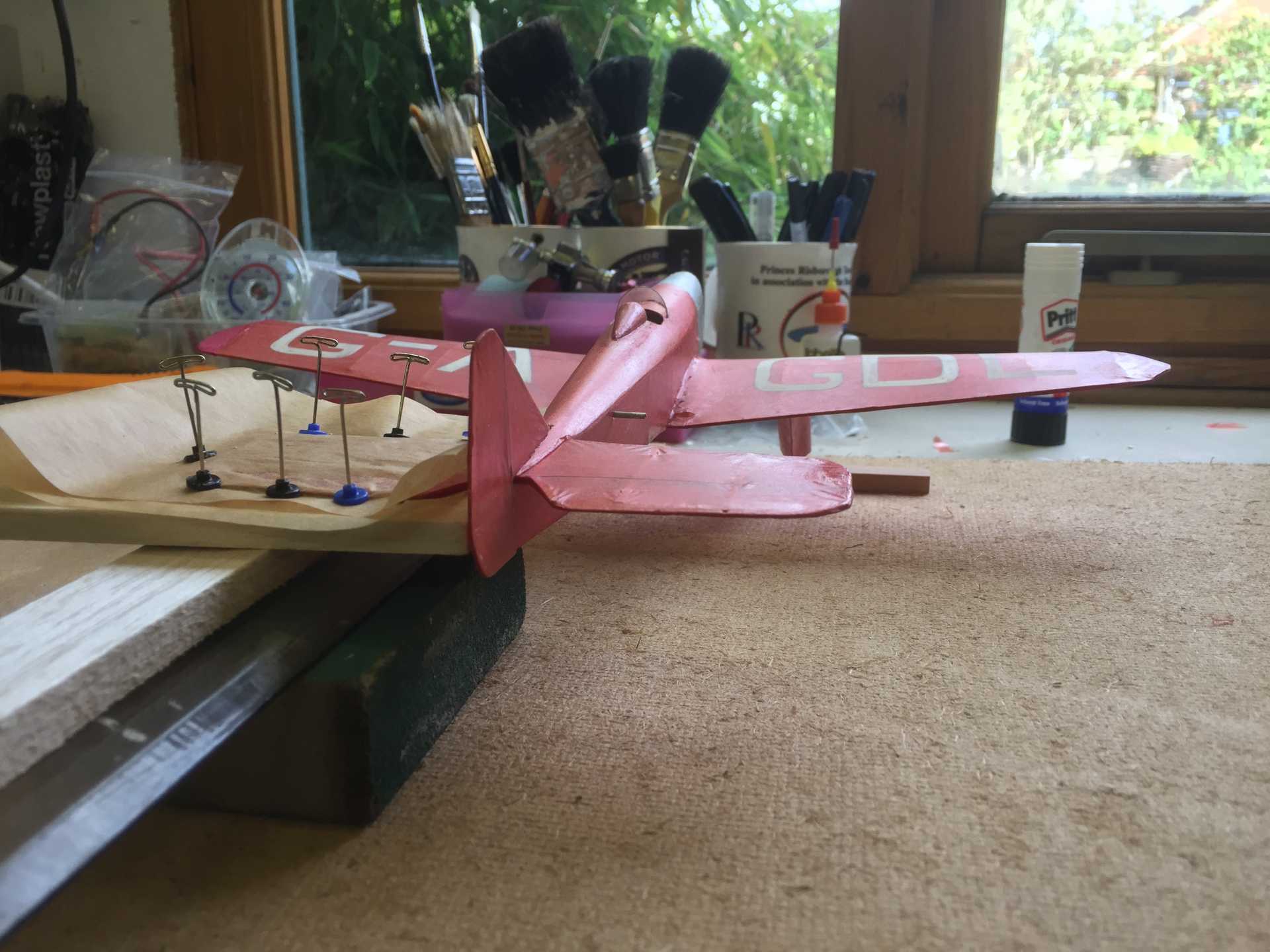
The first is a Miles M5A Sparrowhawk which I think I built from free plan in AM and is my first peanut model. Its quite warped around the tail but a spray with water and pinning down should sort that also the wing tip has been crushed so needs a repair but not bad for a few years in the roof of the workshop

The second is a Hanza-Brandenburg D1 from the Lee Hobbies kit. It has a tiny rudder and no fin and I seem to remember the model had large celluloid fin to counter this. The model is good condition and looks quite straight as well

Pat of the reason for the post though is for a bit of advice. As pretty much a rubber virgin what size rubber should I consider for these models and what sort of length and strands ? I know its a matter of seeing what works but it would be good to have a starting point. I have some 3/32" I bought recently for the now slightly stalled Stuka project but I'm guessing these 13" models need something smaller like 1/16 ?? All advice welcome
The models seem to be in good flyable condition, their tissue covering still looking good and I even managed to find their nose blocks and propellers
The first is a Miles M5A Sparrowhawk which I think I built from free plan in AM and is my first peanut model. Its quite warped around the tail but a spray with water and pinning down should sort that also the wing tip has been crushed so needs a repair but not bad for a few years in the roof of the workshop
The second is a Hanza-Brandenburg D1 from the Lee Hobbies kit. It has a tiny rudder and no fin and I seem to remember the model had large celluloid fin to counter this. The model is good condition and looks quite straight as well
Pat of the reason for the post though is for a bit of advice. As pretty much a rubber virgin what size rubber should I consider for these models and what sort of length and strands ? I know its a matter of seeing what works but it would be good to have a starting point. I have some 3/32" I bought recently for the now slightly stalled Stuka project but I'm guessing these 13" models need something smaller like 1/16 ?? All advice welcome
Last edit: 05 Aug 2017 21:31 by Squirrelnet.
Thanks: boz, Firewood
Please Log in or Create an account to join the conversation.
- one tenor
-

- Offline
- Forum Veteran
-

- johnpcalex@gmail.com
05 Aug 2017 21:40 #2
by one tenor
Anything will fly given enough power
Replied by one tenor on topic Unearthed Peanuts
I have used round rubber in the past and suggest you give it a try I have found a bit on Google that may help. Here it is www.google.co.uk/search?q=Round+Rubber+s...ceid=chrome&ie=UTF-8
Anything will fly given enough power
Thanks: boz, Squirrelnet
Please Log in or Create an account to join the conversation.
- DHNut
- Offline
- New Member
-

Less
More
- Posts: 18
- Thank you received: 29
06 Aug 2017 07:43 #3
by DHNut
Replied by DHNut on topic Unearthed Peanuts
The rubber size will depend on weight. From my own experience a minimum of 3/32 " or even 1/8" loop would be required for the Sparrowhawk and 1/8" for the Hansa Brandenberg. I often play with intermediate sizes to get the right ballance between power and motor run. Lubrication is also important.
Ricky
Ricky
Thanks: boz, Squirrelnet
Please Log in or Create an account to join the conversation.
- Firewood
-

- Offline
- Elite Member
-
Less
More
- Posts: 282
- Thank you received: 268
06 Aug 2017 08:44 - 06 Aug 2017 08:45 #4
by Firewood
I'm so clever that sometimes I don't understand a single word of what I'm saying.
Replied by Firewood on topic Unearthed Peanuts
Just looked at the Walt Mooney plan and he suggests "single loop of 1/8" 17"long for the Miles with up to1800 turns".
I'm so clever that sometimes I don't understand a single word of what I'm saying.
Last edit: 06 Aug 2017 08:45 by Firewood.
Thanks: boz, Squirrelnet
Please Log in or Create an account to join the conversation.
- Ex-Member
- Visitor
-

06 Aug 2017 08:52 - 06 Aug 2017 09:10 #5
by Ex-Member
Replied by Ex-Member on topic Unearthed Peanuts
I would forget about the round rubber. The bottom line here is to look at what the competition duration modellers are using at the moment, which is FAI Tan. FAI Tan SuperSport is readily available from the normal free flight suppliers, SAMS Models sell it pre-cut to various sizes, the others (Free Flight Supplies and Flitehook) normally only have 1/16", 1/8" and 3/16" in stock. They rarely have 1/4" in stock as the manufacturer doesn't normally cut it to that size.
I concur with advice already given, 1/8" should be good for the Sparrowhawk. However, if all you have is 3/32", then try it and see....
I can send you samples in various sizes if you are in a rush.
I concur with advice already given, 1/8" should be good for the Sparrowhawk. However, if all you have is 3/32", then try it and see....
I can send you samples in various sizes if you are in a rush.
Last edit: 06 Aug 2017 09:10 by Ex-Member.
Please Log in or Create an account to join the conversation.
- Squirrelnet
- Topic Author
- Offline
- Elite Member
-
Less
More
- Posts: 809
- Thank you received: 2067
06 Aug 2017 18:14 - 06 Aug 2017 18:27 #6
by Squirrelnet
Replied by Squirrelnet on topic Unearthed Peanuts
Thanks all for the very useful information
A loop of 1/8 seems to be the way to go. I have rechecked whats in my rubber box and I actually have some 2mm and some 3/16 , I think I must have picked the wrong packet up as I'm sure I had some 3/32 , anyway I'll order some 1/8 from Kev when he's back
In the meantime I thought I would get the Sparrowhawk repaired and straight again while I contemplate building a quick simple design to learn on. In case you are wondering I built both over 30 years ago but never really got them to fly properly as I didn't really know what I was doing with rubber motors and at the time no one in my club seemed to know either ...and then I lost interest and they were squirrelled away in box
Wing tip repair is very straight forward

The tail was sprayed with water and pinned flat with blocks underneath to keep the TP incidence correct

Nice flat tail again, shame the red tissue I have doesn't quite match the 30 year old covering ( I can't believe its such good condition but it has been stored in a light proof cardboard box . I assume its UV that does the damage and turns it brittle
Firewood - you are way ahead of me . Yes I think its built to the Walt Mooney Plan, perhaps it featured in AM in the early 1980's. For some reason its suspended on Outerzone , not sure what that means ..copyright issues ?
A loop of 1/8 seems to be the way to go. I have rechecked whats in my rubber box and I actually have some 2mm and some 3/16 , I think I must have picked the wrong packet up as I'm sure I had some 3/32 , anyway I'll order some 1/8 from Kev when he's back
In the meantime I thought I would get the Sparrowhawk repaired and straight again while I contemplate building a quick simple design to learn on. In case you are wondering I built both over 30 years ago but never really got them to fly properly as I didn't really know what I was doing with rubber motors and at the time no one in my club seemed to know either ...and then I lost interest and they were squirrelled away in box
Wing tip repair is very straight forward
The tail was sprayed with water and pinned flat with blocks underneath to keep the TP incidence correct
Nice flat tail again, shame the red tissue I have doesn't quite match the 30 year old covering ( I can't believe its such good condition but it has been stored in a light proof cardboard box . I assume its UV that does the damage and turns it brittle
Firewood - you are way ahead of me . Yes I think its built to the Walt Mooney Plan, perhaps it featured in AM in the early 1980's. For some reason its suspended on Outerzone , not sure what that means ..copyright issues ?
Last edit: 06 Aug 2017 18:27 by Squirrelnet.
Thanks: Ex-Member, boz, Firewood
Please Log in or Create an account to join the conversation.
- Firewood
-
- Offline
- Elite Member
-
Less
More
- Posts: 282
- Thank you received: 268
06 Aug 2017 19:51 #7
by Firewood
I'm so clever that sometimes I don't understand a single word of what I'm saying.
Replied by Firewood on topic Unearthed Peanuts
Hi I have the Walt Mooney AM plan and was trying to post it for you but don't know how to post a PDF file,another of my started but not finished projects LOL very pretty plane built 5 mins from where I live probly photos on FB page.
I'm so clever that sometimes I don't understand a single word of what I'm saying.
Thanks: boz, Squirrelnet
Please Log in or Create an account to join the conversation.
- Crashrr
-

- Offline
- Senior Member
-

Less
More
- Posts: 89
- Thank you received: 284
06 Aug 2017 21:37 #8
by Crashrr
'What the hell' is always the right answer...
Replied by Crashrr on topic Unearthed Peanuts
I was about to start a rubber motor thread of my own, but Squirrelnet got in before me, however, it seems appropriate to add to this thread so the information is available to others in one place.
I have a VMC 18" span Me 109 - which weighs 31g (not inc. rubber) and has a nose hook to rear peg length of 6", and am building a VMC 27" Hurricane - which will have a balsa (pre-tissue) weight of about 40g and a hook to peg length of 11½". VMC supplies the same short strand of 3/16th rubber with each model, and suggests a loop about the length of the nose hook to peg. I followed this instruction (lubricated with silicon) on my 109 and it resulted in a motor capable of about 400 winds. Having trimmed the plane, I lengthened the rubber to about 10", which maxed out (or should that be snapped out) at about 750 winds. Further, the power delivery is very strong at the beginning, then tails off quickly, resulting in consistently short flights of around 20 seconds. I am interested to discover how to re-motor these birds so I can wind them up to around 2,000 turns, so that they have a longer, slower power deliveries. All suggestions for the length and thickness of rubber would be most helpful.
Also, your thoughts on braiding would be most welcome, as would any info on how to wind the motor, i.e how far does one stretch it at the start of the wind, etc. I have just bought a hand drill on ebay to convert into a winder, and am about to build a stooge board which will help with holding the plane - up till now I've had to do knee-tremblers....
I'm wondering if anyone has ever made a rubber motor chart with say, length of nose to peg on one axis and, perhaps, weight of plane on the other?
Many thanks in advance.
Crashrr
I have a VMC 18" span Me 109 - which weighs 31g (not inc. rubber) and has a nose hook to rear peg length of 6", and am building a VMC 27" Hurricane - which will have a balsa (pre-tissue) weight of about 40g and a hook to peg length of 11½". VMC supplies the same short strand of 3/16th rubber with each model, and suggests a loop about the length of the nose hook to peg. I followed this instruction (lubricated with silicon) on my 109 and it resulted in a motor capable of about 400 winds. Having trimmed the plane, I lengthened the rubber to about 10", which maxed out (or should that be snapped out) at about 750 winds. Further, the power delivery is very strong at the beginning, then tails off quickly, resulting in consistently short flights of around 20 seconds. I am interested to discover how to re-motor these birds so I can wind them up to around 2,000 turns, so that they have a longer, slower power deliveries. All suggestions for the length and thickness of rubber would be most helpful.
Also, your thoughts on braiding would be most welcome, as would any info on how to wind the motor, i.e how far does one stretch it at the start of the wind, etc. I have just bought a hand drill on ebay to convert into a winder, and am about to build a stooge board which will help with holding the plane - up till now I've had to do knee-tremblers....
I'm wondering if anyone has ever made a rubber motor chart with say, length of nose to peg on one axis and, perhaps, weight of plane on the other?
Many thanks in advance.
Crashrr
'What the hell' is always the right answer...
Thanks: boz, Firewood, Squirrelnet
Please Log in or Create an account to join the conversation.
- Andrew Darby
- Offline
- Inactivated User
-

Less
More
- Posts: 74
- Thank you received: 234
06 Aug 2017 22:27 - 06 Aug 2017 22:29 #9
by Andrew Darby
Replied by Andrew Darby on topic Unearthed Peanuts
Stretch winding your motor will increase the number of winds significantly.
Forget the drill, just but a winder either from the VMC site or suppliers such as SAMS etc. If you do decide to use the drill DO NOT hold the hook in the drill chuck, remove the chuck cross drill the shaft and make a stiff wire hook to wind your model. Twice last year I saw models completely wrecked by winding hooks coming loose from a drill chuck and smashing into the front of the model.
The 3/16" is fine for the ME109 it should fly fine with a double peg to hook length at the weight you have given, I think you may struggle to get on more winds than about 1000. But in general the longer the motor the higher the potential winds but the lower the torque will be BUT obviously the AUW will rise, thus the compromise of motor length, power and duration. I assume that the hurricane is the "150" version of either the KK or Veron one from the 1950's? This will need much more motor than that supplied either a strip of 1/4" or multiple strands of 1/8". Why they are supplying rubber if that size for a 27" span model heaven knows!
I think that the hook to peg recommendation is only made for the smaller model as a "get you started" recommendation, since most people building them will wind them with their finger, and be happy enough with a short hop. The KK or Veron designs would have been supplied with a useless thick rubber band originally and any instructions only pertanant to the original design span, not the "150" kit you have.
There will always be an initial power burst from the rubber it is the nature of the beast, try adding downthrust if it is causing to steep an initial climb.
There are charts of breaking winds for various grades of rubber, but the best bet is to test each batch yourself if you are keen to max things out. Power requirement will be a moving feast with the model in hand, so tabulated data against weight is unlikely to exist.
There are lots of atticles re braiding, try looking at websites such as Hip Pocket Aeronautics, there is a much larger collection of free flight info, data and expertise on there than here as this is a more general forum.
Andrew
Forget the drill, just but a winder either from the VMC site or suppliers such as SAMS etc. If you do decide to use the drill DO NOT hold the hook in the drill chuck, remove the chuck cross drill the shaft and make a stiff wire hook to wind your model. Twice last year I saw models completely wrecked by winding hooks coming loose from a drill chuck and smashing into the front of the model.
The 3/16" is fine for the ME109 it should fly fine with a double peg to hook length at the weight you have given, I think you may struggle to get on more winds than about 1000. But in general the longer the motor the higher the potential winds but the lower the torque will be BUT obviously the AUW will rise, thus the compromise of motor length, power and duration. I assume that the hurricane is the "150" version of either the KK or Veron one from the 1950's? This will need much more motor than that supplied either a strip of 1/4" or multiple strands of 1/8". Why they are supplying rubber if that size for a 27" span model heaven knows!
I think that the hook to peg recommendation is only made for the smaller model as a "get you started" recommendation, since most people building them will wind them with their finger, and be happy enough with a short hop. The KK or Veron designs would have been supplied with a useless thick rubber band originally and any instructions only pertanant to the original design span, not the "150" kit you have.
There will always be an initial power burst from the rubber it is the nature of the beast, try adding downthrust if it is causing to steep an initial climb.
There are charts of breaking winds for various grades of rubber, but the best bet is to test each batch yourself if you are keen to max things out. Power requirement will be a moving feast with the model in hand, so tabulated data against weight is unlikely to exist.
There are lots of atticles re braiding, try looking at websites such as Hip Pocket Aeronautics, there is a much larger collection of free flight info, data and expertise on there than here as this is a more general forum.
Andrew
Last edit: 06 Aug 2017 22:29 by Andrew Darby.
Thanks: Ex-Member, boz, Firewood, Nigel, Squirrelnet, Crashrr
Please Log in or Create an account to join the conversation.
- Mike Rolls
-

- Offline
- Elite Member
-
Less
More
- Posts: 698
- Thank you received: 573
07 Aug 2017 07:13 #10
by Mike Rolls
The older I get, the better I was!
Replied by Mike Rolls on topic Unearthed Peanuts
As Andrew says, by far the best way of determining how many turns rubber will take is to test a sample from your batch. Back in the 50's when I flew non-contest rubber models and couldn't afford to test samples to destruction, I just wound until the motor felt 'tight', Years later when I did fly contest type (never actually flew in rubber model contests, just loved that sort of model) I did test samples - and found different batches of the same rubber could vary greatly. The most notorious for this was the so called 'black' Pirelli about, IIRC 1974 which was woeful - a small (200 sq. ins) model which flew well on 6 stands of earlier Pirelli needed 8 to get a similar climb!
If you do decide to test your rubber, don't just take a sample fresh from the batch and wind it until it breaks - rubber needs to be 'broken in' to give of its best. Take your test loop and stretch progressively up to around 6 times its unstretched length - you will find that it take a slight permanent increase in length. Then you can test to destruction, although again it is better to work up to that point - when the rubber is about to go you will be able to feel it quite suddenly feel 'hard' - difficult to describe, but easy to identify!
As Andrew says, all rubber motors give an initial burst of high torque - this is more marked in some brands than in others and even in different batches of the same brand. It is coping with this varying power that makes trimming rubber models so challenging - but if you are not after top performance, the easiest way to cope with it is to simply let the initial burst die off before launching the model
HTH
Mike
If you do decide to test your rubber, don't just take a sample fresh from the batch and wind it until it breaks - rubber needs to be 'broken in' to give of its best. Take your test loop and stretch progressively up to around 6 times its unstretched length - you will find that it take a slight permanent increase in length. Then you can test to destruction, although again it is better to work up to that point - when the rubber is about to go you will be able to feel it quite suddenly feel 'hard' - difficult to describe, but easy to identify!
As Andrew says, all rubber motors give an initial burst of high torque - this is more marked in some brands than in others and even in different batches of the same brand. It is coping with this varying power that makes trimming rubber models so challenging - but if you are not after top performance, the easiest way to cope with it is to simply let the initial burst die off before launching the model
HTH
Mike
The older I get, the better I was!
Thanks: Ex-Member, boz, Firewood, Nigel, Squirrelnet, Crashrr
Please Log in or Create an account to join the conversation.
- Ex-Member
- Visitor
-
07 Aug 2017 07:59 #11
by Ex-Member
Replied by Ex-Member on topic Unearthed Peanuts
That's really good advice from Andrew and Mike, thanks for posting!
If you need info on FF models, particularly rubber, then I would suggest a visit to the US National Free Flight Society's Technical Library. It contains articles for free download on just about any FF subject of interest. Be warned, though, it's addictive...you may spend a lot longer looking through the papers than you first thought available.
freeflight.org/library/technical-library/
I built the VMC Me109 a couple of years ago. it's one of the best kits I've ever built for fit and ease of construction. The best flights I've had out of it so far are about 30 seconds.
A thought on your Hurricane, Crashrr, it might be worth considering moving the rear rubber peg to just behind the wing trailing edge in a similar relative position to that on the VMC Me109. The advantage is that you will save a lot of nose weight which would be used to balance the longer motor. Paradoxically, this often leads to a longer duration flight.
If you need info on FF models, particularly rubber, then I would suggest a visit to the US National Free Flight Society's Technical Library. It contains articles for free download on just about any FF subject of interest. Be warned, though, it's addictive...you may spend a lot longer looking through the papers than you first thought available.
freeflight.org/library/technical-library/
I built the VMC Me109 a couple of years ago. it's one of the best kits I've ever built for fit and ease of construction. The best flights I've had out of it so far are about 30 seconds.
A thought on your Hurricane, Crashrr, it might be worth considering moving the rear rubber peg to just behind the wing trailing edge in a similar relative position to that on the VMC Me109. The advantage is that you will save a lot of nose weight which would be used to balance the longer motor. Paradoxically, this often leads to a longer duration flight.
Please Log in or Create an account to join the conversation.
- Andrew Darby
- Offline
- Inactivated User
-
Less
More
- Posts: 74
- Thank you received: 234
07 Aug 2017 08:37 #12
by Andrew Darby
Replied by Andrew Darby on topic Unearthed Peanuts
I came across a video of this chap, don't know who he is, but his 'plane flies ok 
Andrew
Andrew
Thanks: Ex-Member, boz, Firewood, Crashrr
Please Log in or Create an account to join the conversation.
- Ex-Member
- Visitor
-
07 Aug 2017 09:43 #13
by Ex-Member
Ha ha, nice one Andrew!
For Crashrr's benefit, it's the VMC Me109 designed for VMC by our very own Andrew Derby, and built and flown by yours truly for Deluxe Materials. The video was taken at a Peterborough Club indoor meeting at Bushfileld's Leisure Centre, Peterborough. They meet there on Saturday mornings once a month throughout the winter - all are welcome. The model flies really well and looks a treat in the air. The UC has been made removable and is only used for any 'static' presentation.
Replied by Ex-Member on topic Unearthed Peanuts
Andrew Darby wrote: I came across a video of this chap, don't know who he is, but his 'plane flies ok
Andrew
Ha ha, nice one Andrew!
For Crashrr's benefit, it's the VMC Me109 designed for VMC by our very own Andrew Derby, and built and flown by yours truly for Deluxe Materials. The video was taken at a Peterborough Club indoor meeting at Bushfileld's Leisure Centre, Peterborough. They meet there on Saturday mornings once a month throughout the winter - all are welcome. The model flies really well and looks a treat in the air. The UC has been made removable and is only used for any 'static' presentation.
Please Log in or Create an account to join the conversation.
- one tenor
-
- Offline
- Forum Veteran
-
- johnpcalex@gmail.com
09 Aug 2017 03:49 #14
by one tenor
Anything will fly given enough power
Replied by one tenor on topic Unearthed Peanuts
Re the dope going brittle ,yes UV would have some effect but it largely depends on the type of dope used .I believe Nitro Cellulose types are the worst. Like films that were made of this .They went brittle sealed in cans and some were known to burst into flames when exposed to the air. I think some dopes have a plasticiser added to the mix .I have added a drop of Castor Oil to a 2 oz jar for this reason in the past. I have 2 models now over 50 yrs old and the tissue is still in good nick as a result of this and two nylon covered also good .However the Velox has a bit of hangar rash which means the lovely orange skin will need stripping off to fix ribs.
Anything will fly given enough power
Thanks: boz, Nigel, Squirrelnet
Please Log in or Create an account to join the conversation.
- Mike Rolls
-
- Offline
- Elite Member
-
Less
More
- Posts: 698
- Thank you received: 573
09 Aug 2017 05:26 #15
by Mike Rolls
The older I get, the better I was!
Replied by Mike Rolls on topic Unearthed Peanuts
That really is long lived tissue/dope combination. I've normally found doped tissue (light and heavy Modelspan but a variety of dopes) goes brittle after ten years or so. Just renovating an 18 year old model at the - light Modelspan - and you hardly had to look at it for the tissue to split. I do have one model about 50 years old, but it is a solid wood team racer, so the brittleness isn't apparent.
Mike
Mike
The older I get, the better I was!
Thanks: boz
Please Log in or Create an account to join the conversation.
Time to create page: 0.218 seconds