
- Posts: 89
- Thank you received: 284
Sopwith Pup - Scale 20", rubber-powered.
- Crashrr
-
 Topic Author
- Offline
- Senior Member
-

Less
More
24 Aug 2017 15:12 - 24 Aug 2017 15:41 #1
by Crashrr
'What the hell' is always the right answer...
Sopwith Pup - Scale 20", rubber-powered. was created by Crashrr
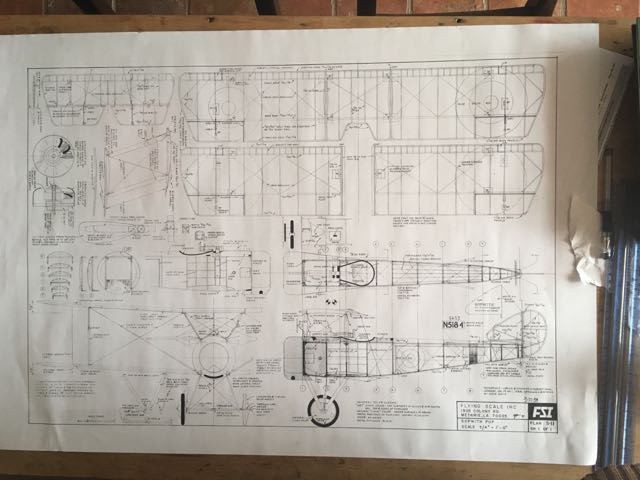
Well, after a great deal of thought, I have finally chosen my next project, which will slow-burn alongside the Hurricane as time permits. I've plumped for the FSI Plans, Mick Davis, 20" span, rubber-powered Sopwith Pup.
Three reasons guided my choice:
1. 2 August 2017 was the centennial of Squadron Leader Edwin Dunning's landing on HMS Furious underway - the first aircraft landing on a moving ship. He died three days later attempting to repeat the exercise. Building his plane will be my way of honouring the man and commemorating his achievement.
2. The plans are beautifully drawn and it looks like a tricky build. I want to do something that will test me.
3. There are several Pups still in existence, so I can get a close-up of the real thing for research if/when necessary.
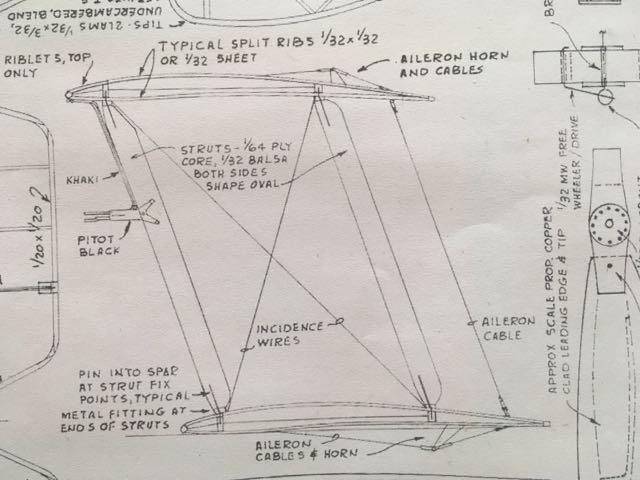
I'm probably going to have a shot at the wings first, however, being split ribbed, under-cambered and thin, I suspect I'll be diving into the deep end from the get go...
As always, I will enjoy reading your thoughts on this build as it matures, (starting with the Tomtit wing incidence discussion).
Crashrr
Three reasons guided my choice:
1. 2 August 2017 was the centennial of Squadron Leader Edwin Dunning's landing on HMS Furious underway - the first aircraft landing on a moving ship. He died three days later attempting to repeat the exercise. Building his plane will be my way of honouring the man and commemorating his achievement.
2. The plans are beautifully drawn and it looks like a tricky build. I want to do something that will test me.
3. There are several Pups still in existence, so I can get a close-up of the real thing for research if/when necessary.
I'm probably going to have a shot at the wings first, however, being split ribbed, under-cambered and thin, I suspect I'll be diving into the deep end from the get go...
As always, I will enjoy reading your thoughts on this build as it matures, (starting with the Tomtit wing incidence discussion).
Crashrr
'What the hell' is always the right answer...
Last edit: 24 Aug 2017 15:41 by Crashrr. Reason: more info
Thanks: Klipkopwildlife, Quorneng, boz, Firewood, Nigel, Squirrelnet
Please Log in or Create an account to join the conversation.
- Quorneng
-

- Offline
- Forum Master
-

Less
More
- Posts: 10058
- Thank you received: 19043
24 Aug 2017 19:01 #2
by Quorneng
Replied by Quorneng on topic Sopwith Pup - Scale 20", rubber-powered.
Crashrr
That does indeed look like an incredibly detailed drawing for a 20" rubber job.
Are you really going to show the 'fittings' on those aileron cables?
I shall follow with interest.
ps
I hope the plan shows the correct arrangement of the fuselage stringers on either side of the cockpit.
L & R are not quite the same!
That does indeed look like an incredibly detailed drawing for a 20" rubber job.
Are you really going to show the 'fittings' on those aileron cables?
I shall follow with interest.
ps
I hope the plan shows the correct arrangement of the fuselage stringers on either side of the cockpit.
L & R are not quite the same!
Thanks: boz, Nigel, Crashrr
Please Log in or Create an account to join the conversation.
- Crashrr
-
Topic Author
- Offline
- Senior Member
-
Less
More
- Posts: 89
- Thank you received: 284
24 Aug 2017 20:26 #3
by Crashrr
'What the hell' is always the right answer...
Replied by Crashrr on topic Sopwith Pup - Scale 20", rubber-powered.
Well, regarding the fittings, I will attempt to load on as much detail as I can manage. Again, I want to push myself with this one.
Thank you so much for pointing out that there's a rigging difference. I have scanned the plan, many other much larger Pup builds and many photos, but as yet, have been unable to discern any discrepancy - darned tricky trying to separate out the wires. Looks like that one slipped past Mick Davis, as did the double front cables! I'd be grateful if you could be more precise - these things must be gotten correctly!
Regards
Crashrr
Thank you so much for pointing out that there's a rigging difference. I have scanned the plan, many other much larger Pup builds and many photos, but as yet, have been unable to discern any discrepancy - darned tricky trying to separate out the wires. Looks like that one slipped past Mick Davis, as did the double front cables! I'd be grateful if you could be more precise - these things must be gotten correctly!
Regards
Crashrr
'What the hell' is always the right answer...
Thanks: boz, Nigel
Please Log in or Create an account to join the conversation.
- Squirrelnet
- Offline
- Elite Member
-

Less
More
- Posts: 809
- Thank you received: 2067
24 Aug 2017 23:32 #4
by Squirrelnet
Replied by Squirrelnet on topic Sopwith Pup - Scale 20", rubber-powered.
Thats a very nice project Crashrr.
I was so impressed with the plan shot I had to download it myself from Outerzone as I've not come across this design before. I've always had a soft spot for the Pup. It was my first FF scale model I built in my youth with lots of help from my dad. I/we did the the Ken McDonough version at about 27" span and powered by a DC merlin. It flew ok on power though it was a bit heavy and had a rather brick like glide, but many hours were spent trying start to the engine and then trying to get it out of a tree (we had small flying field )...happy days. I still have the model complete with brick like glide.
The plan does look like a fair degree of interpretation is needed to build it a few things being left to the builder. I presume the ribs are split so that the thread bracing can be added and then the top half built once its in, not convinced you need the wing internal bracing. The fuselage is thread braced too and looks like is structural. Mike Smith has a page on his site at Freeflightscale about fuselage bracing.
The stringer difference is shown on the plan, its arrowed on the right side sketch.
As with all Sopwiths you need to build the tail light to prevent large amounts of church roof being added to the nose
look forward to seeing it progress
I was so impressed with the plan shot I had to download it myself from Outerzone as I've not come across this design before. I've always had a soft spot for the Pup. It was my first FF scale model I built in my youth with lots of help from my dad. I/we did the the Ken McDonough version at about 27" span and powered by a DC merlin. It flew ok on power though it was a bit heavy and had a rather brick like glide, but many hours were spent trying start to the engine and then trying to get it out of a tree (we had small flying field
)...happy days. I still have the model complete with brick like glide.The plan does look like a fair degree of interpretation is needed to build it a few things being left to the builder. I presume the ribs are split so that the thread bracing can be added and then the top half built once its in, not convinced you need the wing internal bracing. The fuselage is thread braced too and looks like is structural. Mike Smith has a page on his site at Freeflightscale about fuselage bracing.
The stringer difference is shown on the plan, its arrowed on the right side sketch.
As with all Sopwiths you need to build the tail light to prevent large amounts of church roof being added to the nose
look forward to seeing it progress
Thanks: boz, Nigel, Crashrr
Please Log in or Create an account to join the conversation.
- Crashrr
-
Topic Author
- Offline
- Senior Member
-
Less
More
- Posts: 89
- Thank you received: 284
25 Aug 2017 08:06 #5
by Crashrr
'What the hell' is always the right answer...
Replied by Crashrr on topic Sopwith Pup - Scale 20", rubber-powered.
I've just realized that I misread Quorneng's message... It's the fuselage 'stringers', not 'wires' that are different! I was going mad, trying to discern a difference in all the photos I could find...
As Squirrelnet points out, Mick Davis has noted them correctly. I had a Merlin diesel when I was a young laddie, though only ever managed to get it going attached to a chest of drawers in my bedroom. I was so excited I let it run for ten minutes. From that day on my room was covered in a film of oooze!
As Squirrelnet points out, Mick Davis has noted them correctly. I had a Merlin diesel when I was a young laddie, though only ever managed to get it going attached to a chest of drawers in my bedroom. I was so excited I let it run for ten minutes. From that day on my room was covered in a film of oooze!
'What the hell' is always the right answer...
Thanks: boz, Nigel
Please Log in or Create an account to join the conversation.
- Quorneng
-
- Offline
- Forum Master
-
Less
More
- Posts: 10058
- Thank you received: 19043
25 Aug 2017 13:51 #6
by Quorneng
Replied by Quorneng on topic Sopwith Pup - Scale 20", rubber-powered.
Of course the original rear end was light and the Le Rhone relatively heavy.
According to an 1954 article in Flight, but based on a 1916 original, the top decking stringers aft of the cockpit were just 1/4" x 1/8" spruce notched into 1/8" birch 3 ply formers.
I bet those are the sort of wood sizes that would likely be used on a 1/4 scale RC version!
At 20" span (1/16 scale?) even 1/16" x 1/32" balsa stringers (which is what I used on my own 24" version) would still be 4 times over scale.
I will be following with interest.
According to an 1954 article in Flight, but based on a 1916 original, the top decking stringers aft of the cockpit were just 1/4" x 1/8" spruce notched into 1/8" birch 3 ply formers.
I bet those are the sort of wood sizes that would likely be used on a 1/4 scale RC version!
At 20" span (1/16 scale?) even 1/16" x 1/32" balsa stringers (which is what I used on my own 24" version) would still be 4 times over scale.
I will be following with interest.
Thanks: boz, Nigel, Crashrr
Please Log in or Create an account to join the conversation.
- Ex-Member
- Visitor
-

25 Aug 2017 14:40 #7
by Ex-Member
Replied by Ex-Member on topic Sopwith Pup - Scale 20", rubber-powered.
If you're going to build this one Crashrr, then I would strongly consider moving the rear motor peg to just in front to the fuselage roundel. Preferably in front of the upright, but acceptably behind it.
From experience of similar types, you'll find you'll need a lot of nose weight to balance the rubber motor, which will require a larger motor to fly it, which will need more nose weight.....and so on down a never ending spiral! With the motor peg just behind the lower wing, the weight of the mother is far enough forward to require very little extra ballast with a change of motor. You can still put a long motor in the model, provided you pre-tension it and ensure that the motor can rotate around the rear peg. i.e. use a bobbin.
From experience of similar types, you'll find you'll need a lot of nose weight to balance the rubber motor, which will require a larger motor to fly it, which will need more nose weight.....and so on down a never ending spiral! With the motor peg just behind the lower wing, the weight of the mother is far enough forward to require very little extra ballast with a change of motor. You can still put a long motor in the model, provided you pre-tension it and ensure that the motor can rotate around the rear peg. i.e. use a bobbin.
Please Log in or Create an account to join the conversation.
- Crashrr
-
Topic Author
- Offline
- Senior Member
-
Less
More
- Posts: 89
- Thank you received: 284
25 Aug 2017 15:54 #8
by Crashrr
'What the hell' is always the right answer...
Replied by Crashrr on topic Sopwith Pup - Scale 20", rubber-powered.
Crikey! Quorneng, those figures are just amazing...!!! little wonder they had lifting points and stepping plates!
'What the hell' is always the right answer...
Thanks: boz, Nigel
Please Log in or Create an account to join the conversation.
- Quorneng
-
- Offline
- Forum Master
-
Less
More
- Posts: 10058
- Thank you received: 19043
25 Aug 2017 16:11 - 25 Aug 2017 16:14 #9
by Quorneng
Replied by Quorneng on topic Sopwith Pup - Scale 20", rubber-powered.
A bit morbid but this is the picture of Dunning actually going over the side of Furious.
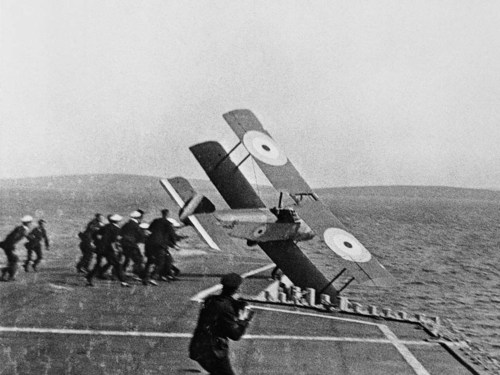
For the first landing Furious was stationary in Scapa Flow but on the second she was under way. It is surmised that the resulting extra wind speed over the deck created stronger turbulence.
Note the red/white/blue stripes on the elevator as well as the fin denoting it was a Sopwith built machine.
For the first landing Furious was stationary in Scapa Flow but on the second she was under way. It is surmised that the resulting extra wind speed over the deck created stronger turbulence.
Note the red/white/blue stripes on the elevator as well as the fin denoting it was a Sopwith built machine.
Last edit: 25 Aug 2017 16:14 by Quorneng.
Thanks: Klipkopwildlife, boz, Firewood, Nigel, Squirrelnet, Crashrr
Please Log in or Create an account to join the conversation.
- Crashrr
-
Topic Author
- Offline
- Senior Member
-
Less
More
- Posts: 89
- Thank you received: 284
25 Aug 2017 18:51 #10
by Crashrr
'What the hell' is always the right answer...
Replied by Crashrr on topic Sopwith Pup - Scale 20", rubber-powered.
I read that there were three underway landings. The first and second were successful - see attached commemorative postcard.
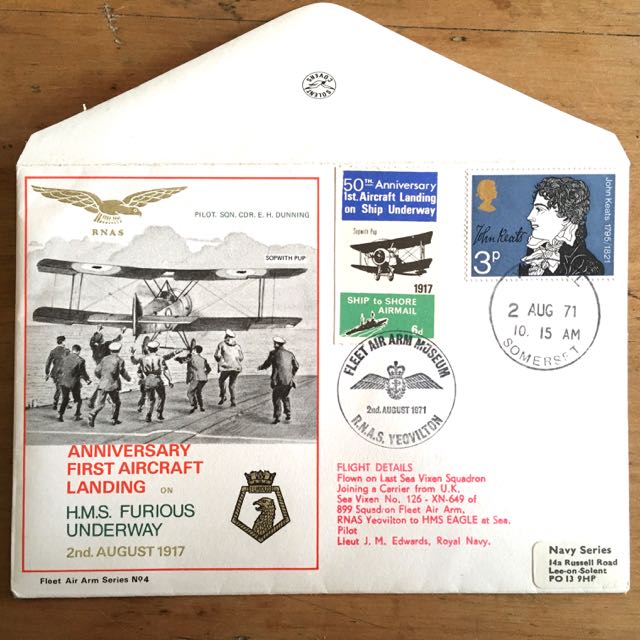
On the third, I have read variously, that either his engine stalled or that an updraft blew him sideways. Whatever the truth, apparently he was knocked out and his plane sank before they could get to him. I presume the Navy has an authoritative account.
He was only twenty-five, all very sad.
I have a Czech model colour card for his aeroplane with his number, 6453.
On the third, I have read variously, that either his engine stalled or that an updraft blew him sideways. Whatever the truth, apparently he was knocked out and his plane sank before they could get to him. I presume the Navy has an authoritative account.
He was only twenty-five, all very sad.
I have a Czech model colour card for his aeroplane with his number, 6453.
'What the hell' is always the right answer...
Thanks: Klipkopwildlife, boz, Firewood, Nigel, Squirrelnet
Please Log in or Create an account to join the conversation.
- Nigel
- Offline
- Elite Member
-
Less
More
- Posts: 204
- Thank you received: 405
30 Aug 2017 00:04 - 30 Aug 2017 00:06 #11
by Nigel
Replied by Nigel on topic Sopwith Pup - Scale 20", rubber-powered.
If you really need a heavy nose, you could push the boat out - make things really difficult for yourself and redesign it to put a big heavy CO2 motor in the front. Mind you, it looks pretty challenging already. Good luck.
Last edit: 30 Aug 2017 00:06 by Nigel.
Thanks: boz, Crashrr
Please Log in or Create an account to join the conversation.
- Crashrr
-
Topic Author
- Offline
- Senior Member
-
Less
More
- Posts: 89
- Thank you received: 284
30 Aug 2017 10:59 #12
by Crashrr
'What the hell' is always the right answer...
Replied by Crashrr on topic Sopwith Pup - Scale 20", rubber-powered.
From what little footage I've seen of CO2 motors, I really like the look of them. I will definitely be contemplating a CO2 project soon, but that's for another day. I'm having enough trouble with a rubber band!
'What the hell' is always the right answer...
Thanks: boz
Please Log in or Create an account to join the conversation.
- Ex-Member
- Visitor
-
30 Aug 2017 12:24 #13
by Ex-Member
Replied by Ex-Member on topic Sopwith Pup - Scale 20", rubber-powered.
CO2 motors are great little devices, but they are now very expensive and require a lot of maintenance to maintain them in running order. Accordingly, spares are also difficult (and expensive) to come by. Their power output is also unpredictable.
A far better alternative is electric power. There are some excellent profilers on the market and some pretty powerful brushed and brushless motors. Tie those up with a small LiPo cell and you have a compact, relatively light, predictable, reasonably cheap and easily maintained power plant which would be ideal for a short nose model such as the Pup.
A suitable electric power system for the Pup would cost around £50, whereas I understand CO2 motors are currently going for well over £100.
A far better alternative is electric power. There are some excellent profilers on the market and some pretty powerful brushed and brushless motors. Tie those up with a small LiPo cell and you have a compact, relatively light, predictable, reasonably cheap and easily maintained power plant which would be ideal for a short nose model such as the Pup.
A suitable electric power system for the Pup would cost around £50, whereas I understand CO2 motors are currently going for well over £100.
Please Log in or Create an account to join the conversation.
- Crashrr
-
Topic Author
- Offline
- Senior Member
-
Less
More
- Posts: 89
- Thank you received: 284
29 Sep 2017 09:45 - 29 Sep 2017 09:49 #14
by Crashrr
'What the hell' is always the right answer...
Replied by Crashrr on topic Sopwith Pup - Scale 20", rubber-powered.
Well, after a great deal of thought, furrowed brows, chocolate biscuits and cheap port I have started the Pup!
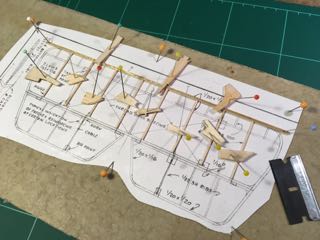
I confess I've strayed from the plan already. The tailplane is supposed to be built with a symmetrical top/bottom camber.
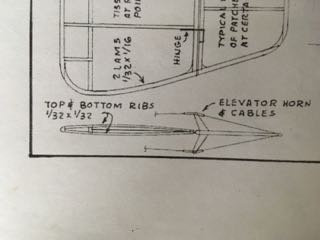
However, considering the thinness and fragility of the ribs, I just couldn't think of a way to do that which would guarantee a consistent section. Instead, I've flattened the bottom for a more conventional build. I will have a similar but more important decision to make when I get to the main wings, which are split-ribbed and under-cambered. Still, that's the challenge of scale modelling...
I suspect this is going to be a long, slow build...
Crashrr.
I confess I've strayed from the plan already. The tailplane is supposed to be built with a symmetrical top/bottom camber.
However, considering the thinness and fragility of the ribs, I just couldn't think of a way to do that which would guarantee a consistent section. Instead, I've flattened the bottom for a more conventional build. I will have a similar but more important decision to make when I get to the main wings, which are split-ribbed and under-cambered. Still, that's the challenge of scale modelling...
I suspect this is going to be a long, slow build...
Crashrr.
'What the hell' is always the right answer...
Last edit: 29 Sep 2017 09:49 by Crashrr.
Thanks: Klipkopwildlife, boz
Please Log in or Create an account to join the conversation.
- Ex-Member
- Visitor
-
29 Sep 2017 09:53 #15
by Ex-Member
Replied by Ex-Member on topic Sopwith Pup - Scale 20", rubber-powered.
If you are changing the tailplane section to flat on the bottom Crashrr, for aerodynamic reasons, you really need to make it flat on top as well. Either that or mount it with the curved surface down.
The reason is that for stability, you will need negative incidence on the tailplane, i.e. it will lift downwards. Accordingly, if you mount it with the curved surface on top, it will be working inefficiently and may cause trimming difficulties. I'm sure this is why lots of 1950s scale models that flew with 'lifting tailplanes' required an overly large tailplane to fly stably!
The reason is that for stability, you will need negative incidence on the tailplane, i.e. it will lift downwards. Accordingly, if you mount it with the curved surface on top, it will be working inefficiently and may cause trimming difficulties. I'm sure this is why lots of 1950s scale models that flew with 'lifting tailplanes' required an overly large tailplane to fly stably!
Please Log in or Create an account to join the conversation.
Time to create page: 0.208 seconds