
- Posts: 211
- Thank you received: 163
Great Planes Electri-Cub...
- Specialbuilder
-
 Topic Author
- Offline
- Elite Member
-

Less
More
14 Sep 2019 09:54 #1
by Specialbuilder
A man needs a plan... and a shed
Great Planes Electri-Cub... was created by Specialbuilder
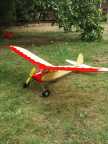
Hi all, I have been building my GP Electri-Cub with a view to using an OS10 on it as did the makers on their prototype, but that would require fuel proffer on my nice emulsion paint yellar finish, so I'm wondering which brushless set up to use instead of the brushed motor that came with it. It's a 600 sized can motor of unknown make. So what size BL should I consider to replace the 600? The estimated weight is 3.3-3.5 lbs. And what size prop would go with that? I'm assuming for a Cub, somewhere around 80 watts per lb.?
Cheers,
Martin
Cheers,
Martin
A man needs a plan... and a shed
Please Log in or Create an account to join the conversation.
- Klipkopwildlife
-

- Offline
- Administrator
-

- I'm supposed to be retired!
14 Sep 2019 12:04 #2
by Klipkopwildlife
Do it now, you may never get another chance
Replied by Klipkopwildlife on topic Great Planes Electri-Cub...
I wouldn't go less than 100W/lb. As a reference my FunCub weighs 2.5lbs and uses a 3s 2200mAh Lipo battery with a 30A ESC. The motor is a 3516 840kV brushless driving a 13x6 propeller although at sea level a 13x4 would be adequate for a training aircraft. On a 13x6 this setup delivers just over 300W. More performance is available on a 13x8.5 but still not unlimited vertical.
I have recently changed the motor to a 1100kV equivalent, this delivers 410W on a 13x6 and gives unlimited vertical, however some control harmony is lost, the throttle is a bit 'all or nothing'
After writing this I realise that you may not have sufficient clearance for the propeller since IC engines tend to use smaller props and higher revs.
I have recently changed the motor to a 1100kV equivalent, this delivers 410W on a 13x6 and gives unlimited vertical, however some control harmony is lost, the throttle is a bit 'all or nothing'
After writing this I realise that you may not have sufficient clearance for the propeller since IC engines tend to use smaller props and higher revs.
Do it now, you may never get another chance
Please Log in or Create an account to join the conversation.
- Specialbuilder
-
Topic Author
- Offline
- Elite Member
-
Less
More
- Posts: 211
- Thank you received: 163
14 Sep 2019 16:15 #3
by Specialbuilder
A man needs a plan... and a shed
Replied by Specialbuilder on topic Great Planes Electri-Cub...
Klipkop,
I'm not interested in vertical! I hate 3D. I'm a scale man. In flight as much as possible given the size. OK, my Skystreak will be fast, but that's just its shape.
The original motor is a Speed 600 which most regarded as gutless. I only want it to bumble around as near scale speed as it will tolerate.
I think it came with an 8x4 prop, which I now have on the OS 10, but the fuel proofer problem has swayed me back to electric.l
Martin
I'm not interested in vertical! I hate 3D. I'm a scale man. In flight as much as possible given the size. OK, my Skystreak will be fast, but that's just its shape.
The original motor is a Speed 600 which most regarded as gutless. I only want it to bumble around as near scale speed as it will tolerate.
I think it came with an 8x4 prop, which I now have on the OS 10, but the fuel proofer problem has swayed me back to electric.l
Martin
A man needs a plan... and a shed
Thanks: Flytilbroke
Please Log in or Create an account to join the conversation.
- Quorneng
-

- Offline
- Forum Master
-

Less
More
- Posts: 10058
- Thank you received: 19043
14 Sep 2019 20:45 #4
by Quorneng
Replied by Quorneng on topic Great Planes Electri-Cub...
Martin
I do agree with you about the attraction of scale flying 'appearance' but then with my lightweight Depron foamies this is more of a by product rather than being an specifically aimed for feature.
The thing to remember about electric is it is easy with LiPo/Brushless to install a 'good' power to weight ratio with very little weight penalty such that for scale type flying full throttle is simple not used. Further with electric there is little or no loss in overall efficiency at part throttle as any drop in motor efficiency tends to be countered by improved efficiency from the prop.
My classic example of this effect is my Depron "Endurance". Agreed not a scale plane, being built specifically for endurance flying, it still has an 'adequate' 80W/lb installed although it can maintain level flight on just 8W! (14 W/lb)
As you can imagine with a maximum of nearly 4 times the level flight power available for climbing it does so at a near vertical angle.
I do agree with you about the attraction of scale flying 'appearance' but then with my lightweight Depron foamies this is more of a by product rather than being an specifically aimed for feature.
The thing to remember about electric is it is easy with LiPo/Brushless to install a 'good' power to weight ratio with very little weight penalty such that for scale type flying full throttle is simple not used. Further with electric there is little or no loss in overall efficiency at part throttle as any drop in motor efficiency tends to be countered by improved efficiency from the prop.
My classic example of this effect is my Depron "Endurance". Agreed not a scale plane, being built specifically for endurance flying, it still has an 'adequate' 80W/lb installed although it can maintain level flight on just 8W! (14 W/lb)
As you can imagine with a maximum of nearly 4 times the level flight power available for climbing it does so at a near vertical angle.
Thanks: THE BLACKBIRD
Please Log in or Create an account to join the conversation.
- Eric
-

- Offline
- Moderator
-

Less
More
- Posts: 15406
- Thank you received: 14306
15 Sep 2019 09:06 - 15 Sep 2019 09:10 #5
by Eric
if you are calm and collected when all about you are going berserk - you've missed something important!
Replied by Eric on topic Great Planes Electri-Cub...
As I put in the other thread, you do not HAVE to fly at full power. That's what the throttle stick is for!
Do you drive your car with the go-pedal jammed to the floor?
Excess power is good on a wet grass field, (or off water) as you can 'blast' out, but then ease back to a more sensible rate.
-
The best way to decide what motor to put into your Cub is to complete the airframe, add the radio gear, fit a battery of (say) three cells and the biggest capacity that will fit into the available space, then weigh it all.
Having got that figure, you can look up a motor that gives the 100 Watts per pound, on three cells, and see what amps and prop the manufacturer advises, and add in the weight of THAT motor, to see if it still matches. (the actual flying speedo 's added weight will be negligible).
-
You don't have to buy the HobbyKing motors and speedo's - but when you look on the motors pages, most of them give weights, dimensions, power drawn, rpm's per volt, prop size to match, etc, to give you a good start-point. (some even have the i/c size equivalent) Don't forget to get a speed controller that is 50% bigger than the motor calls for, so you aren't running that at gut-busting levels!
If you are too mean on the rating, you 'can' fry the thing on the take-off climb-out, and then suddenly you have no radio or power!
-
Scale flying appearance is all well and good, but you cannot scale down the air molecules! So your model is in effect flying through treacle.
Trying to fly too slowly causes you to lose control response, and the model can/may/will go all waffly, as it is trying to stall. Loss of directional stability, and/or wing rocking, is one of the signs of stalling. How the model is balanced affects what happens next.
Do you drive your car with the go-pedal jammed to the floor?
Excess power is good on a wet grass field, (or off water) as you can 'blast' out, but then ease back to a more sensible rate.
-
The best way to decide what motor to put into your Cub is to complete the airframe, add the radio gear, fit a battery of (say) three cells and the biggest capacity that will fit into the available space, then weigh it all.
Having got that figure, you can look up a motor that gives the 100 Watts per pound, on three cells, and see what amps and prop the manufacturer advises, and add in the weight of THAT motor, to see if it still matches. (the actual flying speedo 's added weight will be negligible).
-
You don't have to buy the HobbyKing motors and speedo's - but when you look on the motors pages, most of them give weights, dimensions, power drawn, rpm's per volt, prop size to match, etc, to give you a good start-point. (some even have the i/c size equivalent) Don't forget to get a speed controller that is 50% bigger than the motor calls for, so you aren't running that at gut-busting levels!
If you are too mean on the rating, you 'can' fry the thing on the take-off climb-out, and then suddenly you have no radio or power!
-
Scale flying appearance is all well and good, but you cannot scale down the air molecules! So your model is in effect flying through treacle.
Trying to fly too slowly causes you to lose control response, and the model can/may/will go all waffly, as it is trying to stall. Loss of directional stability, and/or wing rocking, is one of the signs of stalling. How the model is balanced affects what happens next.
if you are calm and collected when all about you are going berserk - you've missed something important!
Last edit: 15 Sep 2019 09:10 by Eric. Reason: added a comment
Thanks: Klipkopwildlife
Please Log in or Create an account to join the conversation.
- Klipkopwildlife
-
- Offline
- Administrator
-
- I'm supposed to be retired!
15 Sep 2019 12:21 #6
by Klipkopwildlife
Do it now, you may never get another chance
Replied by Klipkopwildlife on topic Great Planes Electri-Cub...
This E-flite Power 25 (EFLM4025A) has been recommended as a suitable replacement for a 600 can motor, but from what I remember the OS10 revs at about 17k+ you would need a 1400 or 1500kV motor with a 3s battery to drive an 8x4 prop, unless your undercarriage will allow a 12x6 then you can use an 850kV
Do it now, you may never get another chance
Please Log in or Create an account to join the conversation.
- Klipkopwildlife
-
- Offline
- Administrator
-
- I'm supposed to be retired!
15 Sep 2019 12:22 #7
by Klipkopwildlife
Do it now, you may never get another chance
Replied by Klipkopwildlife on topic Great Planes Electri-Cub...
As an aside, using your equipment in it's mid range is going to give a much longer service life than running at full chat for most of the time.
Do it now, you may never get another chance
Thanks: Eric
Please Log in or Create an account to join the conversation.
- Specialbuilder
-
Topic Author
- Offline
- Elite Member
-
Less
More
- Posts: 211
- Thank you received: 163
16 Sep 2019 00:51 #8
by Specialbuilder
A man needs a plan... and a shed
Replied by Specialbuilder on topic Great Planes Electri-Cub...
So, using a 100Watt/lb motor should enable me to fly at half throttle whilst still retaining a decent amount of control?
I appreciate the wick can be turned down, but then to keep the analogy, I could have a 2 litre car, but the 1.5 is still perfectly capable. I can turn the wick down on my own model, but can only put the throttle wear the instructor says on the club trainer. I don't want to be ripping the poor little Cub's wings off!
Thanks for the recommendations and warnings though.
Martin
I appreciate the wick can be turned down, but then to keep the analogy, I could have a 2 litre car, but the 1.5 is still perfectly capable. I can turn the wick down on my own model, but can only put the throttle wear the instructor says on the club trainer. I don't want to be ripping the poor little Cub's wings off!
Thanks for the recommendations and warnings though.
Martin
A man needs a plan... and a shed
Thanks: Klipkopwildlife
Please Log in or Create an account to join the conversation.
- Klipkopwildlife
-
- Offline
- Administrator
-
- I'm supposed to be retired!
16 Sep 2019 07:43 - 16 Sep 2019 07:46 #9
by Klipkopwildlife
![[badass]](/media/kunena/emoticons/bad_boys_20.gif "[badass]")
Do it now, you may never get another chance
Replied by Klipkopwildlife on topic Great Planes Electri-Cub...
Exactly right on both counts Martin, but the 2litre is going to last longer and be much more comfortable on long trips (quieter) although the cost of ownership is slightly higher.Specialbuilder wrote: So, using a 100Watt/lb motor should enable me to fly at half throttle whilst still retaining a decent amount of control?
I appreciate the wick can be turned down, but then to keep the analogy, I could have a 2 litre car, but the 1.5 is still perfectly capable.
Martin
Do it now, you may never get another chance
Last edit: 16 Sep 2019 07:46 by Klipkopwildlife.
Please Log in or Create an account to join the conversation.
- Eric
-
- Offline
- Moderator
-
Less
More
- Posts: 15406
- Thank you received: 14306
16 Sep 2019 07:58 #10
by Eric
if you are calm and collected when all about you are going berserk - you've missed something important!
Replied by Eric on topic Great Planes Electri-Cub...
Controlability is set by the speed of passage through the air, not throttle setting.
Otherwise a glider would have no control, as it doesn't have an engine to throttle!
Speed through the air on a powered aircraft is set by the rpm's, prop pitch (and diameter), and attitude.
Remember the old saying - point the nose down, it goes down, point the nose up, and it goes up a bit, then down!
Otherwise a glider would have no control, as it doesn't have an engine to throttle!
Speed through the air on a powered aircraft is set by the rpm's, prop pitch (and diameter), and attitude.
Remember the old saying - point the nose down, it goes down, point the nose up, and it goes up a bit, then down!
if you are calm and collected when all about you are going berserk - you've missed something important!
Thanks: Klipkopwildlife
Please Log in or Create an account to join the conversation.
- crash happy
-

- Offline
- Platinum Member
-

- Oops. did I say that out loud!
Less
More
- Posts: 1250
- Thank you received: 1203
16 Sep 2019 08:28 #11
by crash happy
Replied by crash happy on topic Great Planes Electri-Cub...
I haven't been at this for that long but a couple of things to consider, for what it's worth.
1. All my models are electric & from experience I would ALWAYS prefer more power than just enough. Most of my flying is at half throttle.
2. Most of the guys on here have been flying since god was a boy so the advice comes from years of experience, follow it & you won't go far wrong. It is just that "advice" whether you choose to follow it is up to you, I tend to, purely because they are invariably right !
1. All my models are electric & from experience I would ALWAYS prefer more power than just enough. Most of my flying is at half throttle.
2. Most of the guys on here have been flying since god was a boy so the advice comes from years of experience, follow it & you won't go far wrong. It is just that "advice" whether you choose to follow it is up to you, I tend to, purely because they are invariably right !
Thanks: Klipkopwildlife, Flytilbroke, Quorneng, THE BLACKBIRD, paul d
Please Log in or Create an account to join the conversation.
- Specialbuilder
-
Topic Author
- Offline
- Elite Member
-
Less
More
- Posts: 211
- Thank you received: 163
17 Sep 2019 15:56 #12
by Specialbuilder
A man needs a plan... and a shed
Replied by Specialbuilder on topic Great Planes Electri-Cub...
Today, I actually got to waggle the throttle stick as the wind was slowing me down!
Would you recommend doing trial taxying and part take -offs with my newly wheeled Flite Test Pietenpol? I want to practice some stuff on my own and when the instructor's not available.
Martin
Would you recommend doing trial taxying and part take -offs with my newly wheeled Flite Test Pietenpol? I want to practice some stuff on my own and when the instructor's not available.
Martin
A man needs a plan... and a shed
Please Log in or Create an account to join the conversation.
- paul d
-
- Offline
- Forum Veteran
-

Less
More
- Posts: 2074
- Thank you received: 2292
17 Sep 2019 16:31 #13
by paul d
balsa is best.
Replied by paul d on topic Great Planes Electri-Cub...
depends how brave you feel! a taxy can quite easily become a take off!
I had my first solo in exactly the same way, thought a bit of taxying over the school field would be ok, gust of wind and up it went ( 250ft loop followed by a crunch.....I froze on the controls).
I had my first solo in exactly the same way, thought a bit of taxying over the school field would be ok, gust of wind and up it went ( 250ft loop followed by a crunch.....I froze on the controls).
balsa is best.
Please Log in or Create an account to join the conversation.
- Quorneng
-
- Offline
- Forum Master
-
Less
More
- Posts: 10058
- Thank you received: 19043
17 Sep 2019 17:06 #14
by Quorneng
Replied by Quorneng on topic Great Planes Electri-Cub...
My own suggestion is it depends on how smooth and long the runway is!
With smooth tarmac, no obstructions causing wind turbulence (or no wind) there is nothing wrong with gradually increasing the taxi speed particularly with a tail dragger as the tail lifting gives you clues on what is happening.
All this assumes the CofG is something like right otherwise it is much harder to determine what is causing what.
Any sort of grass (unless a bowling green) can cause a problem as the wheel drag means the power required for a fast taxi is actually the same as flying power so one bump and your off, like it or not, so you then have to decide to actually fly (more power) or cut power and try to and land in the space available. As neither situation was intended it usually ends badly.
Certainly on an average grass strip it pays to get a more experienced pilot to trim a new plane so it flies more or less straight and level then power can be safely applied for a 'positive' take off to simply limit the time running on the ground where, to a trainee, the 'flight' controls behave rather differently.
With smooth tarmac, no obstructions causing wind turbulence (or no wind) there is nothing wrong with gradually increasing the taxi speed particularly with a tail dragger as the tail lifting gives you clues on what is happening.
All this assumes the CofG is something like right otherwise it is much harder to determine what is causing what.
Any sort of grass (unless a bowling green) can cause a problem as the wheel drag means the power required for a fast taxi is actually the same as flying power so one bump and your off, like it or not, so you then have to decide to actually fly (more power) or cut power and try to and land in the space available. As neither situation was intended it usually ends badly.
Certainly on an average grass strip it pays to get a more experienced pilot to trim a new plane so it flies more or less straight and level then power can be safely applied for a 'positive' take off to simply limit the time running on the ground where, to a trainee, the 'flight' controls behave rather differently.
Thanks: Flytilbroke
Please Log in or Create an account to join the conversation.
- Specialbuilder
-
Topic Author
- Offline
- Elite Member
-
Less
More
- Posts: 211
- Thank you received: 163
17 Sep 2019 19:19 #15
by Specialbuilder
A man needs a plan... and a shed
Replied by Specialbuilder on topic Great Planes Electri-Cub...
The Pietenpol has already been flown and trimmed by a top club flyer who loved it. I would only be doing practice runs to see if I have a feel for keeping it straight. If I took off I'd immediately cut the power. I've flown a quick RC glider foamy for a few minutes from a hand launch and managed that OK, until the battery alarmed.
But I don't intend taking off until I feel safe doing so. Our field is well rolled, close cut grass and of a very good size, so I assume it'll stop before the edge comes up.
Paul, you should have rolled of the top of the loop and come back down and landed<G>
Martin
But I don't intend taking off until I feel safe doing so. Our field is well rolled, close cut grass and of a very good size, so I assume it'll stop before the edge comes up.
Paul, you should have rolled of the top of the loop and come back down and landed<G>
Martin
A man needs a plan... and a shed
Thanks: Klipkopwildlife, Flytilbroke
Please Log in or Create an account to join the conversation.
Time to create page: 0.220 seconds