
- Posts: 13726
- Thank you received: 14470
One Fuselage, Many Wing Options.
- Eric
-
 Topic Author
- Offline
- Moderator
-

Less
More
16 Aug 2011 22:15 - 16 Aug 2011 22:49 #1
by Eric
if you are calm and collected when all about you are going berserk - you've missed something important!
One Fuselage, Many Wing Options. was created by Eric
I just sent a long dissertation and six pics to this thread, and they have disappeared! I did it right, clicked on insert for each of the pics, and submit at the end, the little connecting wheel went round, and round, and round, then the forum jumped to the home page. No sign of my article!
So - if it now decides to duplicate - sorry!

Well, that seems to have worked - I sent them two at a time, and used the 'edit' button to add the next two. (Perhaps my broadband is so fast I timed out?)
Right, then, here are the words to go with the pics.
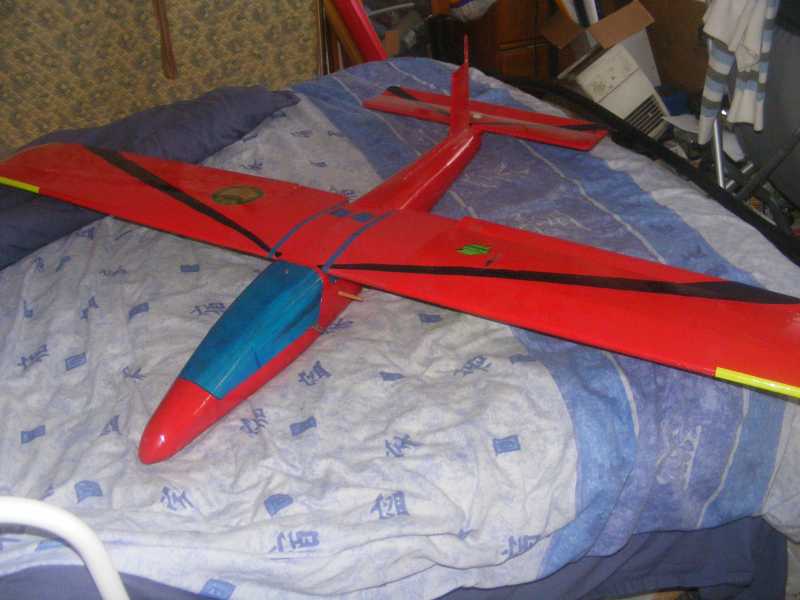
The model was designed as a test-bed for different wing sections, the idea being to simplify the mounting of different sections or chords, without resorting to a lot of balsa butchery.
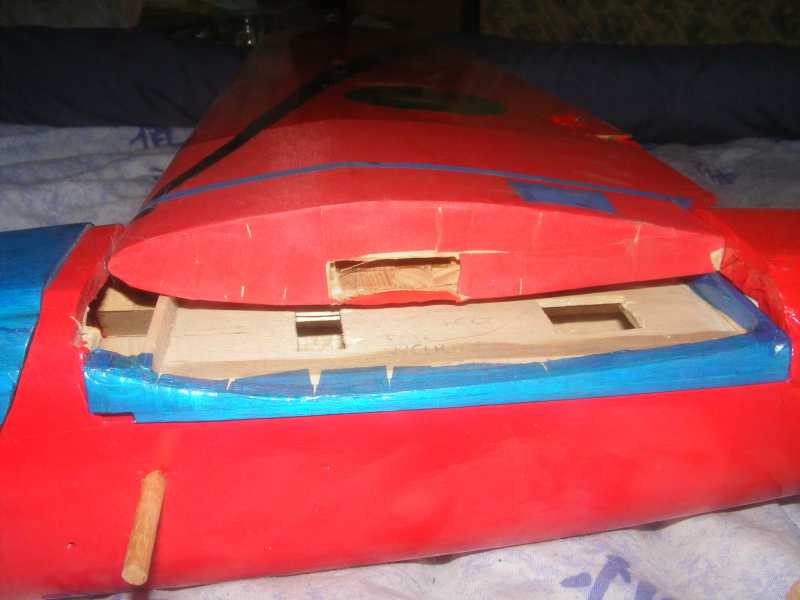
The wing in the pics is a two-piece, with a spruce tongue that goes into the rectangular hole you can see, necessitated by my mode of transport at the time - a motorbike, and the longest structural panel I could comfortably carry, which was about 40".
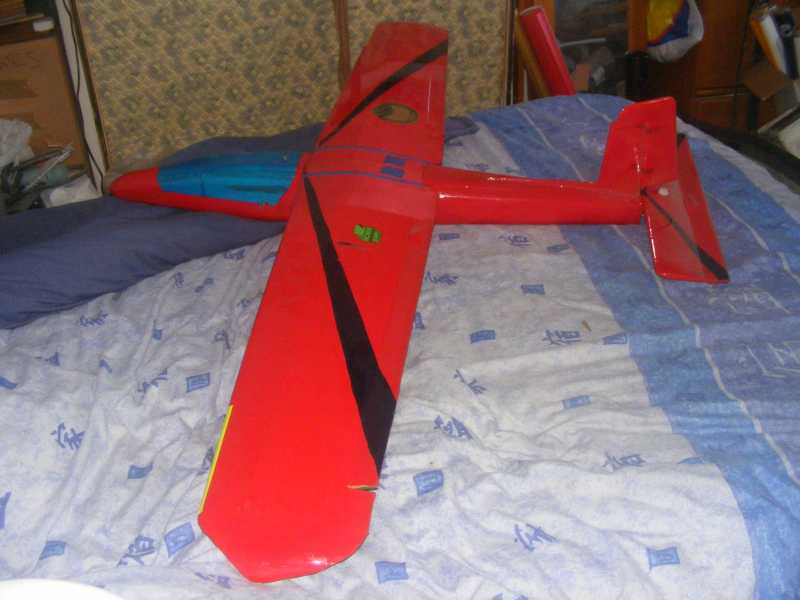
So - it has two panels of 36", making a 72" span, and a simple box fuz with a long nose, to allow experimentation with c of g position. The fuz is quite cavernous, as it was intended to carry my old Reftec UHF radio, the receiver of which was about the size of a 24 box of oxo cubes! The modern Futaba 2.4 one is cowering in a corner, with the servos, under the blue detachable canopy hatch, suffering from agoraphobia!
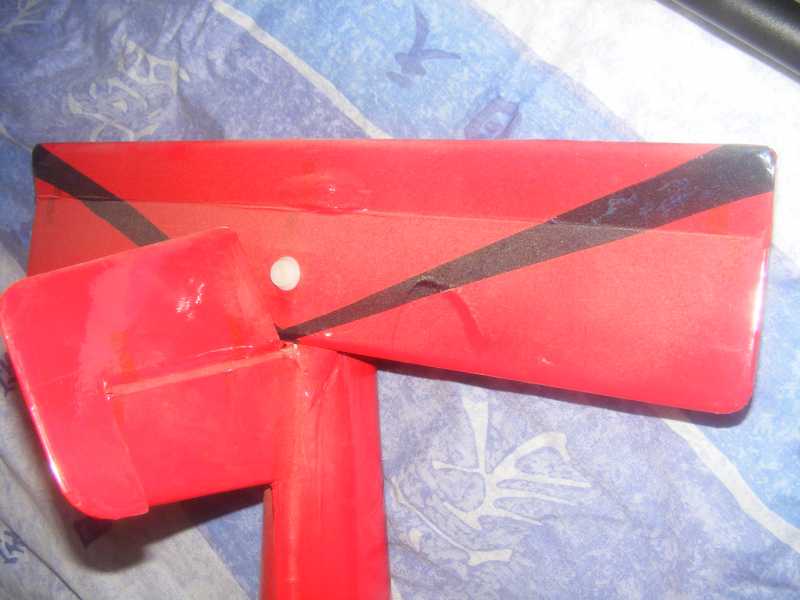
The tailplane bolts on, for ease of changing spans or areas, to match whatever wing is on the front end.
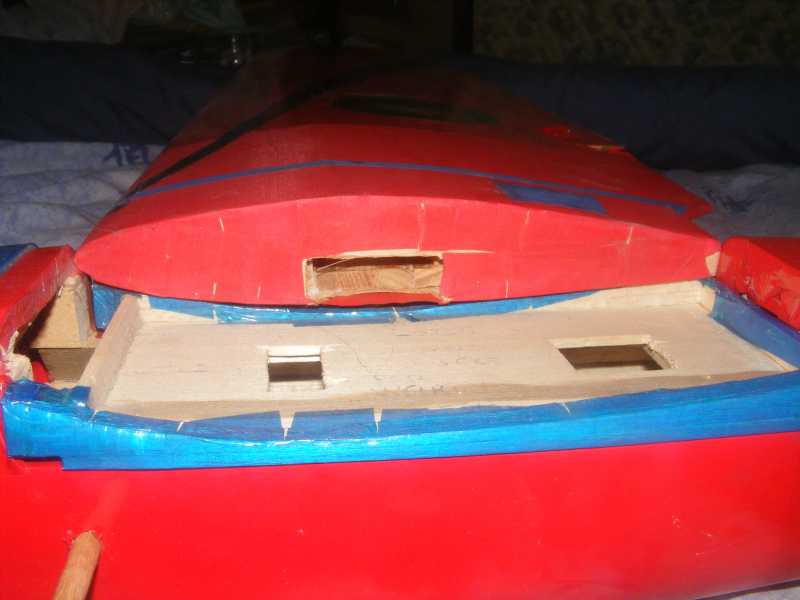
The way it all works is fairly easy to see. Where the wing root should be, is a rectangular hole, into which drops the 'tray' made from scrap, which bears the 'negative' of the aerofoil section of the wing (made from the offcut of the wing ribs!) (recycling!) The tray is located fore and aft by the ends of the fuz cutout, and sideways by a pair of rails, which are visible in one of the pics, that bear up against the fuz sides. The two holes in the tray are for the 'Y' lead for the ailerons, and a mistake :oops: when I had the thing back to front! That can be used for airbrakes, flaps, whatever.
The wing straps on by elastic bands, cheap and simple.
The result is, should I choose to try a different wing, all I need is to carve up a new tray to suit the new section/chord, and job's done. It also means that I can play around with wing incidences, without wrecking the fuz. (Striking the ground at high speed doesn't count!)
To save you asking, the model weighs in at around 2lb, and is remarkably quick, as you will find out when you try to land it in a restricted area! It has been looped, rolled, flown inverted, and spun, when I stalled it inverted, trying a silly manoeuvre, and nothing has fallen off or broken, yet. The aerofoil in use at the moment is a thickened E374, and works quite well when the conditions get scratchy, but as I found out, it has a wicked stall! (Especially inverted!) and loses a fair bit of height before it 'gets going' again.
So - if it now decides to duplicate - sorry!
Well, that seems to have worked - I sent them two at a time, and used the 'edit' button to add the next two. (Perhaps my broadband is so fast I timed out?)
Right, then, here are the words to go with the pics.
The model was designed as a test-bed for different wing sections, the idea being to simplify the mounting of different sections or chords, without resorting to a lot of balsa butchery.
The wing in the pics is a two-piece, with a spruce tongue that goes into the rectangular hole you can see, necessitated by my mode of transport at the time - a motorbike, and the longest structural panel I could comfortably carry, which was about 40".
So - it has two panels of 36", making a 72" span, and a simple box fuz with a long nose, to allow experimentation with c of g position. The fuz is quite cavernous, as it was intended to carry my old Reftec UHF radio, the receiver of which was about the size of a 24 box of oxo cubes! The modern Futaba 2.4 one is cowering in a corner, with the servos, under the blue detachable canopy hatch, suffering from agoraphobia!
The tailplane bolts on, for ease of changing spans or areas, to match whatever wing is on the front end.
The way it all works is fairly easy to see. Where the wing root should be, is a rectangular hole, into which drops the 'tray' made from scrap, which bears the 'negative' of the aerofoil section of the wing (made from the offcut of the wing ribs!) (recycling!) The tray is located fore and aft by the ends of the fuz cutout, and sideways by a pair of rails, which are visible in one of the pics, that bear up against the fuz sides. The two holes in the tray are for the 'Y' lead for the ailerons, and a mistake :oops: when I had the thing back to front! That can be used for airbrakes, flaps, whatever.
The wing straps on by elastic bands, cheap and simple.
The result is, should I choose to try a different wing, all I need is to carve up a new tray to suit the new section/chord, and job's done. It also means that I can play around with wing incidences, without wrecking the fuz. (Striking the ground at high speed doesn't count!)
To save you asking, the model weighs in at around 2lb, and is remarkably quick, as you will find out when you try to land it in a restricted area! It has been looped, rolled, flown inverted, and spun, when I stalled it inverted, trying a silly manoeuvre, and nothing has fallen off or broken, yet. The aerofoil in use at the moment is a thickened E374, and works quite well when the conditions get scratchy, but as I found out, it has a wicked stall! (Especially inverted!) and loses a fair bit of height before it 'gets going' again.
if you are calm and collected when all about you are going berserk - you've missed something important!
Last edit: 16 Aug 2011 22:49 by Eric.
Please Log in or Create an account to join the conversation.
Time to create page: 0.534 seconds