
- Posts: 13726
- Thank you received: 14467
So - You want to learn to fly?
- Eric
-
 Topic Author
- Offline
- Moderator
-

Less
More
02 Apr 2022 12:14 #1
by Eric
if you are calm and collected when all about you are going berserk - you've missed something important!
So - You want to learn to fly? was created by Eric
I hold the copyright of this, but you are welcome to copy-paste it in it's entirety on the understanding that I am credited.
E Bray. April 2022.
So – you want to learn to fly an aircraft?
First, a few simple rules.
1. Take-off is optional. Landing is mandatory.
2. Learn from the mistakes of others, you won't live long enough to make them all yourself.
3. Flying isn't dangerous. It is crashing that can cause pain.
4. There are three simple rules for making a smooth landing – unfortunately, nobody knows what they are.
5. The probability of survival is directly inverse to the angle of arrival on the ground.
6. A good landing is one that is on the flying field. A great landing is one where the aircraft can be used again.
7. If you have height, it can be converted into speed – if you have speed, it can be converted into height. If you have neither height nor speed, you are in trouble!
Please note, wherever I use the word 'he' (or variations of) this is in a gender-free sense – to avoid the endless repetition of all the various options that are prevalent in today's society.
It doesn't matter what kind of aircraft you want to fly, be it a full-size one you can sit in, or a somewhat less expensive - and more portable – model one. It can be powered by a whirling finger-biting propeller, a gas-guzzling miniature turbine that is prone to catching fire in the pits, or the old fashioned gravity in the form of a thermal or slope soaring glider. It can be a moulded foam-plastic one, a wood and fabric one, or even a glass-fibre one. The same rules apply, as do the unavoidable laws of flight. (No, I didn't write those!)
You may have noticed that I have not differentiated between twisted elastic, (Note I don't put rubber, that means something very different in the U.S.!) wet fuel and electrons for the energy source – that is a personal choice to be made by the pupil.
Also – most of this will not apply if your only desire is to play with those cruciform collections of electric motors that have an on-board computer to keep it the right way up, limit how high and how far it will go, and can also bring it back and land it more or less on the exact spot it departed from, at the press of a button – that is not flying, so - if that is you, you may as well stop reading now, and do something else!
OK, that's got rid of 90% of my readers!
For the remaining 10%, consider -
Flying model aircraft basically involves standing in a muddy field, getting cold, rained on, hypothermia from wind-chill, sun-burned, frost-bitten, and thoroughly disillusioned when your latest masterpiece doesn't behave as expected/anticipated – (sometimes, in the U.K. All of those at once!) or as it did in the warmth of your building space at home! (Very few of us have the luxury of a tarmac area to park the car on, and use as a runway!)
Now we're down to 5%.
So – to start at the beginning, which is a very good place to start - -
(I've heard that line before, somewhere!)
No doubt your thoughts are on a Spitfire or a Mustang – carry on dreaming, but don't even consider thinking about it just yet! There was a short report with photo on the news, today, of a person that bought a brand-new Ferrari, drove it about 300 yards from the show-room, and smashed it's front in. (It might have been fake, as it was dated April 1st, but it looked genuine)
Just because you have the money to buy it, doesn't mean you have the skill-set to control it!
Now we're down to 4%
What to do?
Find yourself a club near you, membership often includes third party insurance, with Instructors willing to spend hours and hours of their own flying time, to guide you through your first stumbling (and often crunching) steps through the art of NOT hitting the floor with your basic, boxy, easy to repair, and cheap trainer model. (after spending time explaining why a Spitfire is not an ideal first model, because you ignored the previous paragraphs!) Some clubs even have special (and often much-repaired) models for just this purpose – often with dual controls, so the unfortunate, stressed-out, Instructor can rescue you/the model from all the messes you will get into!
Yes – stressed-out – teaching is not easy, any more than flying helicopters whilst blindfolded is! The Instructor has to guess what the novice is going to do next, contrary to his verbal instruction, and decide how long to wait before wresting control back, to avoid model/ground impact! Too soon, and the pupil doesn't learn – too late, and the lessons for that week are ended!
But – before we can even get that far, the proffered model has to be examined minutely, to ensure that everything works as it should, in the correct directions, and that nothing is about to fall off (especially with ARTF's, where the glue has been VERY thinly and skimpily applied, if at all). It may well appear that the Instructor is trying to pull the model to bits – and he probably is! It is best if the elevator control surface comes off in his hand, with the model safely on the ground, than when at a height of 300 feet in a vertical – out of control – dive! He will also ensure that an important piece, made of a bit of bent metal, or a very shallow V shape of plywood - that had no obvious place to go, has really been installed between the two wing-halves – the critical 'dihedral brace', without which, the life of the model will be rather brief! He will also check that the model balances in the correct place – which is important to achieve controlled flight – and that the radio system (assuming it is not a free-flight or control-line model, which don't HAVE radio) will work correctly and at a distance further than he can spit upwind in a gale. (The instructions with the radio gear often state a much larger distance than that!)
That's another 1% gone, as they don't want their masterpiece mauled like that!
And you still cannot fly!
You have to be acquainted with the BMFA and CAA laws regarding operating your (partly) guided missile AND any particular rules that apply to the club of your choosing, although you will not be expected to quote them verbatim, on your first visit!
Finally, the moment comes. The Instructor will have helped you to start the engine – or plug in the flight-pack battery (whichever) – in a manner that ensures that you still have all your fingers and thumbs at the end of that process, and with minimal loss of blood – he will have placed the model on the runway, checked that everything still works, the wind direction, looked for any obstructions, and a myriad of other things that won't have occurred to the pupil, performed a take-off, trimmed the model so that it flies straight all on it's own, and said those scary magic words - “You Have Control”.
Immediately, the pupil will be struck by a form of paralysis-induced fear! His brain and ears will still function, but the commands coming into the ear-hole, spoken by the Instructor, will not translate into finger movements on the control sticks – as he watches his financial ruin hurtle off into the distance at a breakneck speed!
Eventually, paralysis will be partially overcome, resulting in a brief twitch on the stick, then nothing, or a full deflection- held on for ever – until the Instructor says “I have control” and demonstrates what was supposed to happen, as the model cruises slowly past demonstrating yet again, that if left alone, it will fly straight and level – for ever (or until it runs out of power!) and the pupil can collapse into the nearest chair, whilst his brain dissolves and the down-facing sphincter stops twitching!
In time – the exact duration cannot be measured, as it is infinitely variable – the pupil will be able to fly in circles, in a controlled manner, and may be advancing onto flat 'figure 8's' – which requires turns both to the left AND right, alternately!
Once the fine control of repeatable accurate positioning AND height control have been achieved, the pupil will begin to learn the highly skilled art of crashing – sorry – landing – on the proper field – in the correct direction with regard to the wind!
This is where the stresses really kick in for the Instructor, as so many things can go wrong, very quickly, and all at once! (height, speed, positioning, (or lack of) - angle of descent, obstructions to avoid, reaction time of the pupil, etc.
Once the pupil can repeatedly fly figure 8's AND land in the correct place, the right way up, preferably on the wheels – he can go on to take-offs!
In reality, with a well-tamed model, this is a nothing manoeuvre, but it strikes dread into the pupil, because it happens, starting with NO height and NO speed – things that he has learned are vital! The hardest part to learn is that ailerons don't work at ground speed, so you have to steer with the rudder!! AARGH! So far, he hasn't really used that control stick, except for varying the power a small amount – now and then.
Eventually, the pupil will be allowed to make the entire flight – completely unassisted – but with the Instructor hovering nearby to 'rescue' him - until both he and the Instructor know he can cope, and can manage to crash – sorry – take off, fly and land - without assistance.
What is next?
No, not the Spitfire, yet! How about a loop? Remember the rule – when trying something new – do it three mistakes high! That should (not always) give the pupil room to sort things out when the model departs in a totally unexpected direction! (and it will!)
Another 1% will have dropped out by now, stating “This is not for me”.They can go on to model cars or model trains (they crash as well, but rather less dramatically).
By now, the pupil might have learned how much they don't yet know, and will put in many more hours of basic flying, gradually stepping up to more lively models as his skills improve – often with the Instructor hovering, ready to rescue them yet again – and will hopefully understand why his first model was in reality so slow and dozy! (and hopefully realize how many hours of his own flying time the Instructor has given up, to assist – and will probably be called upon again, to assist with the 'maiden' flight of new models, as they appear).
After all this comes the dreaded 'A' certificate test. Mention test or exam, and a lot of people fall apart!
The 'A' is nothing that the pupil hasn't already done – know the rules, safety in the pits area, take off, fly in a controlled manner around the circuit, demonstrate a figure '8' to show he is flying the model, and not vice versa, demonstrate an engine-failure forced landing, climb away again, and land in the required manner.
Now, the Instructor can finally get around to flying his own models again, but remaining available for 'maidens', test and trimming flights, etc – until a new potential member comes along and asks if they can have a go – then it all starts again!
if you are calm and collected when all about you are going berserk - you've missed something important!
Thanks: admin, Klipkopwildlife, Quorneng, THE BLACKBIRD, jon.in.swansea
Please Log in or Create an account to join the conversation.
- Flytilbroke
-

- Offline
- Platinum Member
-

- Not Tired, long retired "Bob"
Less
More
- Posts: 1601
- Thank you received: 1987
02 Apr 2022 15:07 #2
by Flytilbroke
Have a nice Day, unless I don't like you.
Replied by Flytilbroke on topic So - You want to learn to fly?
No bad, no bad at all. Bowl full of words, not in a nutshell :whistle: All pretty true-ish 
Have a nice Day, unless I don't like you.
Thanks: Eric, Klipkopwildlife
Please Log in or Create an account to join the conversation.
- Klipkopwildlife
-

- Offline
- Administrator
-

- I'm supposed to be retired!
03 Apr 2022 08:00 #3
by Klipkopwildlife
Do it now, you may never get another chance
Replied by Klipkopwildlife on topic So - You want to learn to fly?
You hit the nail on the head again Eric. Being self taught I would never recommend that anyone try it, your words tick all the boxes.
Do it now, you may never get another chance
Thanks: Eric
Please Log in or Create an account to join the conversation.
- Klipkopwildlife
-
- Offline
- Administrator
-
- I'm supposed to be retired!
03 Apr 2022 13:44 #4
by Klipkopwildlife
Do it now, you may never get another chance
Replied by Klipkopwildlife on topic So - You want to learn to fly?
Eric, you missed one, the full sized pilot with lots of hours who has the opinion, "how hard can it be?"
You can include me in that statement, the answer is, "you have absolutely no idea!"
You can include me in that statement, the answer is, "you have absolutely no idea!"
Do it now, you may never get another chance
Thanks: Eric
Please Log in or Create an account to join the conversation.
- Eric
-
Topic Author
- Offline
- Moderator
-
Less
More
- Posts: 13726
- Thank you received: 14467
03 Apr 2022 16:35 #5
by Eric
if you are calm and collected when all about you are going berserk - you've missed something important!
Replied by Eric on topic So - You want to learn to fly?
Haha!
I could also have added - the three least useful things to a full-size pilot
1, Height above you
2. The fuel still in the bowser.
3. Five minutes ago.
I could also have added - the three least useful things to a full-size pilot
1, Height above you
2. The fuel still in the bowser.
3. Five minutes ago.
if you are calm and collected when all about you are going berserk - you've missed something important!
Thanks: Klipkopwildlife
Please Log in or Create an account to join the conversation.
- Magpie
-

- Offline
- Elite Member
-

Less
More
- Posts: 587
- Thank you received: 1048
19 Apr 2024 15:11 #6
by Magpie
Replied by Magpie on topic So - You want to learn to fly?
Yes - & I've never done it before!
At my age I'm not confident of my ability to learn new physical skills so I've been reading around & it seems the best way to start would be a simulator. I gather you can get a control box which will work with a simulator on a PC via a USB port & then later can be actually used to control a real model.
Can I have some suggestions, obviously a low price is a high priority.
I would think 3-channels would be adequate, forward (& back? Did I mention canards?), up/down. left/right.
Do ailerons do both up/down and left/right? How do you decide when to use them?
Thanks: Klipkopwildlife
Please Log in or Create an account to join the conversation.
- Eric
-
Topic Author
- Offline
- Moderator
-
Less
More
- Posts: 13726
- Thank you received: 14467
19 Apr 2024 16:22 - 19 Apr 2024 16:56 #7
by Eric
if you are calm and collected when all about you are going berserk - you've missed something important!
Replied by Eric on topic So - You want to learn to fly?
You've been digging deep, Magpie.
You CAN learn cheaply by using a computer sim - but it does NOT teach depth perception! So you can very quickly become disoriented regarding where the 'ground' is - until you hit it! Plus - you cannot feel the wind, to give you a direction, as there is none while you sit in your house! But you can learn left/right and up/down when it is set up correctly.
Most modern transmitters have a 'buddy socket' on the back that can be used with the p.c. on the flight sim, but setting the thing up can be rather painstaking, as you have to learn how to set up a memory on the transmitter FOR the sim, as well as training the sim which stick does what, or you have to go through the same rigmarole every time you come to use it! Make sure you have more memories than you have models, or you soon run out of space!
It also has to be compatible with someone else's transmitter, which can be set up as master, while yours is slave. (or if you are rich enough, buy two identical transmitters!) Some now interconnect by radio (bluetooth, etc), while others need a cable that plugs into both.
Three channel radio's are ok for boats and cars, but not for aircraft. You need a minimum of four, and later - six or more, for flaps, retracts, etc.
Do NOT buy cheap radio - you will regret it later.
Which one to get - the best advice I can say is to go to your local club, and see what they are using, and listen to their gripes about what went wrong, or their praises of what worked better, then get the same one as them.
What do the four do?
One controls the motor speed, it doesn't matter here if it is wet fuel or electric.
The next one controls the rudder (and nose-wheel if fitted to the model) for directional control.
They are usually both on the same stick, side to side for rudder, and up and down (on the ratchet stick) for motor control.
The other stick then works the ailerons - one on each main wing, for left-right balance (initially) on the left-right stick.
The other remainng one is for the elevator, which is for attitude control (not height! That is done by the motor power!)
You will notice that three of the stick axes are sprung to centre. That ensures that all the control surfaces on the model go to neutral, IF the model is built straight and trimmed correctly. (That's an art-form in itself!) The throttle (ratchet) stick is NOT sprung to centre, you want that to stay where you put it, or the motor will keep going to idle when you let go!
Now MOST, but not all - people have the throttle and rudder on the left-hand side stick, and the ailerons and elevator on the other. There are other combinations that some prefer, but it is best if your Instructor uses the same layout as you do!
Looking at the transmitter, face up, and aerial (or handle) pointing away from you - the throttle stick should be down (towards you) for motor off if electric, or idle if it is wet-fuel.
The rudder (same stick!) should move the rudder (and nose wheel) to the left when you move the stick to the left.
The other stick, left stick should make the aileron on the left wing move UP , AND the right aileron on the other wing move down.
Moving the stick towards you (UP) should move the elevator on the tailwing UP so the back of the plane is pushed down.
Obviously (hopefully) moving the sticks the other way has the reverse effect.
Ignore any and all other switches and knobs on the transmitter, for now, you don't need them. That leaves the four little sliders under and (usually) in between the sticks.These are the 'fine tuning' for the servo centres, you use those (or the Instructor will) to make the model fly straight - on it's own.
Depending on the radio there might be a little counter on the screen that tells you the trim position, or it might be a slider in a bar, one for each trimmer. They should all be set to 0 for now.
Canards are another kettle of beasties, as SOME of the controls appear to go the wrong way. I'd strongly recommend you skip that, for now, and get a simple boxy proper trainer model, and learn the basics first. There are plenty to choose from. Select one with big fat wheels, a high wing, bright orange, red or yellow, NOT blue, white or camoflage pattern, so it stands out against the usually grey UK sky, and green or brown trees, and no smaller than about 48 inches 122 millis, because they get small very quickly, at first - and if you can't SEE it (not just a blob) you cannot control it!
Yes, it looks garish, and probably a bit of an eyesore, on the ground by your feet, but you'll quickly realize why, when it is in the air!
Don't buy expensive, or fragile, because you WILL crash it, and if it is easily repaired, you will be flying again sooner.
Initially, you will be horrified at how fast it seems to fly, and how responsive, but as you get more proficient, you will be equally horrified how slow and dozy the very same model is!
When to use the controls - all the time!!
 The rudder - not so much except to steer when taxiing, until you start to learn aerobatics (much later!) but the ailerons and elevator will be worked all the time, to correct the flight direction, start and stop turns, correct for air bumps, etc.
A free-flight model will NOT make a good radio model. A free-flighter is set up to be self-stabilizing, and to fly at one speed. That is just the opposite of radio model requirements - your radio commands will be 'fighting' the built-in stability, and will therefore have weird - if any - responses!
Which flight sim - there are several out there. A popular one used to be Phoenix, but that has been discontinued, and there is no support for it any more.
You CAN learn cheaply by using a computer sim - but it does NOT teach depth perception! So you can very quickly become disoriented regarding where the 'ground' is - until you hit it! Plus - you cannot feel the wind, to give you a direction, as there is none while you sit in your house! But you can learn left/right and up/down when it is set up correctly.
Most modern transmitters have a 'buddy socket' on the back that can be used with the p.c. on the flight sim, but setting the thing up can be rather painstaking, as you have to learn how to set up a memory on the transmitter FOR the sim, as well as training the sim which stick does what, or you have to go through the same rigmarole every time you come to use it! Make sure you have more memories than you have models, or you soon run out of space!
It also has to be compatible with someone else's transmitter, which can be set up as master, while yours is slave. (or if you are rich enough, buy two identical transmitters!) Some now interconnect by radio (bluetooth, etc), while others need a cable that plugs into both.
Three channel radio's are ok for boats and cars, but not for aircraft. You need a minimum of four, and later - six or more, for flaps, retracts, etc.
Do NOT buy cheap radio - you will regret it later.
Which one to get - the best advice I can say is to go to your local club, and see what they are using, and listen to their gripes about what went wrong, or their praises of what worked better, then get the same one as them.
What do the four do?
One controls the motor speed, it doesn't matter here if it is wet fuel or electric.
The next one controls the rudder (and nose-wheel if fitted to the model) for directional control.
They are usually both on the same stick, side to side for rudder, and up and down (on the ratchet stick) for motor control.
The other stick then works the ailerons - one on each main wing, for left-right balance (initially) on the left-right stick.
The other remainng one is for the elevator, which is for attitude control (not height! That is done by the motor power!)
You will notice that three of the stick axes are sprung to centre. That ensures that all the control surfaces on the model go to neutral, IF the model is built straight and trimmed correctly. (That's an art-form in itself!) The throttle (ratchet) stick is NOT sprung to centre, you want that to stay where you put it, or the motor will keep going to idle when you let go!
Now MOST, but not all - people have the throttle and rudder on the left-hand side stick, and the ailerons and elevator on the other. There are other combinations that some prefer, but it is best if your Instructor uses the same layout as you do!
Looking at the transmitter, face up, and aerial (or handle) pointing away from you - the throttle stick should be down (towards you) for motor off if electric, or idle if it is wet-fuel.
The rudder (same stick!) should move the rudder (and nose wheel) to the left when you move the stick to the left.
The other stick, left stick should make the aileron on the left wing move UP , AND the right aileron on the other wing move down.
Moving the stick towards you (UP) should move the elevator on the tailwing UP so the back of the plane is pushed down.
Obviously (hopefully) moving the sticks the other way has the reverse effect.
Ignore any and all other switches and knobs on the transmitter, for now, you don't need them. That leaves the four little sliders under and (usually) in between the sticks.These are the 'fine tuning' for the servo centres, you use those (or the Instructor will) to make the model fly straight - on it's own.
Depending on the radio there might be a little counter on the screen that tells you the trim position, or it might be a slider in a bar, one for each trimmer. They should all be set to 0 for now.
Canards are another kettle of beasties, as SOME of the controls appear to go the wrong way. I'd strongly recommend you skip that, for now, and get a simple boxy proper trainer model, and learn the basics first. There are plenty to choose from. Select one with big fat wheels, a high wing, bright orange, red or yellow, NOT blue, white or camoflage pattern, so it stands out against the usually grey UK sky, and green or brown trees, and no smaller than about 48 inches 122 millis, because they get small very quickly, at first - and if you can't SEE it (not just a blob) you cannot control it!
Yes, it looks garish, and probably a bit of an eyesore, on the ground by your feet, but you'll quickly realize why, when it is in the air!
Don't buy expensive, or fragile, because you WILL crash it, and if it is easily repaired, you will be flying again sooner.
Initially, you will be horrified at how fast it seems to fly, and how responsive, but as you get more proficient, you will be equally horrified how slow and dozy the very same model is!
When to use the controls - all the time!!
A free-flight model will NOT make a good radio model. A free-flighter is set up to be self-stabilizing, and to fly at one speed. That is just the opposite of radio model requirements - your radio commands will be 'fighting' the built-in stability, and will therefore have weird - if any - responses!
Which flight sim - there are several out there. A popular one used to be Phoenix, but that has been discontinued, and there is no support for it any more.
if you are calm and collected when all about you are going berserk - you've missed something important!
Last edit: 19 Apr 2024 16:56 by Eric. Reason: typo
Thanks: Klipkopwildlife, jon.in.swansea
Please Log in or Create an account to join the conversation.
- Klipkopwildlife
-
- Offline
- Administrator
-
- I'm supposed to be retired!
19 Apr 2024 18:02 #8
by Klipkopwildlife
Do it now, you may never get another chance
Replied by Klipkopwildlife on topic So - You want to learn to fly?
Taranis by FrSky is a good choice, Futaba if you want to spend lots of money. Mode 2 is what Eric is describing as the controls. Mode 1 got popular for a while but Mode 2 is what most people fly today, ailerons and elevator on the same stick like a real plane. Teaching yourself is not an option unless you have very deep pockets, ask me how I know. Foamies are a good choice, easy to repair with the right glue and there's plenty to choose from, do not try a low wing!
Do it now, you may never get another chance
Thanks: Eric, jon.in.swansea
Please Log in or Create an account to join the conversation.
- Magpie
-
- Offline
- Elite Member
-
Less
More
- Posts: 587
- Thank you received: 1048
19 Apr 2024 21:16 #9
by Magpie
Replied by Magpie on topic So - You want to learn to fly?
Thanks for your replies.
I think I'm a long way of actually flying an actual model. I have located the nearest local club & when the weather gets reasonable I''ll call in on a flying day to have a chat & see what the locals are using.
With a simulator it allows you to get used to where the buttons are, I can vaguely remember learning to drive 50 or so years ago & how difficult it was compared to now when its second nature. I came across something called, I think, muscle learning like the progression from one-finger typing to what I can do now, probably 2 or 3 fingers & a thumb on each hand even though on a quiz program I cannot remember where the keys are.
The size recommendations are also surprising, minimum 48", I've always told people smaller is better. I see the MFA test requires a 1Kg model, thats a whole bag of sugar!
Thanks: Eric, Klipkopwildlife
Please Log in or Create an account to join the conversation.
- Quorneng
-

- Offline
- Forum Master
-

Less
More
- Posts: 9436
- Thank you received: 19043
20 Apr 2024 01:19 #10
by Quorneng
Replied by Quorneng on topic So - You want to learn to fly?
If you are trying to teach someone to fly then a certain size does make things easier and some weight means you are less effected by the weather.
Having to cancel a lesson because the instructor judges it is too windy for your light small plane can be very frustration for both you and the instructor.
You will find any club plane intended for tuition will meet those criteria but I do know what you mean. I only have one plane that would meet both the size and weight criteria. Not really a trainer as its a four jet transport plane.
,
Having to cancel a lesson because the instructor judges it is too windy for your light small plane can be very frustration for both you and the instructor.
You will find any club plane intended for tuition will meet those criteria but I do know what you mean. I only have one plane that would meet both the size and weight criteria. Not really a trainer as its a four jet transport plane.
Thanks: Eric, Klipkopwildlife
Please Log in or Create an account to join the conversation.
- Eric
-
Topic Author
- Offline
- Moderator
-
Less
More
- Posts: 13726
- Thank you received: 14467
20 Apr 2024 07:32 - 20 Apr 2024 07:38 #11
by Eric
if you are calm and collected when all about you are going berserk - you've missed something important!
Replied by Eric on topic So - You want to learn to fly?
What Magpie touched on is called muscle memory - not quite the same thing, although related.
Muscle memory applies more to simple - repetitive actions that you do without thinking about it - such as putting a coin into a parking meter, or a key into the lock, and which way to turn it - also where the sticks and switches ARE on the transmitter, without looking at it.
Model flying (also boats, cars etc) requires you to SEE what is happening, and respond appropriately by moving the control sticks.
Initially, for a trainee, it can take a second or two for the instruction to filter through from the eye (or ear!), to the brain, to the fingers - by which time a bigger correction is required, which takes a second or two - - -
With practice (lots of it) it looks, to the spectator, that the pilot corrected something almost before it happened - like intuition!
So - the trainee appears to flounder around all over the sky - on a flat calm day, while the 'expert' can fly, seemingly dead straight and smoothly, in a lumpy gale!
It comes from knowing how the model behaves, how the air moves across the field, and how the various obstructions, ie trees, affect the airflow. You may have noted, in my "Been Flying" posts, that I refer to south winds over the trees creating monster turbulence. That, of course, relates to the field I fly at. Different fields have different obstructions in different places.
I often describe turbulence downwind of trees, etc, as a giant swiss roll that trundles across the field, caused by the wind coming over the tops of the trees then diving down to ground in a rolling action, which is constantly replaced by another 'swiss roll'. Trying to fly ACROSS the 'swiss roll' makes your model want to roll with it. The nearer the ground, the stronger the effect, and the less time you have to correct it!
If your Instructor is any good, you won't be flying in those conditions anyway - they are model-breakers. (a bit like a surfer getting 'wiped out' by the wave).
if you are calm and collected when all about you are going berserk - you've missed something important!
Last edit: 20 Apr 2024 07:38 by Eric. Reason: typo
Thanks: Klipkopwildlife, Quorneng, THE BLACKBIRD
Please Log in or Create an account to join the conversation.
- Magpie
-
- Offline
- Elite Member
-
Less
More
- Posts: 587
- Thank you received: 1048
21 Apr 2024 10:31 #12
by Magpie
Replied by Magpie on topic So - You want to learn to fly?
As it was a nice day I called in at the local clubs flying ground. There were 2 still flying & I had a good chat, they were very helpful.
On the transmitter front they showed me a FlySky i6 which one of them was using, which would probably be all I would ever need unless I progressed up into the higher echelons of aerobatics which of course is highly unlikely and without the additional cost & complications of a Futaba or Taranis.
By the way looking on-line at the Taranis I got the impression it was being phased out, the battery charger was unavailable everywhere.
They have members who are qualifed to train via the buddy box system & a trainer which they said they could resurrect (I quess a less than succesfull trainee).
They suggested looking at getting a foamie as they are cheap to make & easily repaired or replaced.
The site is at about 240m & quite open, the biggest hazard as far as I could see were the wind turbines, but being made of balsa wouldn't do much damage!
www.facebook.com/profile.php?id=61555183857167
Thanks: Eric, Klipkopwildlife
Please Log in or Create an account to join the conversation.
- Eric
-
Topic Author
- Offline
- Moderator
-
Less
More
- Posts: 13726
- Thank you received: 14467
21 Apr 2024 19:29 #13
by Eric
if you are calm and collected when all about you are going berserk - you've missed something important!
Replied by Eric on topic So - You want to learn to fly?
Looks like a nice little club, with a good field. Those wind turbines will chop a foamy up quite nicely!

if you are calm and collected when all about you are going berserk - you've missed something important!
Thanks: Klipkopwildlife
Please Log in or Create an account to join the conversation.
- Quorneng
-
- Offline
- Forum Master
-
Less
More
- Posts: 9436
- Thank you received: 19043
21 Apr 2024 21:35 #14
by Quorneng
Replied by Quorneng on topic So - You want to learn to fly?
I suspect the bigger issue is not what a wind turbine blade might do a model but who pays the huge repair bill if the blade is damaged!
Perhaps the advice for a learner to fly a foam job is to ensure the turbine blade will be stronger.
Perhaps the advice for a learner to fly a foam job is to ensure the turbine blade will be stronger.
Thanks: Klipkopwildlife
Please Log in or Create an account to join the conversation.
- Magpie
-
- Offline
- Elite Member
-
Less
More
- Posts: 587
- Thank you received: 1048
27 May 2024 10:46 #15
by Magpie
Replied by Magpie on topic So - You want to learn to fly?
Looking at the photos someone has sent me of their 150% Sharkfish I see he has two servos controlling the ailerons on the wings, one for each side.
Does each side move up or down independently or are they complementary, ie. if one side goes up the other goes down?
If they are complementary why not use each side of an arm on a single servo?
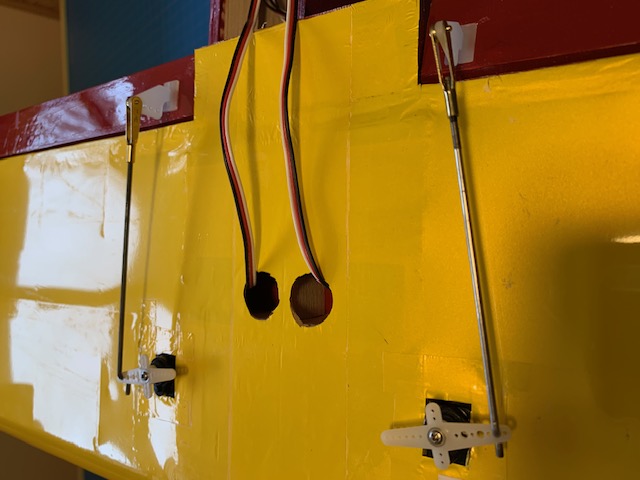
Does each side move up or down independently or are they complementary, ie. if one side goes up the other goes down?
If they are complementary why not use each side of an arm on a single servo?
Thanks: Klipkopwildlife
Please Log in or Create an account to join the conversation.
Time to create page: 0.977 seconds