
- Posts: 9436
- Thank you received: 19043
Printed Ribs
- Quorneng
-
 Topic Author
- Offline
- Forum Master
-

Less
More
01 Feb 2017 18:01 #1
by Quorneng
Printed Ribs was created by Quorneng
With the last of the mods to the printer complete a start can be made on the test wing that uses 3D printed ribs.
The ribs are composite structures. A 3 mm wide by 0.6 mm thick printed rib outline supported by a 3 mm Depron infill.
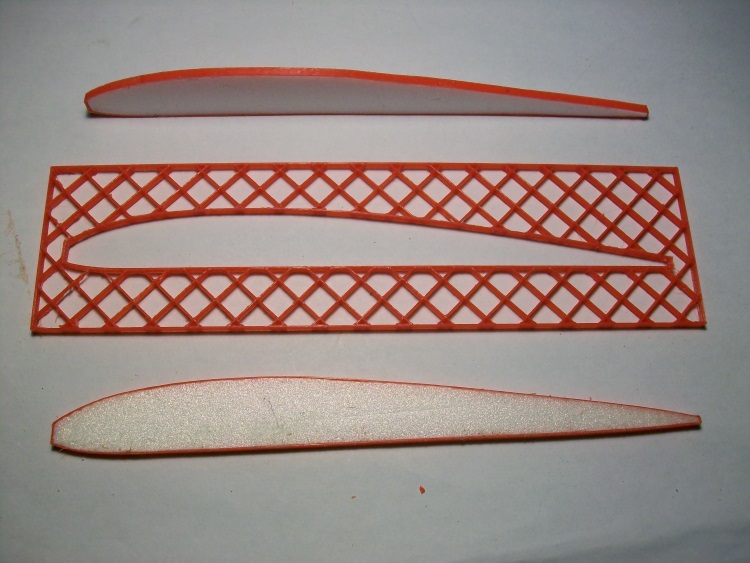
The Depron is cut out using the matching printed jig.
It will be a simple parallel chord wing of 48" span with a balsa/Depron/balsa full depth spar.

Although the spar is a constant depth its balsa flanges taper 3:1 towards the tip with the Depron infill tapering in opposition to compensate.
The ribs will be 'notched' into the balsa leading and trailing edge.
That's about as far as the design goes at the moment!
The ribs are composite structures. A 3 mm wide by 0.6 mm thick printed rib outline supported by a 3 mm Depron infill.
The Depron is cut out using the matching printed jig.
It will be a simple parallel chord wing of 48" span with a balsa/Depron/balsa full depth spar.
Although the spar is a constant depth its balsa flanges taper 3:1 towards the tip with the Depron infill tapering in opposition to compensate.
The ribs will be 'notched' into the balsa leading and trailing edge.
That's about as far as the design goes at the moment!
Thanks: Eric, Klipkopwildlife, THE BLACKBIRD, blue123, boz
Please Log in or Create an account to join the conversation.
- Quorneng
-
Topic Author
- Offline
- Forum Master
-
Less
More
- Posts: 9436
- Thank you received: 19043
02 Feb 2017 12:14 #2
by Quorneng
Replied by Quorneng on topic Printed Ribs
The RH wing panel assembled.
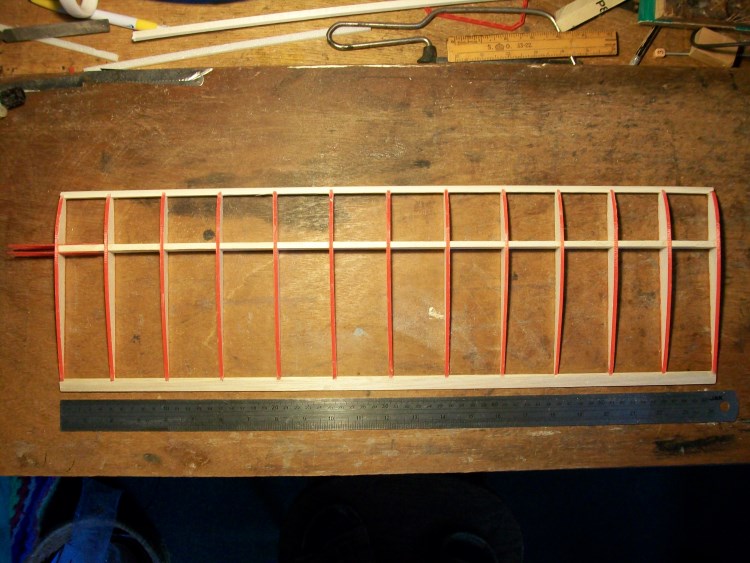
The rins were glued into the notched leading and trailing edges and when firm the spar was fed through the ribs and glued into place.
The 'printed' 1 mm thick dihedral braces.

Although the plastic is adequately strong the braces really should have been made longer to ensure the glue joint was strong as the spar itself. I should have printed them to the maximum size of the printed bed.
I started this really as a 'test' to determine if this form of 'printed rib' was practical but it has gone together surprisingly well so it will actually be made up into a complete wing and flown but it means I shall have to 'back fit' the aileron! :woohoo:
As the other side has not yet been started the necessary changes to the rib design can be incorporated.
I wonder if I can design & print a complete one piece wing tip?
The rins were glued into the notched leading and trailing edges and when firm the spar was fed through the ribs and glued into place.
The 'printed' 1 mm thick dihedral braces.
Although the plastic is adequately strong the braces really should have been made longer to ensure the glue joint was strong as the spar itself. I should have printed them to the maximum size of the printed bed.
I started this really as a 'test' to determine if this form of 'printed rib' was practical but it has gone together surprisingly well so it will actually be made up into a complete wing and flown but it means I shall have to 'back fit' the aileron! :woohoo:
As the other side has not yet been started the necessary changes to the rib design can be incorporated.
I wonder if I can design & print a complete one piece wing tip?
Thanks: Klipkopwildlife, boz
Please Log in or Create an account to join the conversation.
- boz
-

- Offline
- Platinum Member
-

Less
More
- Posts: 1176
- Thank you received: 1420
02 Feb 2017 16:15 #3
by boz
Replied by boz on topic Printed Ribs
Looks good q, was wondering if the top and bottom dihedral braces could be joined at the ends,

Excuse the schoirboy picture, just wondered, I know nothing of building, but as you said you may make them longer next time would a joint here save the length, boz.
Excuse the schoirboy picture, just wondered, I know nothing of building, but as you said you may make them longer next time would a joint here save the length, boz.
Thanks: Klipkopwildlife
Please Log in or Create an account to join the conversation.
- Quorneng
-
Topic Author
- Offline
- Forum Master
-
Less
More
- Posts: 9436
- Thank you received: 19043
02 Feb 2017 17:59 #4
by Quorneng
Replied by Quorneng on topic Printed Ribs
Boz
The likely limit of strength in this sort of brace is how well the forces in the balsa spar flange (tension in the upper, compression in the lower) are carried over to it. My guess is the plastic is itself is plenty strong enough (the cross section of the plastic at the actual wing joint nearly matches that of the balsa) but I am not so confident of the abilities of the balsa to plastic glue joint.
The conventional solution is spread the transfer from one member to another over a distance. With 'like for like' materials, accurate smooth faces and the appropriate glue a joint 10 times longer than the material thickness is just about acceptable.
My spar is 5 mm wide so the 50 mm double sided joint of the existing brace gives a ratio of 20 :1 but then my materials are 'dissimilar' and the glue just foam safe!
I suspect at the limit the glue will fail at the dihedral brace rather than the balsa. :woohoo:
On reflection I should have made the joint length as much as 40:1. i.e. the brace long enough to cover 100 mm of the balsa as this then might have allowed it carry a load limited by the strength of the spar.
Hopefully this is all hypothetical as it will only be used on a 'lightweight' and low powered air frame anyway.
Thanks: Eric, Klipkopwildlife, THE BLACKBIRD, boz
Please Log in or Create an account to join the conversation.
- Eric
-

- Offline
- Moderator
-

Less
More
- Posts: 13726
- Thank you received: 14467
02 Feb 2017 21:46 #5
by Eric
if you are calm and collected when all about you are going berserk - you've missed something important!
Replied by Eric on topic Printed Ribs
No steeply banked turns or tight loops, then! :woohoo: :evil: (There isn't an 'applause' smiley - for when the hands clap! :evil: ).
if you are calm and collected when all about you are going berserk - you've missed something important!
Thanks: boz
Please Log in or Create an account to join the conversation.
- Quorneng
-
Topic Author
- Offline
- Forum Master
-
Less
More
- Posts: 9436
- Thank you received: 19043
02 Feb 2017 23:42 #6
by Quorneng
Replied by Quorneng on topic Printed Ribs
But I will do my 'lift by the wing tip test' to simulate the bending load of pulling a 4 g manoeuvre.
Thanks: boz
Please Log in or Create an account to join the conversation.
- Klipkopwildlife
-

- Offline
- Administrator
-

- I'm supposed to be retired!
03 Feb 2017 08:10 #7
by Klipkopwildlife
Do it now, you may never get another chance
Replied by Klipkopwildlife on topic Printed Ribs
Brilliant thread Simon, I think you've invented a new method of wing building, better patent it quick! Or, better still write a paper on it and publish it, I think that will give your ideas some protection.
Seriously people, all manner of ideas get bounced around on this site and I'm beginning to feel that there's a lot of intellectual property waiting to be stolen.
Seriously people, all manner of ideas get bounced around on this site and I'm beginning to feel that there's a lot of intellectual property waiting to be stolen.
Do it now, you may never get another chance
Please Log in or Create an account to join the conversation.
- Quorneng
-
Topic Author
- Offline
- Forum Master
-
Less
More
- Posts: 9436
- Thank you received: 19043
03 Feb 2017 12:34 #8
by Quorneng
Replied by Quorneng on topic Printed Ribs
Klippy
Thanks but in a former life working with inventors demonstrated that 'value' comes from the process of converting the idea to an industrial process not from the idea itself.
If I have invented a new way of building a wing then anybody is welcome to it.
To create an aileron the first task was to print some new 'truncated' ribs as well as some matching riblets for the ailerons themselves.

With a bit of careful work with a sharp knife the ribs on the already built wing were shortened and a balsa aileron spar inserted. The cut off portion of the trailing edge was reused with the new riblets to create the aileron itself.
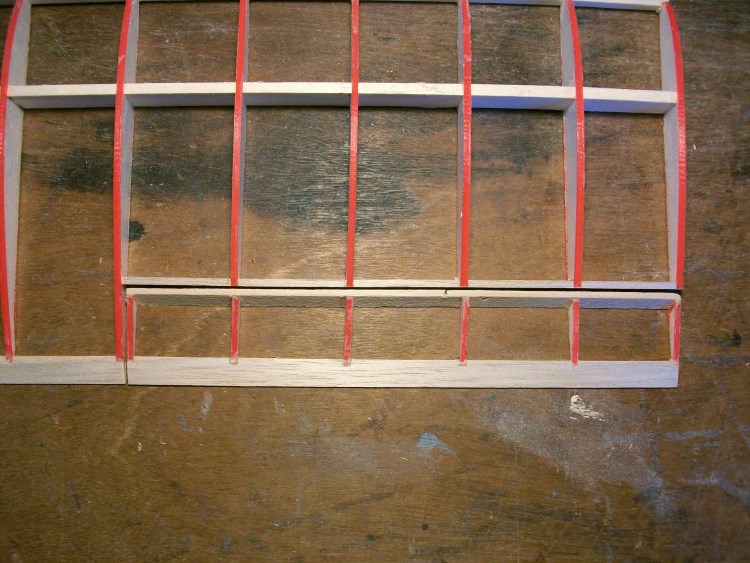
Nothing fancy it will be just top tape hinged.
Now to get the other wing underway.
As it will fit on the bed I would like to print a 'one piece' wing tip but so far I have not found a way to do so in FreeCAD.
Thanks but in a former life working with inventors demonstrated that 'value' comes from the process of converting the idea to an industrial process not from the idea itself.
If I have invented a new way of building a wing then anybody is welcome to it.
To create an aileron the first task was to print some new 'truncated' ribs as well as some matching riblets for the ailerons themselves.
With a bit of careful work with a sharp knife the ribs on the already built wing were shortened and a balsa aileron spar inserted. The cut off portion of the trailing edge was reused with the new riblets to create the aileron itself.
Nothing fancy it will be just top tape hinged.
Now to get the other wing underway.
As it will fit on the bed I would like to print a 'one piece' wing tip but so far I have not found a way to do so in FreeCAD.
Thanks: Klipkopwildlife
Please Log in or Create an account to join the conversation.
- Ex-Member
- User
-

Less
More
- Thank you received: 0
03 Feb 2017 12:51 #9
by Ex-Member
Will that not be a bit heavy, Q, especially in a position where you want minimum weight?
Replied by Ex-Member on topic Printed Ribs
Quorneng wrote: As it will fit on the bed I would like to print a 'one piece' wing tip but so far I have not found a way to do so in FreeCAD.
Will that not be a bit heavy, Q, especially in a position where you want minimum weight?
Please Log in or Create an account to join the conversation.
- Quorneng
-
Topic Author
- Offline
- Forum Master
-
Less
More
- Posts: 9436
- Thank you received: 19043
03 Feb 2017 16:35 #10
by Quorneng
Replied by Quorneng on topic Printed Ribs
Andy
In theory at least it is possible to print shapes with just one pass so it ends up very thin. My nozzle is currently 0.4 mm but smaller are available. This is the sort of process used to make those full printed aeroplanes.
Of course a flat surface done like this is very flexible without significant internal support but a modest wing tip is quite highly curved so should be passably stiff and strong.
Based on the weight of the 30 mm dia spinner I printed (0.8 g) I would expect a modest sized tip should weigh no more than 3 g.
Thanks: Ex-Member, boz
Please Log in or Create an account to join the conversation.
- Quorneng
-
Topic Author
- Offline
- Forum Master
-
Less
More
- Posts: 9436
- Thank you received: 19043
05 Feb 2017 12:19 #11
by Quorneng
Replied by Quorneng on topic Printed Ribs
The bare 48" wing.
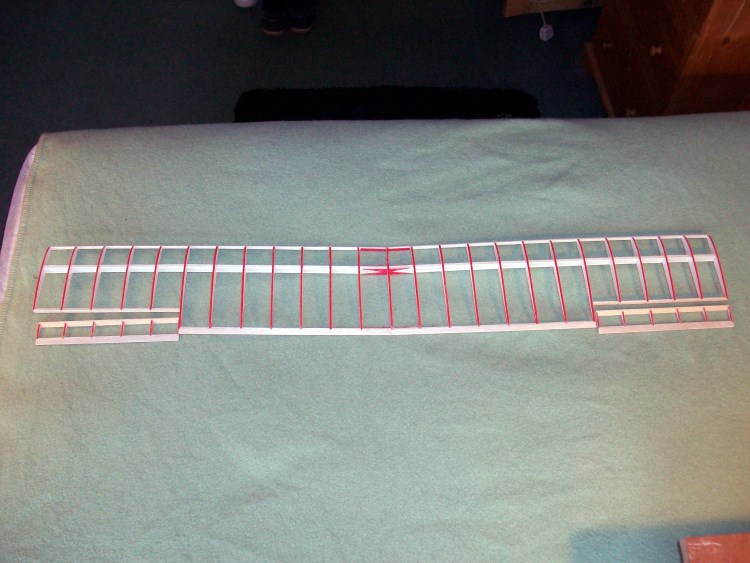
Additional thin printed braces are used to support the leading and trailing edges.
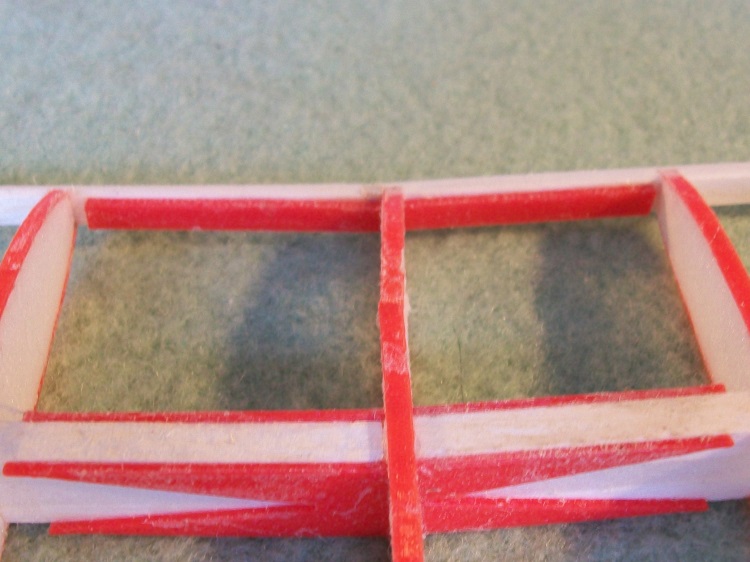
Next are the aileron horns and the supports for the aileron servos.
Additional thin printed braces are used to support the leading and trailing edges.
Next are the aileron horns and the supports for the aileron servos.
Thanks: Klipkopwildlife, blue123, Ex-Member, boz
Please Log in or Create an account to join the conversation.
- Ex-Member
- User
-
Less
More
- Thank you received: 0
05 Feb 2017 20:11 #12
by Ex-Member
Replied by Ex-Member on topic Printed Ribs
A quick question please, Q?
Have you done any comparative strength/bending load tests of the printed medium compared to, say, balsa, plywood, spruce and/or carbon for material of a similar weight and/or thickness?
I'd be very interested in the results.
Have you done any comparative strength/bending load tests of the printed medium compared to, say, balsa, plywood, spruce and/or carbon for material of a similar weight and/or thickness?
I'd be very interested in the results.
Please Log in or Create an account to join the conversation.
- Quorneng
-
Topic Author
- Offline
- Forum Master
-
Less
More
- Posts: 9436
- Thank you received: 19043
05 Feb 2017 21:35 - 05 Feb 2017 21:36 #13
by Quorneng
Replied by Quorneng on topic Printed Ribs
Andy
Compared to balsa! That's a bit like asking how long is a piece of string!
However this site might give you some of the answers.
About the most telling comparison is in the section "PLA compared to wood materials"
PLA comes out pretty poorly against balsa which has something like four times the strength to weight ratio. :woohoo:
The comparison suggests PLA's basic mechanical properties are in the 'hardwood' or 'MDF' class (but not where any temperature is involved!) hence my observations that any plastic that can be printed is not really the right sort of material to make a whole plane but is likely to be effective for creating relatively small complex shapes where ultimate strength to weight is not a critical factor.
I hope this helps.
Last edit: 05 Feb 2017 21:36 by Quorneng.
Thanks: boz
Please Log in or Create an account to join the conversation.
- Quorneng
-
Topic Author
- Offline
- Forum Master
-
Less
More
- Posts: 9436
- Thank you received: 19043
06 Feb 2017 16:44 #14
by Quorneng
Replied by Quorneng on topic Printed Ribs
As this wing will be film or tissue covered (I have not decided which yet) the 'slot' in the skin for the servo arm will need a 'surround'.
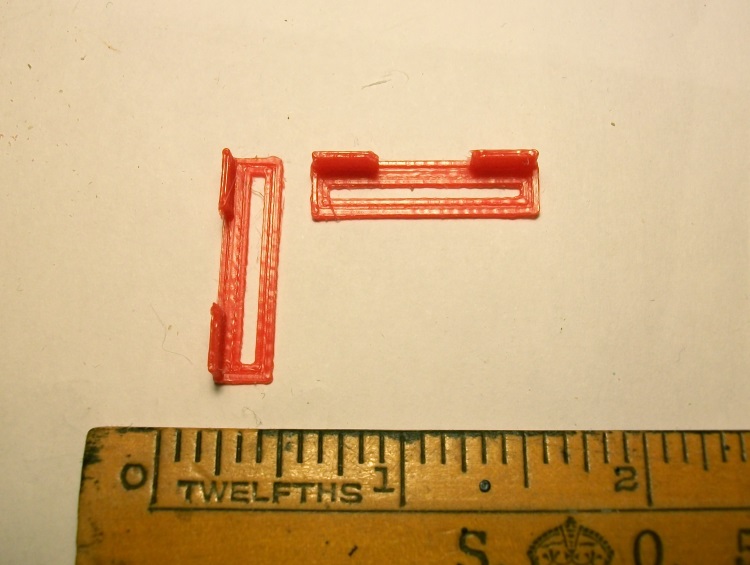
The servo will be mounted so it just 'pokes through' a rib. This bracket will be glued to the rib so that the servo arm protrudes through the slot. Well that's the plan.
Very specific 'one off' small components like this is where 3D printing really excels with a quality that could only be matched by expensive injection moulding. Quick and cheap to make if it does not quite fit right you just change the design to suite and print off some more.
Thanks: Klipkopwildlife, boz
Please Log in or Create an account to join the conversation.
- Ex-Member
- User
-
Less
More
- Thank you received: 0
06 Feb 2017 17:16 #15
by Ex-Member
Thanks for the response Q. My question was really directed towards your decision to use a printed dihedral brace. Given your normal thoroughness, I'd assumed you'd tested the plastic first before you committed it to a critical component.
Replied by Ex-Member on topic Printed Ribs
Quorneng wrote: Andy
Compared to balsa! That's a bit like asking how long is a piece of string!
However this site might give you some of the answers.
About the most telling comparison is in the section "PLA compared to wood materials"
PLA comes out pretty poorly against balsa which has something like four times the strength to weight ratio. :woohoo:
The comparison suggests PLA's basic mechanical properties are in the 'hardwood' or 'MDF' class (but not where any temperature is involved!) hence my observations that any plastic that can be printed is not really the right sort of material to make a whole plane but is likely to be effective for creating relatively small complex shapes where ultimate strength to weight is not a critical factor.
I hope this helps.
Thanks for the response Q. My question was really directed towards your decision to use a printed dihedral brace. Given your normal thoroughness, I'd assumed you'd tested the plastic first before you committed it to a critical component.
Please Log in or Create an account to join the conversation.
Time to create page: 1.054 seconds