
- Posts: 754
- Thank you received: 2067
150 Scale VMC (Veron) rubber-powered Hurricane
- Squirrelnet
- Offline
- Elite Member
-

Less
More
03 Sep 2017 20:35 #76
by Squirrelnet
Replied by Squirrelnet on topic 150 Scale VMC (Veron) rubber-powered Hurricane
I like your observers gun, very nicely done.
On knock off wings, the idea you mention sounds good though neodymium magnets may be needed to give strong bond so it doesn't 'knock off' in normal flight and it will make the wing to fuselage fairing a bit more difficult to achieve. You might possibly get away with a one piece model if the weight is kept low but at 30" you're probably pushing it a bit.
Andy's method does work very well but it does mean a bit of re engineering to make the centre section part of the fuselage and having separate wing panels and with tongue boxes built in to both parts. The wire joiners in tubes help give the required dihedral with a bit of added flex in a hard landing
Thanks: boz, Firewood, Crashrr
Please Log in or Create an account to join the conversation.
- Ex-Member
- User
-

Less
More
- Thank you received: 0
04 Sep 2017 07:46 #77
by Ex-Member
Replied by Ex-Member on topic 150 Scale VMC (Veron) rubber-powered Hurricane
In respect of wing joining Crasher, it might be worth taking a look at a thread I wrote on the subject a few years ago:
www.aeromodellers.co.uk/forum/free-fligh...l?limitstart=0#44348
The tongues are 1/16" balsa, the wires are 1/32" dia going into 1/16" dia ali tube and the studs are 1/4" balsa turned into a circular cross-section (using a razor plane, then spinning them in an electric drill while holding in a fold of sandpaper).
I've recently tried magnets on an RC Lacey, but I've not yet flown it so I can't report or advise on the method.
if I were building a 30" Hurricane, I would use a similar method to that I used on the Gannet and Wildcat - see the above linked thread for the latter. As well as the advantage of separate knock-off panels, the model will pack into a smaller box for transport compared to a one piece wing.
Please Log in or Create an account to join the conversation.
- DHNut
- Offline
- New Member
-

Less
More
- Posts: 17
- Thank you received: 29
04 Sep 2017 12:23 #78
by DHNut
Replied by DHNut on topic 150 Scale VMC (Veron) rubber-powered Hurricane
I have used a single peg on the leading edge with magnets on the trailing edge of a FW190D in 20"and 26" sizes. The smalled modelis in one piece because the wing would part company on an arrival In this case the wing and fuselage are almost the same length so not a transport issue. Also gravity is helping the wing stay put. I got the idea from Lindsey Smith who used it on his FW 190D and his Tempest..
I tried magnets on a Vengence and it did not work as well and in this case the tongue method is the better.
I tried magnets on a Vengence and it did not work as well and in this case the tongue method is the better.
Thanks: boz, Crashrr
Please Log in or Create an account to join the conversation.
- Crashrr
-
 Topic Author
- Offline
- Senior Member
-

Less
More
- Posts: 87
- Thank you received: 284
04 Sep 2017 19:55 #79
by Crashrr
'What the hell' is always the right answer...
Replied by Crashrr on topic 150 Scale VMC (Veron) rubber-powered Hurricane
Thanks for the replies which are providing much food for thought. It seems to me that unless we experiment, we'll never know and, with forums like this, one person's experiments can now be shared and improved by others, which has me leaning towards the magnets... but not yet committed.
I'm going to take my time with this decision. I'll keep pouring the cheap sherry, keep staring at it, and keep hoping that the ghosts of great aircraft designers take pity on me and light my path...
Many thanks
Crashrr
I'm going to take my time with this decision. I'll keep pouring the cheap sherry, keep staring at it, and keep hoping that the ghosts of great aircraft designers take pity on me and light my path...
Many thanks
Crashrr
'What the hell' is always the right answer...
Thanks: boz, Firewood, Mike Rolls, Squirrelnet
Please Log in or Create an account to join the conversation.
- one tenor
-

- Offline
- Forum Veteran
-

- johnpcalex@gmail.com
04 Sep 2017 20:30 #80
by one tenor
Anything will fly given enough power
Replied by one tenor on topic 150 Scale VMC (Veron) rubber-powered Hurricane
Have you thought of box and tongue with a balsa shear pin right through both box and tongue?
Anything will fly given enough power
Thanks: Crashrr
Please Log in or Create an account to join the conversation.
- Squirrelnet
- Offline
- Elite Member
-
Less
More
- Posts: 754
- Thank you received: 2067
04 Sep 2017 20:33 #81
by Squirrelnet
Replied by Squirrelnet on topic 150 Scale VMC (Veron) rubber-powered Hurricane
Good thought John but with Andy's method the tongue itself becomes the shear joint and can be easily replaced. In fact you can get several breaks out of the same tongue by just advancing it slightly into the box...very clever
Thanks: Ex-Member, boz, Crashrr
Please Log in or Create an account to join the conversation.
- one tenor
-
- Offline
- Forum Veteran
-
- johnpcalex@gmail.com
05 Sep 2017 15:18 #82
by one tenor
Anything will fly given enough power
Replied by one tenor on topic 150 Scale VMC (Veron) rubber-powered Hurricane
Of course I missed that Doh!
Anything will fly given enough power
Please Log in or Create an account to join the conversation.
- Crashrr
-
Topic Author
- Offline
- Senior Member
-
Less
More
- Posts: 87
- Thank you received: 284
05 Sep 2017 16:02 #83
by Crashrr
'What the hell' is always the right answer...
Replied by Crashrr on topic 150 Scale VMC (Veron) rubber-powered Hurricane
Well, after quite a lot of the cheap but strong stuff, I've made a decision... I'm going to keep the wings as one piece and use magnets to hold them on to the fuselage. I've chosen this approach because - regarding the keeping of wing surfaces consistent using break-off wings - I'm not sure my building skills are on a par with Andy's. Second, magnets are new, cheap, clean, and (in a plane) unbreakable. So, it seems to me that it's worth experimenting with them, and passing that knowledge on to others to play around with and improve.
I'm thinking:
A registration mechanism (peg or ledge) at the front to centre the wing, then two larger magnets either side on the next former, and one small one in the middle on the trailing edge. (Obviously, these magnets would have doubles set in the fuselage.)
It's all guess work at this stage because I haven't seen a neodymium magnet for years and have no idea of their weight, let alone investigated putting them on a model. So, I'll be more than happy for any advice regarding the size of the magnets. I'm thinking about 5mm wide round ones as the main bearers and perhaps 2mm for the rear...
'What the hell' is always the right answer...
Thanks: Klipkopwildlife, boz, Firewood
Please Log in or Create an account to join the conversation.
- Ralpharr2001
-

- Offline
- Elite Member
-
Less
More
- Posts: 496
- Thank you received: 1484
05 Sep 2017 16:09 #84
by Ralpharr2001
I'm currently unsupervised. I know it freaks me out as well, but the possibilities are endless!!
Replied by Ralpharr2001 on topic 150 Scale VMC (Veron) rubber-powered Hurricane
If you have an old brushless motor break out the magnets from the outer can and experiment with those. They are not round but rectangular. I use them all the time to secure canopies on and its a cheap source of strong magnets especially when you use two, one one each surface at each securing point. Just make sure you set them to attract and not repel!!! :ohmy: :blush: :woohoo:
I'm currently unsupervised. I know it freaks me out as well, but the possibilities are endless!!
Thanks: Ex-Member, boz, Crashrr
Please Log in or Create an account to join the conversation.
- Mike Rolls
-

- Offline
- Elite Member
-
Less
More
- Posts: 634
- Thank you received: 573
05 Sep 2017 16:14 #85
by Mike Rolls
The older I get, the better I was!
Replied by Mike Rolls on topic 150 Scale VMC (Veron) rubber-powered Hurricane
And that the adhesion of the magnets to their mounting surfaces is stronger than the attraction between the magnets!
Mike
Mike
The older I get, the better I was!
Thanks: Ex-Member, boz, Firewood, Crashrr
Please Log in or Create an account to join the conversation.
- Crashrr
-
Topic Author
- Offline
- Senior Member
-
Less
More
- Posts: 87
- Thank you received: 284
09 Sep 2017 11:08 #86
by Crashrr
'What the hell' is always the right answer...
Replied by Crashrr on topic 150 Scale VMC (Veron) rubber-powered Hurricane
Well, I bought some 5mmx1mm magnets and they appear to have done the job a treat. I love 'em. They were a bugger to set correctly, but I got there in the end. (They are so small and fiddly that it's hard setting them into a mount after the mount has been glued into the model. I found it far easier to set a magnet into a balsa mount first, glue that into the fuselage, then set another magnet into another mount, when dry let it connect with its opposing magnet in the fuselage, finally, trim and glue it into its place in the wing. That way, you know the magnets are correctly lined up.)
And boy are they sensitive. I can now attach the wings to the fuselage merely by gently waving the fuselage over the wing, and it will magically rise to meet the fuselage and set itself into exactly the correct position - no need for any registration pegs!
I hope this works as well in flight (and landing) as it appears to be working now.
I'm wondering whether I should use them to hold on the tailplane...?

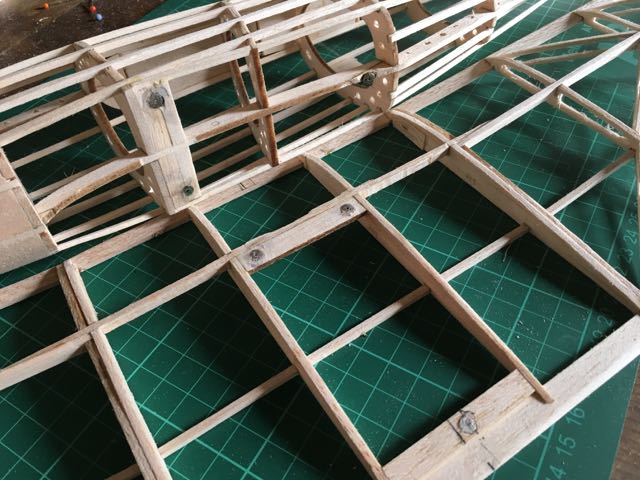
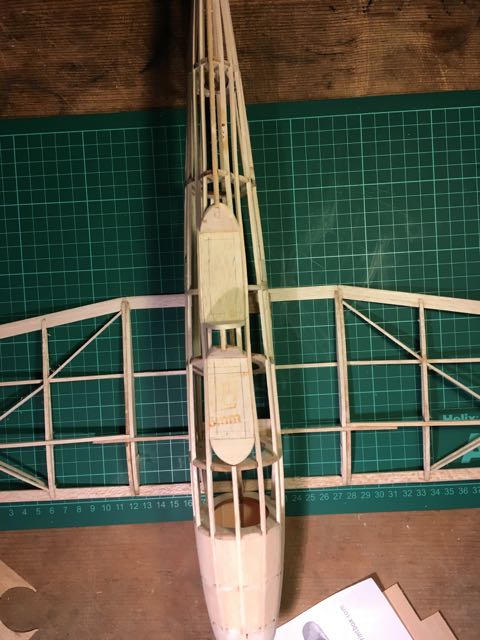
I've ditched the retractable undercarriage, it was causing far too many headaches to get right. Instead I've finally made seme depron halves to insert into an undercarriage bay. Gotta say, this is my first time making anything with Depron, and it was a joy! I love the stuff - and only 1/10th the weight of the plastic wheels supplied!
All up weight of the basic balsa skeleton has crept up from a svelte 33g to almost 40g. Oh well, it is a kit, the next one will be lighter yet...
and now to tissueing....
And boy are they sensitive. I can now attach the wings to the fuselage merely by gently waving the fuselage over the wing, and it will magically rise to meet the fuselage and set itself into exactly the correct position - no need for any registration pegs!
I hope this works as well in flight (and landing) as it appears to be working now.
I'm wondering whether I should use them to hold on the tailplane...?
I've ditched the retractable undercarriage, it was causing far too many headaches to get right. Instead I've finally made seme depron halves to insert into an undercarriage bay. Gotta say, this is my first time making anything with Depron, and it was a joy! I love the stuff - and only 1/10th the weight of the plastic wheels supplied!
All up weight of the basic balsa skeleton has crept up from a svelte 33g to almost 40g. Oh well, it is a kit, the next one will be lighter yet...
and now to tissueing....
'What the hell' is always the right answer...
Thanks: Klipkopwildlife, THE BLACKBIRD, Ex-Member, boz, Firewood
Please Log in or Create an account to join the conversation.
- THE BLACKBIRD
-

- Offline
- Forum Master
-

Less
More
- Posts: 6368
- Thank you received: 10844
09 Sep 2017 12:53 #87
by THE BLACKBIRD
Replied by THE BLACKBIRD on topic 150 Scale VMC (Veron) rubber-powered Hurricane
Iv got 40 sheets of the bloody stuff ( depron ) under my bench taking room up, I will throw it soon !!!
Thanks: Crashrr
Please Log in or Create an account to join the conversation.
- one tenor
-
- Offline
- Forum Veteran
-
- johnpcalex@gmail.com
09 Sep 2017 15:26 #88
by one tenor
Anything will fly given enough power
Replied by one tenor on topic 150 Scale VMC (Veron) rubber-powered Hurricane
What a pity you are so far away BB I would have taken it off your hands.
Anything will fly given enough power
Please Log in or Create an account to join the conversation.
- Crashrr
-
Topic Author
- Offline
- Senior Member
-
Less
More
- Posts: 87
- Thank you received: 284
13 Sep 2017 19:23 - 13 Sep 2017 19:27 #89
by Crashrr
'What the hell' is always the right answer...
Replied by Crashrr on topic 150 Scale VMC (Veron) rubber-powered Hurricane
Well, while we're on the subject of Depron... I've used it to make the wing fillets, of which I'm reasonably pleased with the outcome.
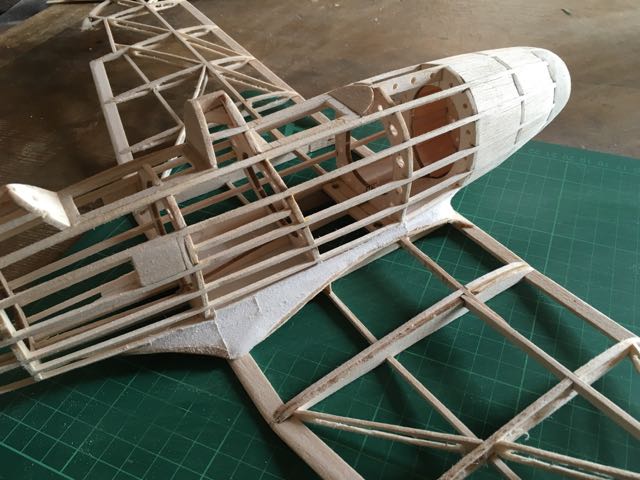
However, this has brought up two more questions...
1. The UHU Por is more resilient to sanding than the depron and leaves a raised tell-tale line. I've tried picking this out, but that can cause more damage to my work than leaving it. so just wondering if there are any clever techniques for minimizing its presence.
2. Should I seal or prep the depron with anything before I cover it with tissue? I'm also wondering if I should 'harden' the thin edges of the fillet before I cover it? (The balsa under the mid-section of the fillet is glued to the upper surface of the wing, and is not part of the actual fillet - aft of the wing the balsa is part of the fillet.)
All thoughts most gratefully received.
Crashrr
'What the hell' is always the right answer...
Last edit: 13 Sep 2017 19:27 by Crashrr.
Thanks: Ex-Member, boz, Firewood
Please Log in or Create an account to join the conversation.
- Quorneng
-

- Offline
- Forum Master
-
Less
More
- Posts: 9436
- Thank you received: 19043
13 Sep 2017 20:13 #90
by Quorneng
Replied by Quorneng on topic 150 Scale VMC (Veron) rubber-powered Hurricane
Crashrr
You have discovered the weakness of Depron and UHU POR - it is hard to sand a glued joint smooth!
On 'block fill' sections I use a very thin film of POR as the strength of the joint is not critical and leave it for at least 24 hours. Use brand new quite coarse (60 grit) oxide paper with a fast action but very light pressure then 'fill' the rough Depron surface with lightweight filler. When dry it can be sanded really smooth with finer paper.
As my planes are all Depron sheet covered I paint the Depron directly which also seals and hardens the surface. Sanding between coats further smooths out any visible joints but to my mind aiming for a super gloss finish tends to.work against the weight benefit of using Depron in the first place.
Thanks: boz, Crashrr
Please Log in or Create an account to join the conversation.
Time to create page: 1.159 seconds