
3D printed props
- Klipkopwildlife
-

- Offline
- Administrator
-

- I'm supposed to be retired!
Do it now, you may never get another chance
Please Log in or Create an account to join the conversation.
- Quorneng
-

- Offline
- Forum Master
-

- Posts: 9436
- Thank you received: 19043
No exponential. It uses my 'steam' 35 meg Futaba so no gizmos.
With a high wing, heavy low battery & adequate dihedral it has quite a bit of natural lateral stability. Throw in modest size ailerons but with end plates to improve their effectiveness at big deflections (aerodynamic expo?) along with the 'floating' characteristics of its Clark Y section mean it is very forgiving in the right conditions.
Talking of "aerodynamic expo" I found this picture of a B29 rudder interesting.

Clearly hinged some way back from the rudder leading edge to give the substantial aerodynamic balance required as the B29 had only manual controls but why the pointed leading edge?
The idea was there would be little aerodynamic counter balance for slight rudder deflections but once the pointed leading edge passed the width of the fin and became exposed to the slip stream the balance effects would become effective.
This picture suggest the rudder tab was for trim only and not a servo tab.
Please Log in or Create an account to join the conversation.
- Klipkopwildlife
-
- Offline
- Administrator
-
- I'm supposed to be retired!
Do it now, you may never get another chance
Please Log in or Create an account to join the conversation.
- Quorneng
-
- Offline
- Forum Master
-
- Posts: 9436
- Thank you received: 19043
A 3 minute edited video (full flight was 9 minutes) of it doing what it does best.
Sound still gets out of sync as the video progresses !
I really couldn't detect any loss of performance. It would take a max endurance flight to determine how much if any less efficient the printed prop was at converting Watts into thrust.
Please Log in or Create an account to join the conversation.
- jon.in.swansea
-
 Topic Author
- Offline
- Elite Member
-

- Posts: 766
- Thank you received: 1192
Although the scale of the beastie was 200mm diameter and using a supposedly fixed speed tied-into-a-plug AC motor is not in keeping with RC work the guy's determination against multiple failures is, I think rather Aeromodeller's in style. I wish I knew how he managed to show animations of equations being written out.
He wanted to find out what the theoretical vs actual performance and set of a rig and gathered lots of equations and then played them off against each other. There were any number of iterations as he tried to figure out why the numbers and observations were not as expected.
His idea about how to decide how much twist to put in the blade to compensate for the relative speed near the hub and tip - could it be that simple? And what areas to use and what possible measurements to take that can fit back into the equations. He even stumbles into figuring out how many Newtons with the limited types of observations. Another funny was that his 'tachometer' was initially picking up the flicker in the overhead flourescent lights rather than the mark on the blades. I ended up watching the hole thing it was so entertaining. -Jon
The link is:
Please Log in or Create an account to join the conversation.
- Eric
-

- Offline
- Moderator
-

- Posts: 13726
- Thank you received: 14467
At first glance that doesn't make sense, because it is all one piece - but when you consider how far the tip travels in one rev, compared with how far the hub does - - -

if you are calm and collected when all about you are going berserk - you've missed something important!
Please Log in or Create an account to join the conversation.
- Quorneng
-
- Offline
- Forum Master
-
- Posts: 9436
- Thank you received: 19043
The clever bit would then to see if it s possible to actually improve on the performance a particular fan. If the same improvement works on other fan designs then you are really onto something.
What you tend to discover is that there are so many humans in the world someone will have done it already.

Please Log in or Create an account to join the conversation.
- jon.in.swansea
-
Topic Author
- Offline
- Elite Member
-
- Posts: 766
- Thank you received: 1192
A virtual resize should do the trick. One would think that the STL file printed so it must be a proper closed body and syntactically correct. Import it into FreeCAD and walk through the steps of converting the mesh to a solid and a) you could retire before the process completes, b) it says it can't make a solid because it is 'not manifold'. Argh. Ok, let's try Blender as a CAD tool, import it and do a boolean operation with a suitable primitive shape and then export it (see image). Try and pull it into the printer slicer and it may or may not like it. It may preview fine but then print it with no shaft at all. Argh again.

Hours pass. Various tangents explored. And then I happen to notice on the Prusa Slicer an option to create a 'negative body'. What is that?
Well it turns out one can do a boolean operation in the slicer by defining a primitive shape, scaling it to the correct length and radius and thus match just about any prop size and shaft size without the tangental journey into the world of crazy meshes.

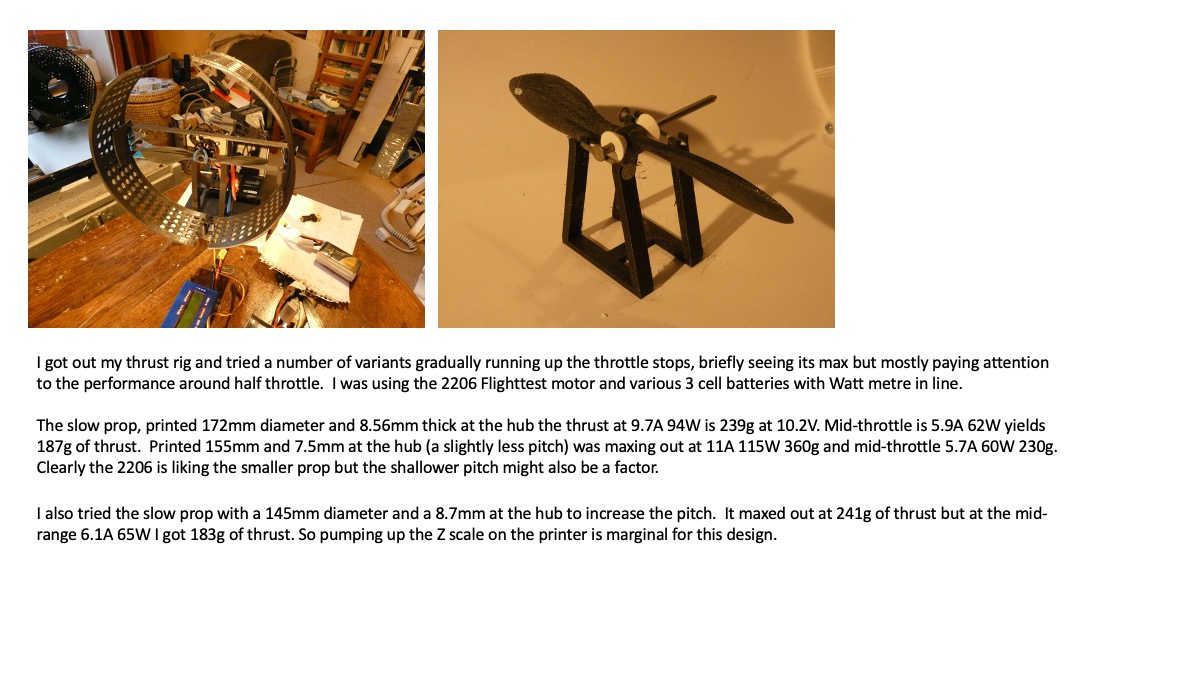
I have also been busy looking at tweaking various props for different pitches to get better mid-revs performance (some props work well only at very high revs and I don't want to go there). I am using my thrust test rig with that nice safety ring to prove the variants I am working with. As my best working 'slow' prop design is a bit heavy and I am checking out other variants that are lighter (and faster to print).

I have come across one STL intended for a drone which I thought would be a joke but scaled up and with that negative-volume shaft trick is turning out rather impressive thrust at mid-stick throttle. -Jon
Please Log in or Create an account to join the conversation.
- jon.in.swansea
-
Topic Author
- Offline
- Elite Member
-
- Posts: 766
- Thank you received: 1192
My usual go-to 'slow 8x4.5' is slow to print, takes ages to sand and is a bit heavy. Time for compitition... what I thought of as a joke prop from a drone (it has a curve at the tip) shifts a lot of air at moderate revs and is quieter. A 9x6 which was deceptively simple and light weight also did quite well although the trailing edge was paper-thin and hard to finish. Another 8x4.5 was light but the trailing edge was easily damaged and in smaller sizes shifted little air.
The story line comes as a sequence of images from PPT (easier to create montages of words and images) and a PDF (in case that gives a better view). So 4 different props, some background, observations of the printing/balancing and then what were the thrust vs Amps vs Watts I measured.
I did try some variants of pitch by altering the Z % in the slicer. Often a bit less pitch yielded a bit more flow. Sometimes squeezing the Z made for very thin prints which would be easy to damage and were certainly a challenge to loosen printing supports from or to sand for balancing.
It was an interesting exploration. Learned a lot. And the safety shield caught a couple of tips that decided to go their own way. So many thrust rigs I see are open to the world and folks eyes!
Some props would seem only to work well at high revs and so are out of bounds for 3D prints in my opinion - if I see poor response at mid-throttle I tend to stop the test.
I have the Prusa *.3mf files (which include the supports and the negative volumes if anyone is interested).



All of those pages within a PDF... no that did not work.
Here are the STL files I drew from...
Please log in or register to see it.
Please log in or register to see it.
Please log in or register to see it.
Please Log in or Create an account to join the conversation.
- jon.in.swansea
-
Topic Author
- Offline
- Elite Member
-
- Posts: 766
- Thank you received: 1192
Please log in or register to see it.
Please Log in or Create an account to join the conversation.
- Klipkopwildlife
-
- Offline
- Administrator
-
- I'm supposed to be retired!
Do it now, you may never get another chance
Please Log in or Create an account to join the conversation.
- Eric
-
- Offline
- Moderator
-
- Posts: 13726
- Thank you received: 14467
well, it would! The pitch describes how far the prop would move (disregarding slippage, etc) through a substance in one revolution, usully measured in inches, (unless it's a metric prop) - so a x4.5 would move 4.5 inches forwards, while a x8 would move 8 inches per rev.
Then, of course a 14 x would move a larger AREA of air than a 7 x!
So - the revs per minute plus diameter plus pitch describe how much air a prop can shift.
-
Of course, you knew that! [badass]
if you are calm and collected when all about you are going berserk - you've missed something important!
Please Log in or Create an account to join the conversation.
- jon.in.swansea
-
Topic Author
- Offline
- Elite Member
-
- Posts: 766
- Thank you received: 1192
Please Log in or Create an account to join the conversation.
- jon.in.swansea
-
Topic Author
- Offline
- Elite Member
-
- Posts: 766
- Thank you received: 1192
The ability to scale what was initially a 9" prop brings up all kinds of issues. Trailing edges getting to be super thin, the connection from the blade to the hub concentrating stresses. Trade-offs from printing a much thicker shell to cope with those stresses and then having more weight.
I suspect that the 2206 was under powered for the larger/higher pitch props. Dropping down size and/or pitch shifted it to a range it was better suite for. The glitch in the test method was changing more than one attribute at a time. I should know better than that.
A better regime would explore pitch changes for a constant diameter and would swap motors as well.
Anyone have an idea why the drone prop with the complex tip was doing so well?
Please Log in or Create an account to join the conversation.
- Quorneng
-
- Offline
- Forum Master
-
- Posts: 9436
- Thank you received: 19043
However to get the full picture of a props performance you would also have to include the velocity of the airstream it is running in. A coarser pitch may not generate the static thrust but would give a better figure at speed. This introduces another variable parameter so it quickly becomes a wind tunnel job to gain a valid comparison.
Without accurate telemetry an RC plane's "performance in the air" is subjective to the pilot so prop selection tends to be of the 'suck it and see' variety rather than by measurement.
Please Log in or Create an account to join the conversation.