
- Posts: 10058
- Thank you received: 19043
English Electric Canberra - in Depron of course
- Quorneng
-
 Topic Author
- Offline
- Forum Master
-

Less
More
07 Dec 2014 00:48 #31
by Quorneng
Replied by Quorneng on topic English Electric Canberra - in Depron of course
Next is to build an outer wing panel both to work out the best? way to actually make it and to structurally fix it to the nacelle.
The lower skin of the D box.

AS I go I am cutting pairs of everything so ready for the other side.
The lower skin of the D box.
AS I go I am cutting pairs of everything so ready for the other side.
Thanks: Klipkopwildlife, blue123, old fart
Please Log in or Create an account to join the conversation.
- Quorneng
-
Topic Author
- Offline
- Forum Master
-
Less
More
- Posts: 10058
- Thank you received: 19043
08 Dec 2014 00:58 #32
by Quorneng
Replied by Quorneng on topic English Electric Canberra - in Depron of course
The completed "D" box is rigid enough to allow the rest of the wing structure to be built from it 'in the hand'.

A rather unusual way of doing it and rather fiddly. It does require quite a bit of 'eye ball' to keep thing straight and true but it seems to work ok.
It weighs 6.6g.
A rather unusual way of doing it and rather fiddly. It does require quite a bit of 'eye ball' to keep thing straight and true but it seems to work ok.
It weighs 6.6g.
Thanks: Klipkopwildlife, THE BLACKBIRD, blue123, old fart
Please Log in or Create an account to join the conversation.
- Quorneng
-
Topic Author
- Offline
- Forum Master
-
Less
More
- Posts: 10058
- Thank you received: 19043
09 Dec 2014 17:02 - 09 Dec 2014 17:09 #33
by Quorneng
Replied by Quorneng on topic English Electric Canberra - in Depron of course
After finishing the outer wing panel the next task is to glue it to the nacelle so I can get some idea how rigid and strong it will be given that it just Depron with no reinforcing at all.

A bit of a b***** to fit as the nacelle on the Canberra is canted up slightly compared to the wing datum still even before the glue has fully hardened and just holding the nacelle the joint was able to support a 2oz weight sitting on the wing tip.
Next comes the wing centre section. A bit more complicated to make as the dihedral break is on the fuselage centre line suggesting the wing centre section would have to be made in two halves and joined.
I have not decided yet exactly how to do it.
The other outer wing panel is under way.
A bit of a b***** to fit as the nacelle on the Canberra is canted up slightly compared to the wing datum still even before the glue has fully hardened and just holding the nacelle the joint was able to support a 2oz weight sitting on the wing tip.
Next comes the wing centre section. A bit more complicated to make as the dihedral break is on the fuselage centre line suggesting the wing centre section would have to be made in two halves and joined.
I have not decided yet exactly how to do it.
The other outer wing panel is under way.
Last edit: 09 Dec 2014 17:09 by Quorneng.
Thanks: Klipkopwildlife, THE BLACKBIRD, blue123, old fart
Please Log in or Create an account to join the conversation.
- Quorneng
-
Topic Author
- Offline
- Forum Master
-
Less
More
- Posts: 10058
- Thank you received: 19043
10 Dec 2014 16:01 #34
by Quorneng
Replied by Quorneng on topic English Electric Canberra - in Depron of course
This is where the build starts to get a bit boring doing the same sort of fiddly operations for the rest of the wing structure.
All the bits I have made so far.

Construction does speed up a bit as it is mostly copying what I did before but nevertheless the Depron construction rate is nearly 1 hour per gramme!
It is just as well it is very light.
All the bits I have made so far.
Construction does speed up a bit as it is mostly copying what I did before but nevertheless the Depron construction rate is nearly 1 hour per gramme!
It is just as well it is very light.
Thanks: Klipkopwildlife, blue123, old fart
Please Log in or Create an account to join the conversation.
- Garry Pollard
- Visitor
-

10 Dec 2014 18:20 #35
by Garry Pollard
Replied by Garry Pollard on topic English Electric Canberra - in Depron of course
Sorry Q, must wholeheartedly disagree with the first line of your post. The day that any of your builds get boring I will eat my lappy.
Keep them going mate please, and I am sure I speak for the rest of the members .
Garry
Keep them going mate please, and I am sure I speak for the rest of the members .
Garry
Please Log in or Create an account to join the conversation.
- Quorneng
-
Topic Author
- Offline
- Forum Master
-
Less
More
- Posts: 10058
- Thank you received: 19043
10 Dec 2014 20:52 #36
by Quorneng
Replied by Quorneng on topic English Electric Canberra - in Depron of course
Gary thank you for that but ...er.. I was referring to my feelings. You can't see my boredom in the pictures! 
You can't see my boredom in the pictures!
Thanks: Garry Pollard
Please Log in or Create an account to join the conversation.
- Ex-Member
- Visitor
-
10 Dec 2014 21:11 #37
by Ex-Member
Replied by Ex-Member on topic English Electric Canberra - in Depron of course
it's fascinating watching you work so delicately with depron.
i struggle to not break the huge heavy lumps i use.
i struggle to not break the huge heavy lumps i use.
Please Log in or Create an account to join the conversation.
- Quorneng
-
Topic Author
- Offline
- Forum Master
-
Less
More
- Posts: 10058
- Thank you received: 19043
11 Dec 2014 22:31 #38
by Quorneng
Replied by Quorneng on topic English Electric Canberra - in Depron of course
The nacelle is now fixed to the wing centre section and a modest start made on the fuselage centre section.

The replacement EDF has arrived so I no longer have an excuse not to start the other nacelle!
The replacement EDF has arrived so I no longer have an excuse not to start the other nacelle!
Thanks: Klipkopwildlife, Ex-Member, THE BLACKBIRD, blue123, old fart
Please Log in or Create an account to join the conversation.
- Modelflyer99
-

- Offline
- Senior Member
-

Less
More
- Posts: 84
- Thank you received: 200
12 Dec 2014 06:19 #39
by Modelflyer99
Replied by Modelflyer99 on topic English Electric Canberra - in Depron of course
Great build, really enjoying it!
Andy
Andy
Please Log in or Create an account to join the conversation.
- Quorneng
-
Topic Author
- Offline
- Forum Master
-
Less
More
- Posts: 10058
- Thank you received: 19043
13 Dec 2014 12:06 - 13 Dec 2014 12:06 #40
by Quorneng
Replied by Quorneng on topic English Electric Canberra - in Depron of course
Os!

A start on the second nacelle
The first bit of the fuselage skinned.

My usual ring formers and planking.
It make you realise how small the Canberra fuselage was, just twice the diameter of the engine nacelle.
This is about as far as this bit can go. The rear fuselage and tail feathers are next.
A start on the second nacelle
The first bit of the fuselage skinned.
My usual ring formers and planking.
It make you realise how small the Canberra fuselage was, just twice the diameter of the engine nacelle.
This is about as far as this bit can go. The rear fuselage and tail feathers are next.
Last edit: 13 Dec 2014 12:06 by Quorneng.
Thanks: Klipkopwildlife, Ex-Member, THE BLACKBIRD, blue123, old fart
Please Log in or Create an account to join the conversation.
- Quorneng
-
Topic Author
- Offline
- Forum Master
-
Less
More
- Posts: 10058
- Thank you received: 19043
14 Dec 2014 23:47 - 14 Dec 2014 23:50 #41
by Quorneng
Replied by Quorneng on topic English Electric Canberra - in Depron of course
The rear fuselage half formers on the plan.

The formers are glued onto temporary top and bottom keels and then planked.

Lifted from the plan showing the temporary keel pieces.

With the keels removed the other half of the formers can be added.
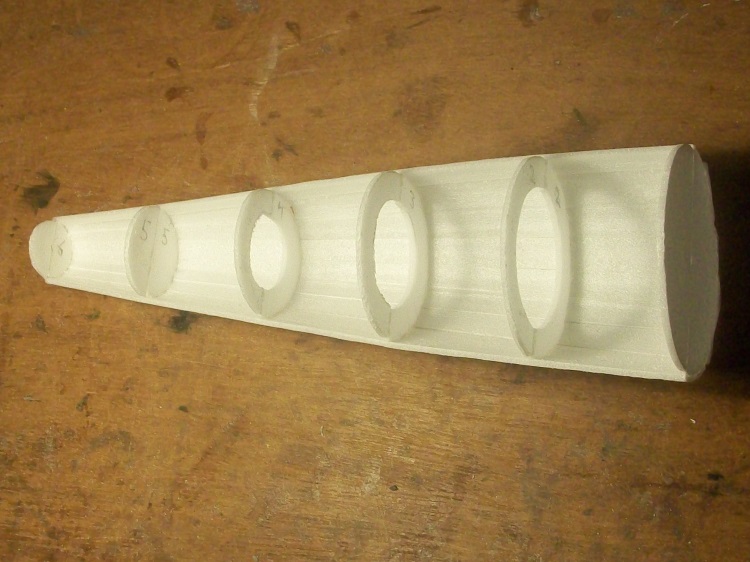
The most difficult bit will be squeezing the elevator servo into the fuselage in such a way that it can move both aileron halves on the distinctly dihedral tailplane.
The second nacelle formers glued onto the paper thrust tube on its mandrel.

Now that has to be planked as well.
The formers are glued onto temporary top and bottom keels and then planked.
Lifted from the plan showing the temporary keel pieces.
With the keels removed the other half of the formers can be added.
The most difficult bit will be squeezing the elevator servo into the fuselage in such a way that it can move both aileron halves on the distinctly dihedral tailplane.
The second nacelle formers glued onto the paper thrust tube on its mandrel.
Now that has to be planked as well.
Last edit: 14 Dec 2014 23:50 by Quorneng.
Thanks: Klipkopwildlife, Ex-Member, THE BLACKBIRD, blue123, old fart
Please Log in or Create an account to join the conversation.
- Ex-Member
- Visitor
-
15 Dec 2014 06:40 #42
by Ex-Member
Replied by Ex-Member on topic English Electric Canberra - in Depron of course
wow such delicate work.
i often marvel at how you manage to build so carefully, my hands would destroy that in 5 mins flat.
i often marvel at how you manage to build so carefully, my hands would destroy that in 5 mins flat.
Please Log in or Create an account to join the conversation.
- Quorneng
-
Topic Author
- Offline
- Forum Master
-
Less
More
- Posts: 10058
- Thank you received: 19043
16 Dec 2014 19:50 #43
by Quorneng
Replied by Quorneng on topic English Electric Canberra - in Depron of course
The fuselage tail section complete.

The top section cut out to seat the 3mm Depron tailplane.

The 2.5g servo just fits in the fuselage.
The skin section refitted.

The servo horn just protrudes through the top of the fuselage so Individual links can go back to each elevator half although the RH link will have to pass through the base of the fin.
I think it will work!
The top section cut out to seat the 3mm Depron tailplane.
The 2.5g servo just fits in the fuselage.
The skin section refitted.
The servo horn just protrudes through the top of the fuselage so Individual links can go back to each elevator half although the RH link will have to pass through the base of the fin.
I think it will work!
Thanks: Klipkopwildlife, Ex-Member, THE BLACKBIRD, blue123, old fart
Please Log in or Create an account to join the conversation.
- Ex-Member
- Visitor
-
16 Dec 2014 20:07 #44
by Ex-Member
Replied by Ex-Member on topic English Electric Canberra - in Depron of course
it will work, i have faith in your building skills.
Please Log in or Create an account to join the conversation.
- Quorneng
-
Topic Author
- Offline
- Forum Master
-
Less
More
- Posts: 10058
- Thank you received: 19043
17 Dec 2014 17:23 #45
by Quorneng
Replied by Quorneng on topic English Electric Canberra - in Depron of course
For structural and space reasons the servos on the Canberra will end up several inches away from the control surface they move which tends to make the push rod link relatively heavy.
I say relatively because the servo only weighs 2.5 g. I really don't want the horn and push rod to end up weighing as much.
So I built a 'test' 5" (130 mm) push rod reverting to good old hard wood (1x2 mm) with an acetate clevis and horn connected with a pin (literally!) joint .
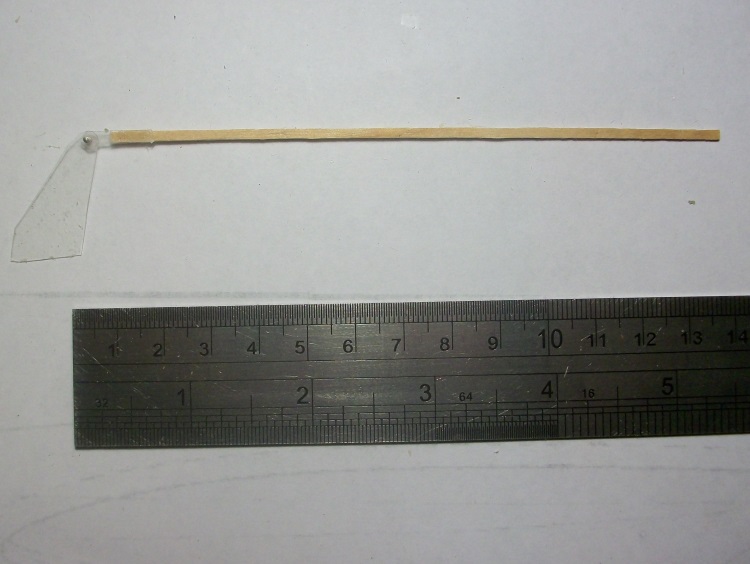
It weighs 0.38 g.
The same principle applied to the 'divided' push rod for the elevator servo.

I fear this might be taking 'light weight' to the extreme and I may yet regret it!
I say relatively because the servo only weighs 2.5 g. I really don't want the horn and push rod to end up weighing as much.
So I built a 'test' 5" (130 mm) push rod reverting to good old hard wood (1x2 mm) with an acetate clevis and horn connected with a pin (literally!) joint .
It weighs 0.38 g.
The same principle applied to the 'divided' push rod for the elevator servo.
I fear this might be taking 'light weight' to the extreme and I may yet regret it!
Thanks: Klipkopwildlife, THE BLACKBIRD, old fart
Please Log in or Create an account to join the conversation.
Time to create page: 0.574 seconds