
- Posts: 15406
- Thank you received: 14306
Tomcat
- Eric
-

- Offline
- Moderator
-

Less
More
09 Mar 2020 07:40 #61
by Eric
if you are calm and collected when all about you are going berserk - you've missed something important!
Replied by Eric on topic Tomcat
Correcting myself now I'm awake - : Pratt & Whitney R-985 Wasp Junior
if you are calm and collected when all about you are going berserk - you've missed something important!
Please Log in or Create an account to join the conversation.
- crash happy
-
 Topic Author
- Offline
- Platinum Member
-

- Oops. did I say that out loud!
Less
More
- Posts: 1250
- Thank you received: 1203
09 Mar 2020 09:06 #62
by crash happy
Replied by crash happy on topic Tomcat
Iconic aircraft. Dehavilland bet the farm on it being successful at a time when that was contrary to opinion. Brave decision, but it paid off in spades !
Please Log in or Create an account to join the conversation.
- crash happy
-
Topic Author
- Offline
- Platinum Member
-
- Oops. did I say that out loud!
Less
More
- Posts: 1250
- Thank you received: 1203
11 Mar 2020 18:25 #63
by crash happy
Replied by crash happy on topic Tomcat
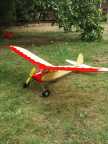
I had no inkling when I came up with the bright idea of building a set of floats how complicated it is ! It has taken me all day to get the geometry right & tested what little patience I possess to the limit.  I got there in the end though!

 I have increased the size of the tail fin & rudder & added a small strake underneath for good measure. Lot's of sanding on the horizon for tomorrow !

I got there in the end though!
Thanks: Klipkopwildlife, Quorneng, THE BLACKBIRD
Please Log in or Create an account to join the conversation.
- paul d
-
- Offline
- Forum Veteran
-

Less
More
- Posts: 2074
- Thank you received: 2292
11 Mar 2020 18:47 #64
by paul d
Thanks: crash happy
Please Log in or Create an account to join the conversation.
- Eric
-
- Offline
- Moderator
-
Less
More
- Posts: 15406
- Thank you received: 14306
11 Mar 2020 20:18 #65
by Eric
if you are calm and collected when all about you are going berserk - you've missed something important!
Replied by Eric on topic Tomcat
You need boat shaped pointy-fronts on those floats, or it will trip over at the first ripple!
if you are calm and collected when all about you are going berserk - you've missed something important!
Please Log in or Create an account to join the conversation.
- Klipkopwildlife
-

- Offline
- Administrator
-

- I'm supposed to be retired!
12 Mar 2020 09:56 #66
by Klipkopwildlife
Do it now, you may never get another chance
Replied by Klipkopwildlife on topic Tomcat
A lot will depend on the CoG, a bit behind the centre of buoyancy would be nice!
Do it now, you may never get another chance
Thanks: crash happy
Please Log in or Create an account to join the conversation.
- Quorneng
-

- Offline
- Forum Master
-

Less
More
- Posts: 10058
- Thank you received: 19043
12 Mar 2020 14:57 - 12 Mar 2020 14:59 #67
by Quorneng
Replied by Quorneng on topic Tomcat
Difficult to be tell from the picture but I wonder if the float step is a bit far back on the Tomcat.
The conventional wisdom is CofG needs to be not far in front of the step so it is easy to 'rotate' to leave the water. Similarly on landing it is important to be able to keep the nose of the floats up until it stops planing and the float becomes a boat.
A side view of a DH Beaver on floats.

It is reasonable to assume the CofG is on or close to where the wing strut joins the wing.
Note the float step is not that far behind the CofG.
How does this location compare to your Tomcat?
I suspect on a model with plenty of power the take off is not the problem apart from keeping straight but landing is a different matter.
It is worth noting that the initial motor torque will tend to depress the LH float and raise the RH one. Water drag is directly proportional to displacement unlike a wheel where rolling resistance is much less sensitive to the load carried.
The conventional wisdom is CofG needs to be not far in front of the step so it is easy to 'rotate' to leave the water. Similarly on landing it is important to be able to keep the nose of the floats up until it stops planing and the float becomes a boat.
A side view of a DH Beaver on floats.
It is reasonable to assume the CofG is on or close to where the wing strut joins the wing.
Note the float step is not that far behind the CofG.
How does this location compare to your Tomcat?
I suspect on a model with plenty of power the take off is not the problem apart from keeping straight but landing is a different matter.
It is worth noting that the initial motor torque will tend to depress the LH float and raise the RH one. Water drag is directly proportional to displacement unlike a wheel where rolling resistance is much less sensitive to the load carried.
Last edit: 12 Mar 2020 14:59 by Quorneng.
Thanks: Klipkopwildlife, crash happy
Please Log in or Create an account to join the conversation.
- crash happy
-
Topic Author
- Offline
- Platinum Member
-
- Oops. did I say that out loud!
Less
More
- Posts: 1250
- Thank you received: 1203
12 Mar 2020 18:24 #68
by crash happy
Replied by crash happy on topic Tomcat
I think it's the angle of the photo giving a false impression Q. The step is 1/2" behind the CG, according to the plan. It will be interesting to see how she floats, that is if I ever get them finished. The lacquer is taking forever to dry due to the weather ! I couldn't start sanding today so I started on the water rudders. After a lot of umming & arhing I've decided to stick a 9 gram servo in one float to drive them. I am trying to make them as easy to swap out for wheels as possible, as it stands there are only five screws & its done. If I stick a Y lead permanently on the rudder servo, one end can just sit inside the redundant battery box in the bottom to be connected when the floats are on. I should be able to run the wiring through one of the struts. Well that's the plan anyway.
I have also been swatting up on the flying side. The general consensus seems to be; Nearly full up elevator & advance the throttle "smoothly" to full, once planing ease off on the elevator a bit until she lifts off, simple ! Landing, well I will worry about that when I get to it, It's coming down one way or another !
I couldn't start sanding today so I started on the water rudders. After a lot of umming & arhing I've decided to stick a 9 gram servo in one float to drive them. I am trying to make them as easy to swap out for wheels as possible, as it stands there are only five screws & its done. If I stick a Y lead permanently on the rudder servo, one end can just sit inside the redundant battery box in the bottom to be connected when the floats are on. I should be able to run the wiring through one of the struts. Well that's the plan anyway.I have also been swatting up on the flying side. The general consensus seems to be; Nearly full up elevator & advance the throttle "smoothly" to full, once planing ease off on the elevator a bit until she lifts off, simple !
Landing, well I will worry about that when I get to it, It's coming down one way or another !
Thanks: THE BLACKBIRD
Please Log in or Create an account to join the conversation.
- Flytilbroke
-

- Offline
- Platinum Member
-
- Not Tired, long retired "Bob"
Less
More
- Posts: 1981
- Thank you received: 1978
13 Mar 2020 11:49 #69
by Flytilbroke
Have a nice Day, unless I don't like you.
Replied by Flytilbroke on topic Tomcat
Yep. It will always land itself if you let it 
Have a nice Day, unless I don't like you.
Thanks: crash happy
Please Log in or Create an account to join the conversation.
- Klipkopwildlife
-
- Offline
- Administrator
-
- I'm supposed to be retired!
13 Mar 2020 12:23 #70
by Klipkopwildlife
Do it now, you may never get another chance
Replied by Klipkopwildlife on topic Tomcat
One thing that can catch you out when landing on water is the lack of turbulence.
Do it now, you may never get another chance
Please Log in or Create an account to join the conversation.
- crash happy
-
Topic Author
- Offline
- Platinum Member
-
- Oops. did I say that out loud!
Less
More
- Posts: 1250
- Thank you received: 1203
13 Mar 2020 14:34 #71
by crash happy
Replied by crash happy on topic Tomcat
Thanks Klippy, iv'e not heard that mentioned before !Klipkopwildlife wrote: One thing that can catch you out when landing on water is the lack of turbulence.
Please Log in or Create an account to join the conversation.
- Klipkopwildlife
-
- Offline
- Administrator
-
- I'm supposed to be retired!
13 Mar 2020 17:26 #72
by Klipkopwildlife
Do it now, you may never get another chance
Replied by Klipkopwildlife on topic Tomcat
What this means is that, once you get into ground effect (water effect), say 2 wing spans up, you can concentrate on, position, attitude and speed. Do not do a 3 point landing, you fly it down to the water, once you touch the water friction does the rest.
Do it now, you may never get another chance
Thanks: crash happy
Please Log in or Create an account to join the conversation.
- Quorneng
-
- Offline
- Forum Master
-
Less
More
- Posts: 10058
- Thank you received: 19043
13 Mar 2020 17:37 #73
by Quorneng
Replied by Quorneng on topic Tomcat
"water friction does the rest" can also be a problem if the landing speed is too high.
Water resistance is proportional to at least the square of the speed. The bottom of the floats touch first and are lower down than a wheel so a 'fast' landing with floats is much more likely to result in a nose over than with wheels. Furthermore unless you have divine powers you can't just walk over to pick it up!
Water resistance is proportional to at least the square of the speed. The bottom of the floats touch first and are lower down than a wheel so a 'fast' landing with floats is much more likely to result in a nose over than with wheels. Furthermore unless you have divine powers you can't just walk over to pick it up!
Thanks: crash happy
Please Log in or Create an account to join the conversation.
- crash happy
-
Topic Author
- Offline
- Platinum Member
-
- Oops. did I say that out loud!
Less
More
- Posts: 1250
- Thank you received: 1203
13 Mar 2020 18:09 #74
by crash happy
 Not something I will be trying with the Tomcat though! Letting it "settle" gently seems the way go. I think I might invest in some waders.
Replied by crash happy on topic Tomcat
That all makes sense. I know that our RIB can go from 35 knots to a standstill in a very short distance if you chop the throttle. As soon as it falls of the plane the bow digs in quite hard. The knack then is to do a hard 90 degree turn to avoid the stern wave catching up & filling the back with water, something that regularly catches out new recruits !Quorneng wrote: "water friction does the rest" can also be a problem if the landing speed is too high.
Water resistance is proportional to at least the square of the speed. The bottom of the floats touch first and are lower down than a wheel so a 'fast' landing with floats is much more likely to result in a nose over than with wheels. Furthermore unless you have divine powers you can't just walk over to pick it up!
Not something I will be trying with the Tomcat though! Letting it "settle" gently seems the way go. I think I might invest in some waders. Please Log in or Create an account to join the conversation.
- Flytilbroke
-
- Offline
- Platinum Member
-
- Not Tired, long retired "Bob"
Less
More
- Posts: 1981
- Thank you received: 1978
14 Mar 2020 09:58 #75
by Flytilbroke
Have a nice Day, unless I don't like you.
Replied by Flytilbroke on topic Tomcat
Sorry to disagree Klippy. Turbulence does not stop... it affects the flying model till the model stops.
Have a nice Day, unless I don't like you.
Please Log in or Create an account to join the conversation.
Time to create page: 0.507 seconds