
- Posts: 15406
- Thank you received: 14305
3D printing Widgets
- Eric
-

- Offline
- Moderator
-

Less
More
18 Apr 2026 07:23 #391
by Eric
if you are calm and collected when all about you are going berserk - you've missed something important!
Replied by Eric on topic 3D printing Widgets
Printing the LE flat, so the strands run along the length - I suppose you were comparing it with a wood LE, where the grain runs along, making it stronger in the bending plane?
if you are calm and collected when all about you are going berserk - you've missed something important!
Thanks: Klipkopwildlife
Please Log in or Create an account to join the conversation.
- Quorneng
-

- Offline
- Forum Master
-

Less
More
- Posts: 10058
- Thank you received: 19043
18 Apr 2026 16:05 #392
by Quorneng
Replied by Quorneng on topic 3D printing Widgets
Yes indeed. Filament laid along the line of the wing.
3D printing is really quite strong in tension along the line of printing, a bit less so in compression but considerable less across the line of printing.
On the other hand LW-PLA is rather better across the lines of printing as the foaming increases the bond between them but as a "foamed" material overall it is not as strong thus a LW-Structure has a more uniform XYZ strength than normal PLA.
The bed limits do restrict the size of any wing component.
I have considered printing wing sections in two parts. A leading edge box spar in PLA with a suitable structer to give good bending and torsional stiffness with the rear of the wing in LW-PLA and simply gluing them together!
3D printing is really quite strong in tension along the line of printing, a bit less so in compression but considerable less across the line of printing.
On the other hand LW-PLA is rather better across the lines of printing as the foaming increases the bond between them but as a "foamed" material overall it is not as strong thus a LW-Structure has a more uniform XYZ strength than normal PLA.
The bed limits do restrict the size of any wing component.
I have considered printing wing sections in two parts. A leading edge box spar in PLA with a suitable structer to give good bending and torsional stiffness with the rear of the wing in LW-PLA and simply gluing them together!
Thanks: Eric, Klipkopwildlife, jon.in.swansea
Please Log in or Create an account to join the conversation.
- jon.in.swansea
-

- Offline
- Elite Member
-

Less
More
- Posts: 757
- Thank you received: 1164
19 Apr 2026 07:01 #393
by jon.in.swansea
Replied by jon.in.swansea on topic 3D printing Widgets
The idea of a hybrid wing of PLA and LWPLA - would be interesting if you made test prints vs other material alternatives for the same shape of wing in terms of strength and twist resistance.... Of course there are lots of print variables that might contribute to or detract from performance so quite a matrix of variants might eat a lot of time...
Thanks: Klipkopwildlife
Please Log in or Create an account to join the conversation.
- Quorneng
-
- Offline
- Forum Master
-
Less
More
- Posts: 10058
- Thank you received: 19043
21 Apr 2026 09:51 #394
by Quorneng
Replied by Quorneng on topic 3D printing Widgets
My hypothesis with a D box wing section is to print the wing spar at the same time as the rest of the box.
This is a sketch of the D box wing showing how the top and bottom spar flanges are incorporated into the Clarke Y section. The complete wing would have a chord of 6" (150mm).

As it is printed in this orientation the surface between the spar flanges is the print "bottom" layer so can be several layers thick to carry the shear loads. All the rest is single wall.
The "ribs" are created by an "infill" function.
A CAD view of the first 10 layers of the print showing the spar flanges.
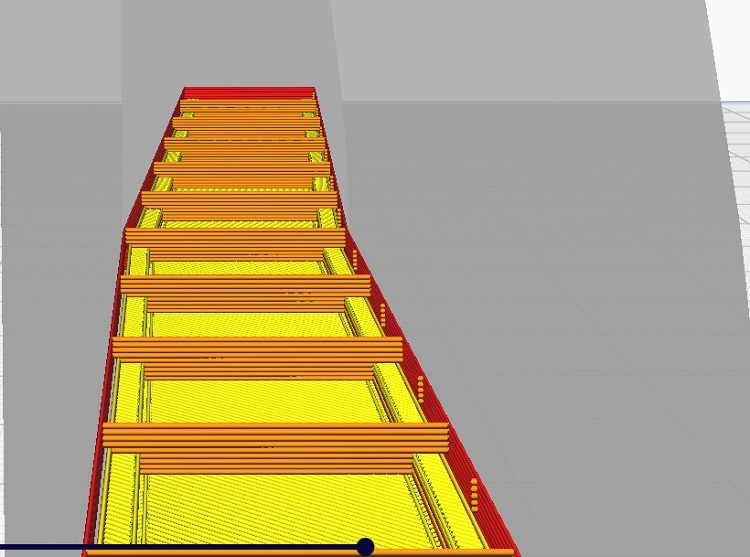
Note the print includes the dihedral!
The 200mm long (the limit of the printer bed) D box complete.

The D Box printed in LW-PLA

As I hoped even in LW-PLA it is remarkably strong and torsionally stiff. It weighs 14.4g.
Still a long way to go but the ultimate intention is to create a fully printed version of this 60" wing.

This is a sketch of the D box wing showing how the top and bottom spar flanges are incorporated into the Clarke Y section. The complete wing would have a chord of 6" (150mm).
As it is printed in this orientation the surface between the spar flanges is the print "bottom" layer so can be several layers thick to carry the shear loads. All the rest is single wall.
The "ribs" are created by an "infill" function.
A CAD view of the first 10 layers of the print showing the spar flanges.
Note the print includes the dihedral!
The 200mm long (the limit of the printer bed) D box complete.
The D Box printed in LW-PLA
As I hoped even in LW-PLA it is remarkably strong and torsionally stiff. It weighs 14.4g.
Still a long way to go but the ultimate intention is to create a fully printed version of this 60" wing.
Attachments:
Thanks: Klipkopwildlife, Flytilbroke, THE BLACKBIRD, jon.in.swansea
Please Log in or Create an account to join the conversation.
- jon.in.swansea
-
- Offline
- Elite Member
-
Less
More
- Posts: 757
- Thank you received: 1164
21 Apr 2026 18:35 #395
by jon.in.swansea
Replied by jon.in.swansea on topic 3D printing Widgets
Nice to see this experiment. Adding in spars is potentially a brilliant idea. I should look back over my older CAD files to see if I have something that I could try it out on 
Thanks: Klipkopwildlife
Please Log in or Create an account to join the conversation.
- Quorneng
-
- Offline
- Forum Master
-
Less
More
- Posts: 10058
- Thank you received: 19043
24 Apr 2026 22:55 - 24 Apr 2026 22:57 #396
by Quorneng
Replied by Quorneng on topic 3D printing Widgets
Doing quite a bit of experimenting to find what is possible using just printing with no reinforcement.
Three structural box sections (dihedral + L & R outer) glued together with a matching dihedral rear wing section.

Each section has a 200mm span and weighs 9g.
The wing uses a Clark Y section.
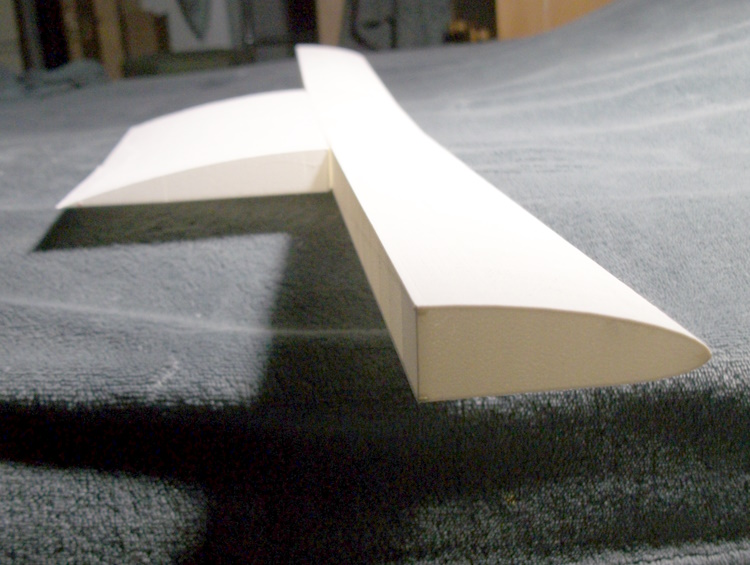
Once the glue is fully hard (it takes a couple of days) it will be possible to do a static test to find out how much load it can take.
The rear section of the wing although twice the area of the leading edge box is of the same weight! It requires very little structural strength so is printed "light" with a lower density as shown in this picture by comparing the amount of light passing through them.
 .
.
Just gluing the sections together is rather suspect as even foamed PLA does not really glue edge to edge well unlike the much more open structure of Depron which actually absorbs glue into the cells giving a joint as strong as the foam itself.
The skin of even foamed PLA is only 0.7mm thick whereas 2mm Depron sheet is 3 time thicker giving more area to an "edge to edge" joint.
This suggests that no matter how complex is the structure of a fully printed wing it will never have the same stiffness for weight as a "reinforced" foam wing.
The next test is to compare the stiffness of two identical wing pieces, one having its strands along the span (as mine is) and the other with the more normal strands across the span.
They would use exactly the same print file but the print orientation is set 90 degrees different.
If the difference is a big as I think it will be then it would pay to design a joint to glue two sections together that results in a joint as strong the printed structure itself.
Three structural box sections (dihedral + L & R outer) glued together with a matching dihedral rear wing section.
Each section has a 200mm span and weighs 9g.
The wing uses a Clark Y section.
Once the glue is fully hard (it takes a couple of days) it will be possible to do a static test to find out how much load it can take.
The rear section of the wing although twice the area of the leading edge box is of the same weight! It requires very little structural strength so is printed "light" with a lower density as shown in this picture by comparing the amount of light passing through them.
Just gluing the sections together is rather suspect as even foamed PLA does not really glue edge to edge well unlike the much more open structure of Depron which actually absorbs glue into the cells giving a joint as strong as the foam itself.
The skin of even foamed PLA is only 0.7mm thick whereas 2mm Depron sheet is 3 time thicker giving more area to an "edge to edge" joint.
This suggests that no matter how complex is the structure of a fully printed wing it will never have the same stiffness for weight as a "reinforced" foam wing.
The next test is to compare the stiffness of two identical wing pieces, one having its strands along the span (as mine is) and the other with the more normal strands across the span.
They would use exactly the same print file but the print orientation is set 90 degrees different.
If the difference is a big as I think it will be then it would pay to design a joint to glue two sections together that results in a joint as strong the printed structure itself.
Attachments:
Last edit: 24 Apr 2026 22:57 by Quorneng.
Thanks: Klipkopwildlife, Flytilbroke, jon.in.swansea
Please Log in or Create an account to join the conversation.
- Quorneng
-
- Offline
- Forum Master
-
Less
More
- Posts: 10058
- Thank you received: 19043
30 Apr 2026 12:56 - 30 Apr 2026 13:01 #397
by Quorneng
Replied by Quorneng on topic 3D printing Widgets
Although an individual printed wing box section may have adequate stiffness properties I was concerned at the effectiveness of simply gluing such sections end to end so I looked into ways to properly transfer the tension and compression forces from one unit to the next using a 'plug and socket' arrangement.
One advantage of printing is that the ends of each box section can be modified to actually become a "good fit" plug and socket and still retain the true wing section. Done like this any glue joint would be only in shear which glue is well able to resist. Well that's the theory!
First was to see how difficult it might be to actually print a plug and sock wing section. As this was only to test the practicality of the printing rather than its strength only short wing sections were printed., however arranging wing shapes to fit as a true close fit inside each other involved rather a lot of print, adjust, repeat!
The final two parts of the "trial" box spar joint.

Pushed together but not glued. They are printed in carbon reinforced PLA!

Certainly a pretty good fit but next is to arrange for the 'plug and socket' to be longer, at least twice the wing's thickness and to arrange that the "built in" spar elements are continued into the plug so the forces can be appropriately transferred to the socket and thus onto the other wing.
The object of the joint is to uniformly transfer all the loads from one wing to the other without creating any stress raising points and at the same time putting any glued joint only in shear.
Now if I had a printer with a 2m wide bed there would be no need for any joints!
One advantage of printing is that the ends of each box section can be modified to actually become a "good fit" plug and socket and still retain the true wing section. Done like this any glue joint would be only in shear which glue is well able to resist. Well that's the theory!
First was to see how difficult it might be to actually print a plug and sock wing section. As this was only to test the practicality of the printing rather than its strength only short wing sections were printed., however arranging wing shapes to fit as a true close fit inside each other involved rather a lot of print, adjust, repeat!
The final two parts of the "trial" box spar joint.
Pushed together but not glued. They are printed in carbon reinforced PLA!
Certainly a pretty good fit but next is to arrange for the 'plug and socket' to be longer, at least twice the wing's thickness and to arrange that the "built in" spar elements are continued into the plug so the forces can be appropriately transferred to the socket and thus onto the other wing.
The object of the joint is to uniformly transfer all the loads from one wing to the other without creating any stress raising points and at the same time putting any glued joint only in shear.
Now if I had a printer with a 2m wide bed there would be no need for any joints!
Attachments:
Last edit: 30 Apr 2026 13:01 by Quorneng.
Thanks: Klipkopwildlife, Flytilbroke, jon.in.swansea
Please Log in or Create an account to join the conversation.
- jon.in.swansea
-
- Offline
- Elite Member
-
Less
More
- Posts: 757
- Thank you received: 1164
02 May 2026 06:47 #398
by jon.in.swansea
Replied by jon.in.swansea on topic 3D printing Widgets
Interesting test. From the photo there would seem to be more than a single layer in the flange so that should carry stresses somewhat beyond the join. What kind of dimensions are we looking at?
Would be interesting to see some images from the 'slicer' and/or on the print bed. I can imagine using slicer settings to alter the number of perimeters and/or infiltration % near the joint.
Would be interesting to see some images from the 'slicer' and/or on the print bed. I can imagine using slicer settings to alter the number of perimeters and/or infiltration % near the joint.
Please Log in or Create an account to join the conversation.
- Quorneng
-
- Offline
- Forum Master
-
Less
More
- Posts: 10058
- Thank you received: 19043
02 May 2026 13:11 #399
by Quorneng
Replied by Quorneng on topic 3D printing Widgets
First I extended the overlap of the plug & socket joint to 10mm to give more glue area.

These CURA views show their construction.
The first layer showing the start of the flanges and the intervening shear web .

The spar complete by layer 8.

The spar actually continues into the plug.
Next the ribs forming, actually "double" infill at 90 degrees.

Note the first rib is accurately positioned at the start of the plug and the double thickness of the socket matches the double thickness of the box.
The complete test piece.

Both sides of the test piece are double wall but the intention is double wall would only apply the wing centre section and with plug ends. The outer sections with a socket end would be single wall to save weight but would still match the reduced bending loads.
As a test I have printed out a dihedral double wall centre section with plugs at each.

This view clearly shows the longitudinal top and bottom multiple spar flanges and the vertical filament layer of the shear web between them.
It is 220mm long and 50 mm wide. It would represent a wing box for a 6" chord wing.
By my standards it is relatively heavy at 30g but it is immensely strong and stiff.
I did some tests and by printing across the diagonal of the bed it would be possible to print 12" long wing sections.
It would take a lot of printing time but as the wing is printed on front and rear parts it means a wing with a chord of 18" is theoretically possible!

I have just invested in a multiple spool arrangement for my printer so in theory it will be possible to print a wing in LW-PLA but the spar in carbon PLA all at the same time!
These CURA views show their construction.
The first layer showing the start of the flanges and the intervening shear web .
The spar complete by layer 8.
The spar actually continues into the plug.
Next the ribs forming, actually "double" infill at 90 degrees.
Note the first rib is accurately positioned at the start of the plug and the double thickness of the socket matches the double thickness of the box.
The complete test piece.
Both sides of the test piece are double wall but the intention is double wall would only apply the wing centre section and with plug ends. The outer sections with a socket end would be single wall to save weight but would still match the reduced bending loads.
As a test I have printed out a dihedral double wall centre section with plugs at each.
This view clearly shows the longitudinal top and bottom multiple spar flanges and the vertical filament layer of the shear web between them.
It is 220mm long and 50 mm wide. It would represent a wing box for a 6" chord wing.
By my standards it is relatively heavy at 30g but it is immensely strong and stiff.
I did some tests and by printing across the diagonal of the bed it would be possible to print 12" long wing sections.
It would take a lot of printing time but as the wing is printed on front and rear parts it means a wing with a chord of 18" is theoretically possible!
I have just invested in a multiple spool arrangement for my printer so in theory it will be possible to print a wing in LW-PLA but the spar in carbon PLA all at the same time!
Attachments:
Thanks: Klipkopwildlife, jon.in.swansea
Please Log in or Create an account to join the conversation.
- jon.in.swansea
-
- Offline
- Elite Member
-
Less
More
- Posts: 757
- Thank you received: 1164
03 May 2026 07:01 #400
by jon.in.swansea
Replied by jon.in.swansea on topic 3D printing Widgets
Thanks for the extra images. They did help me get my grey cells working.
Multi-material printing is something I have not yet gotten into - the ability to cooperatively design a wing to fuse together LW-PLA and something stronger without glues might be a game-changer.
Multi-material printing is something I have not yet gotten into - the ability to cooperatively design a wing to fuse together LW-PLA and something stronger without glues might be a game-changer.
Thanks: Klipkopwildlife, Quorneng, THE BLACKBIRD
Please Log in or Create an account to join the conversation.
- Magpie
-

- Offline
- Elite Member
-
Less
More
- Posts: 587
- Thank you received: 1047
13 May 2026 11:06 #401
by Magpie
Replied by Magpie on topic 3D printing Widgets
I have been having a problem with my Malyan printer over the past two weeks. In the middle of a print it randomly switches itself & my computer off. Nothing else in the house is affected so its not a mains supply dip..
I have been using it since last August running the printer online via a USB connection.
I replaced the power supply unit a week ago & that seemed to have cured it but yesterday it faulted again.
I have contacted Malyan & they have said that they do not recommend using the online USB for extended printing as its not stable enough & say to run it off an SD card, which is a pain in the proverbial.
I also don't see how this should restart my computer.
Has anyone experience of this? Do they run their printers via a USB cable?
I have been using it since last August running the printer online via a USB connection.
I replaced the power supply unit a week ago & that seemed to have cured it but yesterday it faulted again.
I have contacted Malyan & they have said that they do not recommend using the online USB for extended printing as its not stable enough & say to run it off an SD card, which is a pain in the proverbial.
I also don't see how this should restart my computer.
Has anyone experience of this? Do they run their printers via a USB cable?
Thanks: Klipkopwildlife, THE BLACKBIRD
Please Log in or Create an account to join the conversation.
- Eric
-
- Offline
- Moderator
-
Less
More
- Posts: 15406
- Thank you received: 14305
13 May 2026 12:19 #402
by Eric
if you are calm and collected when all about you are going berserk - you've missed something important!
Replied by Eric on topic 3D printing Widgets
This is probably irrelevent, but I do know there are different kinds of usb cable.
It is decided by the twist and weave pattern in the individual wires in the cable, for balanced feeds, or blocking or rejecting external noise.
Have you tried a different cable, or different type of cable?
It is decided by the twist and weave pattern in the individual wires in the cable, for balanced feeds, or blocking or rejecting external noise.
Have you tried a different cable, or different type of cable?
if you are calm and collected when all about you are going berserk - you've missed something important!
Thanks: Klipkopwildlife, THE BLACKBIRD
Please Log in or Create an account to join the conversation.
- Quorneng
-
- Offline
- Forum Master
-
Less
More
- Posts: 10058
- Thank you received: 19043
13 May 2026 14:05 - 13 May 2026 14:08 #403
by Quorneng
Replied by Quorneng on topic 3D printing Widgets
The transfer of data dowm the USB is not continuous just bursts as required by the printer. This does mean there could be periods long enough when the computer is not doing anyhting for it to "time out". It would appear petty random as it would depnd on the nature of the print. The problem then is the printer recognises the loss of signal and also stops. I am sure there are ways to alter or even cancel any computer "time out".
I have to use an SD card to transfer print files due to the locations of the PC and printer but it does mean on a long print the computer can safely go to "sleep mode".
I have to use an SD card to transfer print files due to the locations of the PC and printer but it does mean on a long print the computer can safely go to "sleep mode".
Last edit: 13 May 2026 14:08 by Quorneng.
Thanks: Eric
Please Log in or Create an account to join the conversation.
- Magpie
-
- Offline
- Elite Member
-
Less
More
- Posts: 587
- Thank you received: 1047
13 May 2026 15:00 - 13 May 2026 15:01 #404
by Magpie
Replied by Magpie on topic 3D printing Widgets
I have got my computer set up like New York - it never sleeps unless I tell it to.
They went for 8 months with just 8 hours a night & never complained until the end of April.
It doesn't just happen on one component or material or a particular point.
The big question is why both the printer & the computer switch off - not go to sleep - & then immediately power back up.
They went for 8 months with just 8 hours a night & never complained until the end of April.
It doesn't just happen on one component or material or a particular point.
The big question is why both the printer & the computer switch off - not go to sleep - & then immediately power back up.
Last edit: 13 May 2026 15:01 by Magpie.
Thanks: Eric, Klipkopwildlife, Quorneng
Please Log in or Create an account to join the conversation.
- Magpie
-
- Offline
- Elite Member
-
Less
More
- Posts: 587
- Thank you received: 1047
13 May 2026 16:00 - 13 May 2026 16:02 #405
by Magpie
Replied by Magpie on topic 3D printing Widgets
I've just remembered one occasion when it happened.
I was at the computer & my paper printer also did a restart. It was near the end of its life & had been playing up abit so my immediate reaction was that the printer had thrown a wobbler & caused the fault. I have a new printer now & the fault has still occurred.
But this points to a supply problem not a USB one.
I've now got the Malyan plugged into an extension cable from the other side of the room.
I was at the computer & my paper printer also did a restart. It was near the end of its life & had been playing up abit so my immediate reaction was that the printer had thrown a wobbler & caused the fault. I have a new printer now & the fault has still occurred.
But this points to a supply problem not a USB one.
I've now got the Malyan plugged into an extension cable from the other side of the room.
Last edit: 13 May 2026 16:02 by Magpie.
Thanks: Eric, Quorneng, THE BLACKBIRD, jon.in.swansea
Please Log in or Create an account to join the conversation.
Time to create page: 0.332 seconds