
- Posts: 13726
- Thank you received: 14467
Here's one for the serious builders. Show us your ideas
An EDF Concorde - in Depron.
- Eric
-

- Offline
- Moderator
-

Less
More
18 Dec 2013 16:32 #16
by Eric
if you are calm and collected when all about you are going berserk - you've missed something important!
Replied by Eric on topic An EDF Concorde - in Depron.
3 in 1 isn't a very good long-term lubricant, Simon, it fairly quickly decomposes into a sticky mess again, although it is good at unsticking stuck bearings. A good automotive oil would be better.
if you are calm and collected when all about you are going berserk - you've missed something important!
Please Log in or Create an account to join the conversation.
- Quorneng
-
 Topic Author
- Offline
- Forum Master
-

Less
More
- Posts: 9436
- Thank you received: 19043
19 Dec 2013 00:20 - 23 Dec 2013 21:10 #17
by Quorneng
Replied by Quorneng on topic An EDF Concorde - in Depron.
Eric
I am not sure you are right about 3in1.
I believe it was originally marketed as a sewing machine oil intended to last for long periods. WD40 on the other hand has very poor long term characteristics.
A long chain automotive oil would be fine but I am not sure how well it would penetrate into the sintered bearing material so I judged it would likely need attention before the 'lighter' 3in1. Time will tell.
Last edit: 23 Dec 2013 21:10 by .
Please Log in or Create an account to join the conversation.
- Quorneng
-
Topic Author
- Offline
- Forum Master
-
Less
More
- Posts: 9436
- Thank you received: 19043
19 Dec 2013 13:31 #18
by Quorneng
Replied by Quorneng on topic An EDF Concorde - in Depron.
The second fan fitted to my 'test' nacelle.
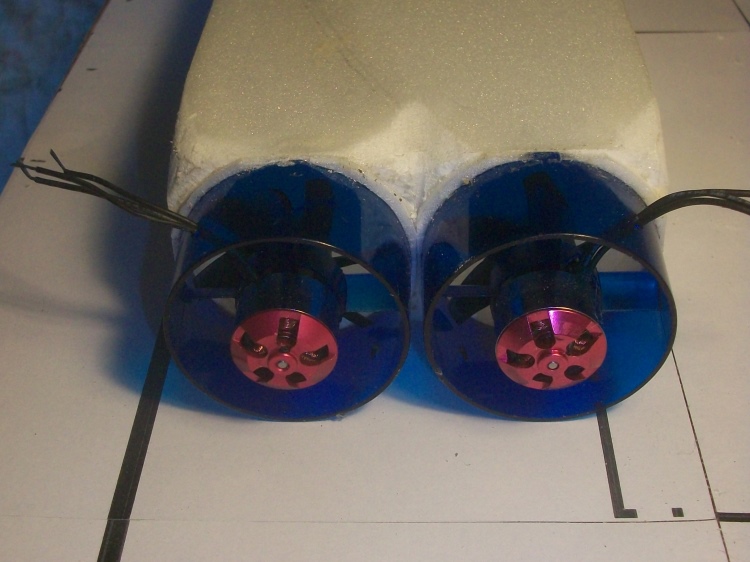
It looks (and sounds) quite impressive.
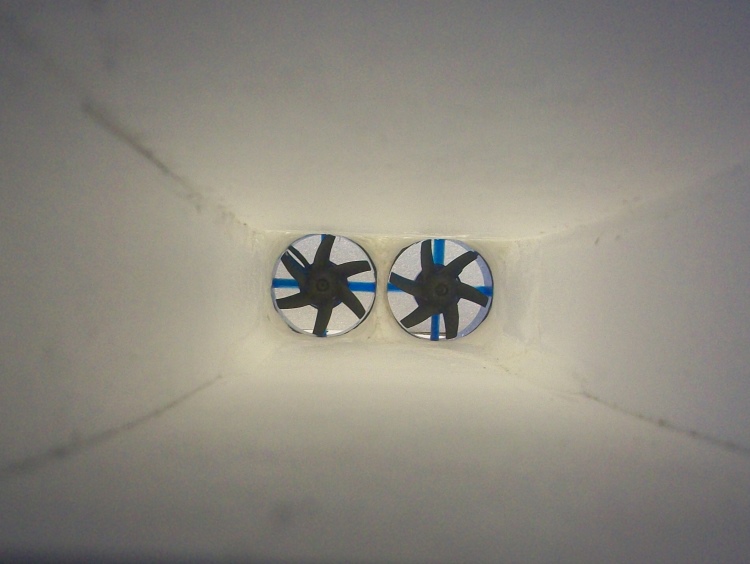
My first test shows it delivers just over 8oz thrust.
The extra weight of the fans, ESCs and a 3000mAh 2s will be about 5oz.
16oz thrust for a flying weight of 23oz sounds a better bet than 8.4 for 18 so it looks like I will have to order the extra bits.
These very high kV motors appear quite reluctant to start every time so the biggest problem I can see will be getting all 4 going at once.
It looks (and sounds) quite impressive.
My first test shows it delivers just over 8oz thrust.
The extra weight of the fans, ESCs and a 3000mAh 2s will be about 5oz.
16oz thrust for a flying weight of 23oz sounds a better bet than 8.4 for 18 so it looks like I will have to order the extra bits.
These very high kV motors appear quite reluctant to start every time so the biggest problem I can see will be getting all 4 going at once.
Thanks: Sarah-Jane Smith
Please Log in or Create an account to join the conversation.
- Quorneng
-
Topic Author
- Offline
- Forum Master
-
Less
More
- Posts: 9436
- Thank you received: 19043
19 Dec 2013 14:21 #19
by Quorneng
Replied by Quorneng on topic An EDF Concorde - in Depron.
They make an interesting sound but surprisingly very little in the way of harmonics to suggest two motors.
I suspect 4 will just be a noise.
I suspect 4 will just be a noise.
Thanks: blue123, Sarah-Jane Smith
Please Log in or Create an account to join the conversation.
- Eric
-
- Offline
- Moderator
-
Less
More
- Posts: 13726
- Thank you received: 14467
19 Dec 2013 15:34 #20
by Eric
if you are calm and collected when all about you are going berserk - you've missed something important!
Replied by Eric on topic An EDF Concorde - in Depron.
I see you have a speedo for each motor, so the only reason I can think of is minor differences in spec and tolerances between the two - motors and speedos.
if you are calm and collected when all about you are going berserk - you've missed something important!
Please Log in or Create an account to join the conversation.
- CeeJayP
-

- Offline
- Elite Member
-

- Hi Peeps
Less
More
- Posts: 386
- Thank you received: 833
19 Dec 2013 16:04 #21
by CeeJayP
Replied by CeeJayP on topic An EDF Concorde - in Depron.
as i understand it brushless motors need a controller each, they dont just supply electrikery at varying amounts to go faster or slower but they Read?? and syncronise the pulses of the motor to make it go, which is what the brushes and armatuer do in a standard motor, and one controller would get confused if it was asked to do two i would think!!
cj
cj
Please Log in or Create an account to join the conversation.
- Klipkopwildlife
-

- Offline
- Administrator
-

- I'm supposed to be retired!
19 Dec 2013 16:42 - 19 Dec 2013 16:42 #22
by Klipkopwildlife
Do it now, you may never get another chance
Replied by Klipkopwildlife on topic An EDF Concorde - in Depron.
You can actually have two motors on one ESC, but occasionally you won't get a clean start! Which could be a bit limiting whilst flying! Of course you can set your throttle to a low idle and then use the throttle cut facility.
Do it now, you may never get another chance
Last edit: 19 Dec 2013 16:42 by Klipkopwildlife.
Please Log in or Create an account to join the conversation.
- Quorneng
-
Topic Author
- Offline
- Forum Master
-
Less
More
- Posts: 9436
- Thank you received: 19043
19 Dec 2013 17:21 - 19 Dec 2013 17:21 #23
by Quorneng
Replied by Quorneng on topic An EDF Concorde - in Depron.
Two brushless on one ESC never worked for me, either one ran or the other but NEVER both.
There are some videos on YouTube of them working but they seem to be with quite big motors which can probably handle the slight variations in commutation better then the smaller ones which just seem to stop.
I was rather expecting the two motors to make a twin sound (like you get with props) but expect there is so much other noise you just can't hear it
Last edit: 19 Dec 2013 17:21 by Quorneng.
Thanks: Klipkopwildlife
Please Log in or Create an account to join the conversation.
- Eric
-
- Offline
- Moderator
-
Less
More
- Posts: 13726
- Thank you received: 14467
19 Dec 2013 18:20 #24
by Eric
if you are calm and collected when all about you are going berserk - you've missed something important!
Replied by Eric on topic An EDF Concorde - in Depron.
Prop resonance is audible because there are only two blades (per motor). Multi-blades don't seem to resonate as much, for some reason, instead they tend to drone, instead of the rerr rerr sound of slight mis-match of revs. Maybe with seven or nine blade fans, the resonance frequency is so high that the chamber doesn't respond, or maybe even damps it out.
if you are calm and collected when all about you are going berserk - you've missed something important!
Please Log in or Create an account to join the conversation.
- Quorneng
-
Topic Author
- Offline
- Forum Master
-
Less
More
- Posts: 9436
- Thank you received: 19043
19 Dec 2013 23:49 - 19 Dec 2013 23:50 #25
by Quorneng
Replied by Quorneng on topic An EDF Concorde - in Depron.
Begun work on the wing.
As I have no idea how to make such a complex shape I am rather making it up as I go along.
First the centre rib.

This will be the only rib in the entire wing and is in 6mm Depron to overlap the joint between the L & R wing skins. The wing had a 3% depth to chord ratio.
On the production Concorde the 'droop' on the inner third of the leading edge was significantly increased to improve the low speed handling.

The wing skins have been cold formed to approximately the right shape to match the 19 wing 'webs'. There are no spars as such.
The first 7 wing webs in place.

When the two halves of the wing are joined the middle section of the fuselage will be built above (and below) it.
The tail section will be built like the nose as two half shells but then permanently fixed to the fuselage centre section so the fin can be added.
At some stage 6 motor wires (and a servo lead) will have to be run through each the wing. :ohmy:
But all of this is a long way in the future!
As I have no idea how to make such a complex shape I am rather making it up as I go along.
First the centre rib.
This will be the only rib in the entire wing and is in 6mm Depron to overlap the joint between the L & R wing skins. The wing had a 3% depth to chord ratio.
On the production Concorde the 'droop' on the inner third of the leading edge was significantly increased to improve the low speed handling.
The wing skins have been cold formed to approximately the right shape to match the 19 wing 'webs'. There are no spars as such.
The first 7 wing webs in place.
When the two halves of the wing are joined the middle section of the fuselage will be built above (and below) it.
The tail section will be built like the nose as two half shells but then permanently fixed to the fuselage centre section so the fin can be added.
At some stage 6 motor wires (and a servo lead) will have to be run through each the wing. :ohmy:
But all of this is a long way in the future!
Last edit: 19 Dec 2013 23:50 by Quorneng.
Thanks: Eric, Klipkopwildlife, Dean M, THE BLACKBIRD, blue123, Sarah-Jane Smith, old fart
Please Log in or Create an account to join the conversation.
- andy watson
- Offline
- New Member
-

Less
More
- Posts: 7
- Thank you received: 4
20 Dec 2013 08:46 #26
by andy watson
Replied by andy watson on topic An EDF Concorde - in Depron.
I've never built in depron- so apologies if this is a stupid question, but how big a wing can you build without a spar? I ask because all my balsa wings have had a spar. I am guessing the box structure of the skin & ribs gives sufficient strength for the depron not to need the spar- but wouldn't the same be true of balsa? If the strength issue is marginal (and I note many depron builds seem very marginal on power/weight once above a certain size) how much weight would a depron spar add to each wing? Would it be worth it for "insurance" or am I just designing in extra useless weight and making a flying brick in my head (again).
Lovely build though- I might have to have a play with depron when I get my new workshop.
Lovely build though- I might have to have a play with depron when I get my new workshop.
Please Log in or Create an account to join the conversation.
- The Beard
-

- Offline
- Forum Master
-
Less
More
- Posts: 6913
- Thank you received: 2167
20 Dec 2013 09:50 #27
by The Beard
Replied by The Beard on topic An EDF Concorde - in Depron.
Good to hear from you Andy how is your Concorde
Please Log in or Create an account to join the conversation.
- CeeJayP
-
- Offline
- Elite Member
-
- Hi Peeps
Less
More
- Posts: 386
- Thank you received: 833
20 Dec 2013 14:04 #28
by CeeJayP
Replied by CeeJayP on topic An EDF Concorde - in Depron.
p'raps they,s the same profile!!!
cj
cj
Thanks: Sarah-Jane Smith
Please Log in or Create an account to join the conversation.
- Quorneng
-
Topic Author
- Offline
- Forum Master
-
Less
More
- Posts: 9436
- Thank you received: 19043
20 Dec 2013 14:52 - 23 Dec 2013 21:15 #29
by Quorneng
Replied by Quorneng on topic An EDF Concorde - in Depron.
Andy
It really comes down to how big is big?
Depron is a form of expanded polystyrene. Polystyrene itself is an 'engineering' plastic which has specific mechanical properties which are not that different to the cellulose that makes up balsa.
The biggest difference is in how their internal structures are arranged.
Depron has a much lower density and a lower strength to weight ratio but it is equal in all directions. Balsa's superior strength is however distinctly directional.
So if you can make use of Depron's lightweight characteristics with a structure keeps the stresses low by increasing the area of the load bearing elements the resultant strength to weight can actually exceed that of balsa.
Depron works particularly well as a monocoque skin in a fuselage that has a reasonable cross section. Its light weight allows a relatively thick skin to be used that will handle both the tensile and compressive forces with a limited internal structure. The result is very light and remarkable stiff however actually making such a thing can be quite involved.
Most wings on the other hand have by their nature a relatively high span to depth ratio so generate higher skin forces that are less well suited to Depron. This limits the maximum span to weight ratio possible without some form of reinforcement.
In most wing designs the bending stresses create forces far higher than the torsional ones so a simple spar can take the major part of the bending loads leaving the Depron to provide the twisting stiffness.
This is the strategy I have used on most of my conventional wings.
A low aspect ratio delta (Concorde) is rather a special case in that it has a lot of skin for its span so can go to greater spans before reinforcement is required.
In general a balsa/Depron mix will be lighter than using just balsa but I am afraid there are no hard and fast rules as it depends entirely on the details of the design.
I hope this helps.
Last edit: 23 Dec 2013 21:15 by .
Thanks: Dean M, Sarah-Jane Smith
Please Log in or Create an account to join the conversation.
- andy watson
- Offline
- New Member
-
Less
More
- Posts: 7
- Thank you received: 4
20 Dec 2013 22:49 - 20 Dec 2013 22:51 #30
by andy watson
Replied by andy watson on topic An EDF Concorde - in Depron.
OK, so if I understand..................
Depron is particularly suited for a model with a very big wing chord compared to its span- such as is found in many jets. It is less suited for a traditional prop driven wing where a spar is needed because the wing is longer and narrower. I had in my head a full depth depron spar, but from what you have said a balsa one (or possibly 2 very small ones with very thin spar webbing) would actually work out better.
Again, from your description, it sounds like as more and more people push the limits of what is possible with depron we are actually likely to see a move towards more composite structures as the limits of depron lead to replacement parts being made of alternative materials. I guess we are probably getting close to carbon fibre tubes as a skeleton with a depron skin- not something I have seen done.
Stephen (I think it is Stephen) I am guessing you mean my Vulcan. Still not flown. Lost all impetus to fly with the closure of the workshop trying to sell the house (don't ask- it's been a nightmare). It doesn't have the power to get off our field- I need to rig up a dolly.
Last edit: 20 Dec 2013 22:51 by andy watson.
Please Log in or Create an account to join the conversation.
Time to create page: 1.363 seconds