
- Posts: 587
- Thank you received: 1048
The Spuggie
- Magpie
-
 Topic Author
- Offline
- Elite Member
-

Less
More
22 Apr 2026 18:06 - 22 Apr 2026 18:08 #1
by Magpie
The Spuggie was created by Magpie
I've started the layouts based on "The Magpie" but as its too dumpy for a magpie I've called it "The Spuggie". I thought about calling it "The Pig"
but I didn't know if it would fly then!
The fuselage is dumpy & the wings are decidedly squat, just like real spuggies, & it doesn't have the long tail of a magpie.
The original fuselage had 3/32nd sheet sides with no internal structure (apart from the formers) with the two halves to each side joined by tape & glued. I wasn't happy with that so I'm doing a conventional balsa frame & covering it with 1/16th sheet. I've ordered some C-grain for the sides to help with rigidity.
Now I've got a laser cutter I can make the formers in 2mm ply, the cross pieces in balsa formers were always prone to snapping & had to be backed up with balsa cross--pieces.
My trainer emailed on monday to say the weather on saturday looks promising so we've arranged a flying day. The other member who did training has had to give it up because of health issues so now the club only has one & he goes off in his caravan for two months in the summer, which is a good part of it up here, so if The Spuggie proves easy to fly it means I can just ask other members to look over my shoulder & keep me right.
Last edit: 22 Apr 2026 18:08 by Magpie.
Thanks: Klipkopwildlife, Flytilbroke, THE BLACKBIRD, jon.in.swansea
Please Log in or Create an account to join the conversation.
- Eric
-

- Offline
- Moderator
-

Less
More
- Posts: 13726
- Thank you received: 14467
22 Apr 2026 19:58 #2
by Eric
if you are calm and collected when all about you are going berserk - you've missed something important!
Replied by Eric on topic The Spuggie
Pigs DO fly! I used to have a slope-soarer called a Slim Pig. It had a fairly short GRP (no carbon in those days) fuselage, and a foam-veneer wing. Once I'd got the c of g and the throws right, it was a nice flyer.
if you are calm and collected when all about you are going berserk - you've missed something important!
Thanks: Klipkopwildlife, Janine
Please Log in or Create an account to join the conversation.
- Magpie
-
Topic Author
- Offline
- Elite Member
-
Less
More
- Posts: 587
- Thank you received: 1048
28 Apr 2026 11:10 #3
by Magpie
Replied by Magpie on topic The Spuggie
After I received the laser cutter & 400mm honeycomb I realised I should have got the 500mm one as you lose 20mm all round because of the frame. I checked the available area this morning & it's just under 360mm square which means I have to limit my parts to 350mm.
The tail on the Spuggie works out at 362.5mm half-span with the resizing for a V-tail so I'm going to have to reduce it to the 350mm which is about 3.5% reduction. I don't think that's significant especially as the V-tail algorithm incorporates a 150% arbitrary enlargement on the fin because more is required with RC than for free-flight.
The wood has just arrived but I'm going to have to resist the temptation to get started & get on with some of my day-jobs. To start with our boiler has thrown a wobbler so I need to clear some space in the garage so the service engineer can get at it.
Thanks: Klipkopwildlife, Flytilbroke, jon.in.swansea
Please Log in or Create an account to join the conversation.
- Magpie
-
Topic Author
- Offline
- Elite Member
-
Less
More
- Posts: 587
- Thank you received: 1048
09 May 2026 17:41 - 09 May 2026 17:43 #4
by Magpie
Replied by Magpie on topic The Spuggie
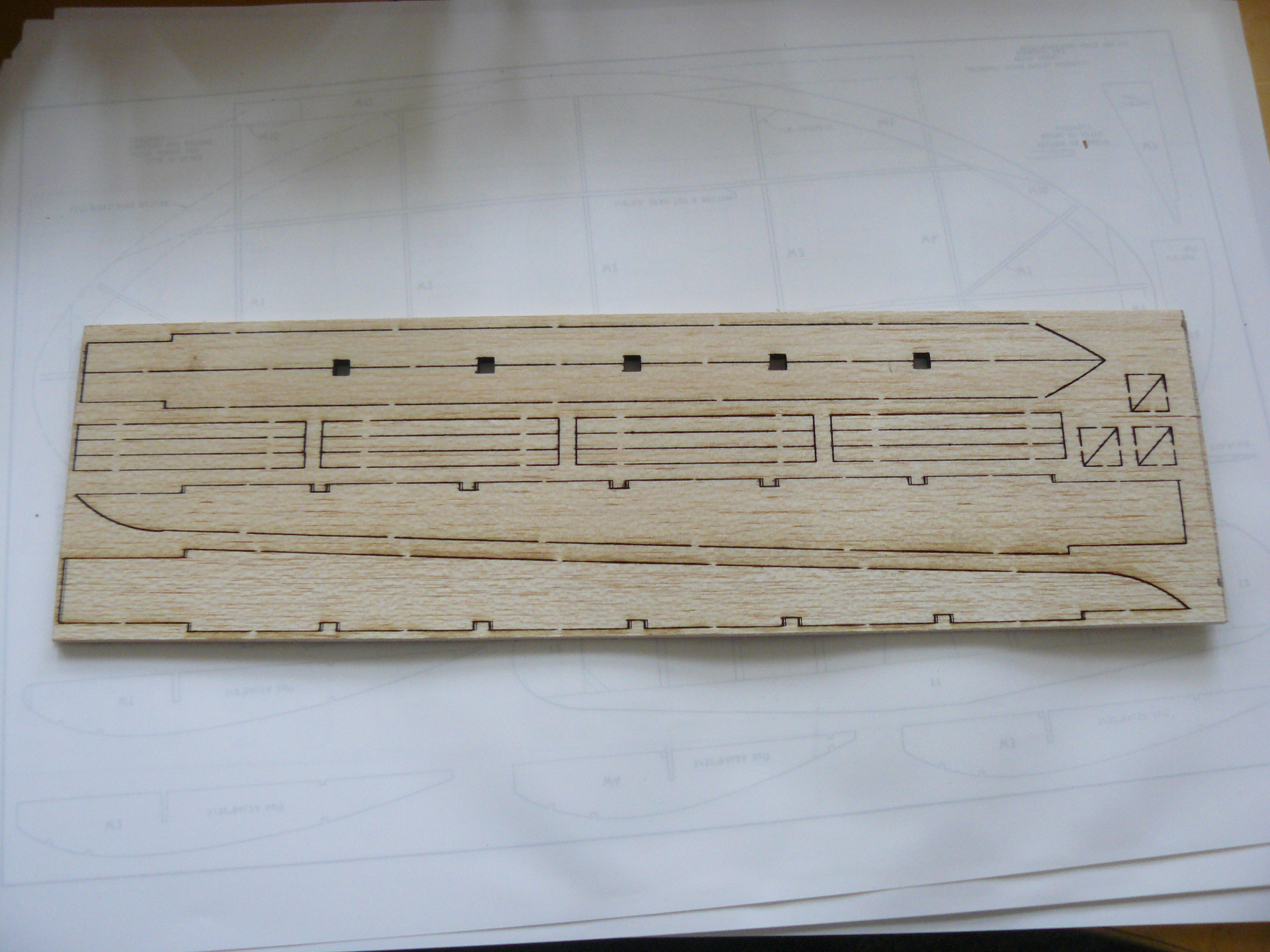
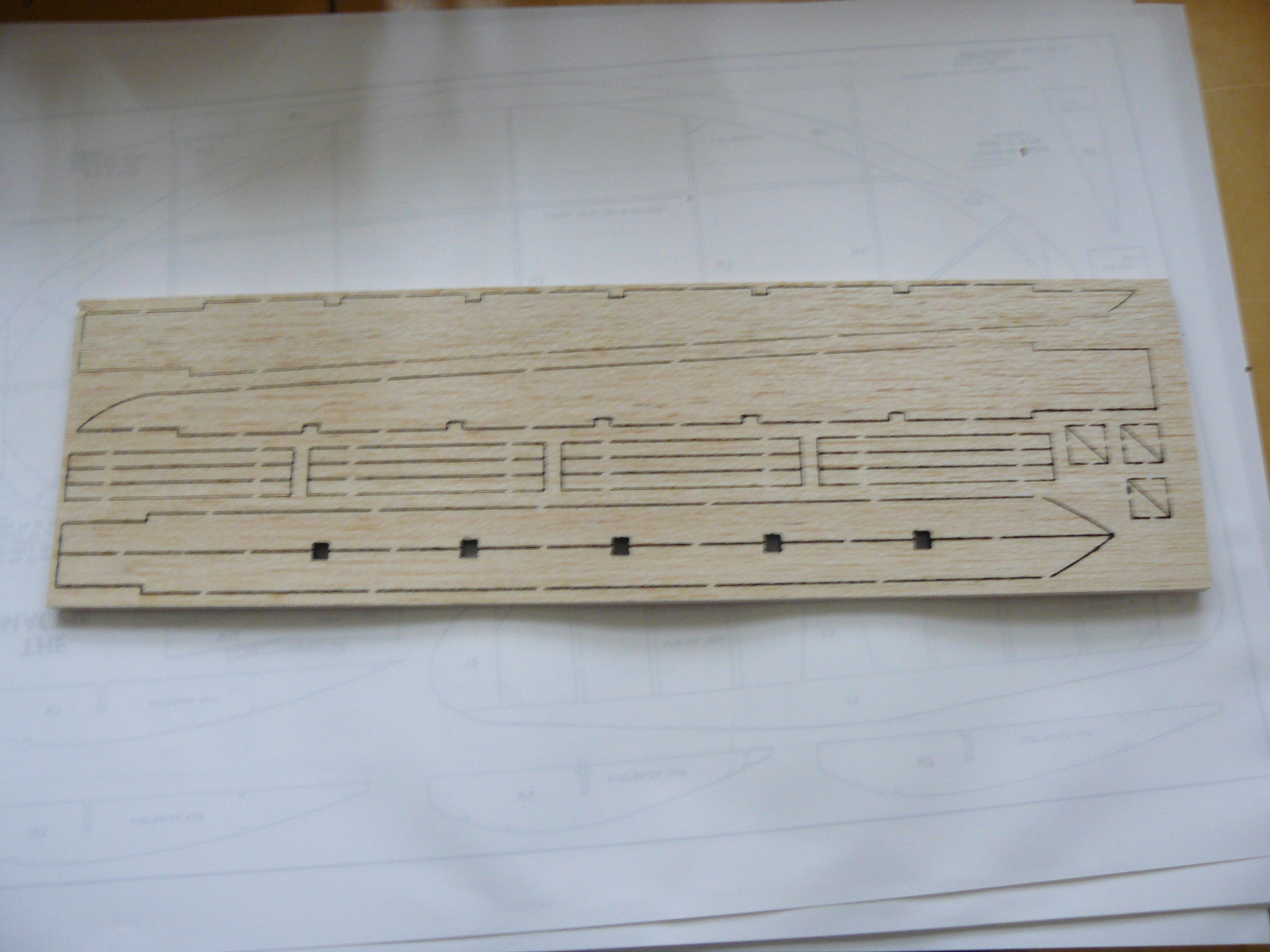
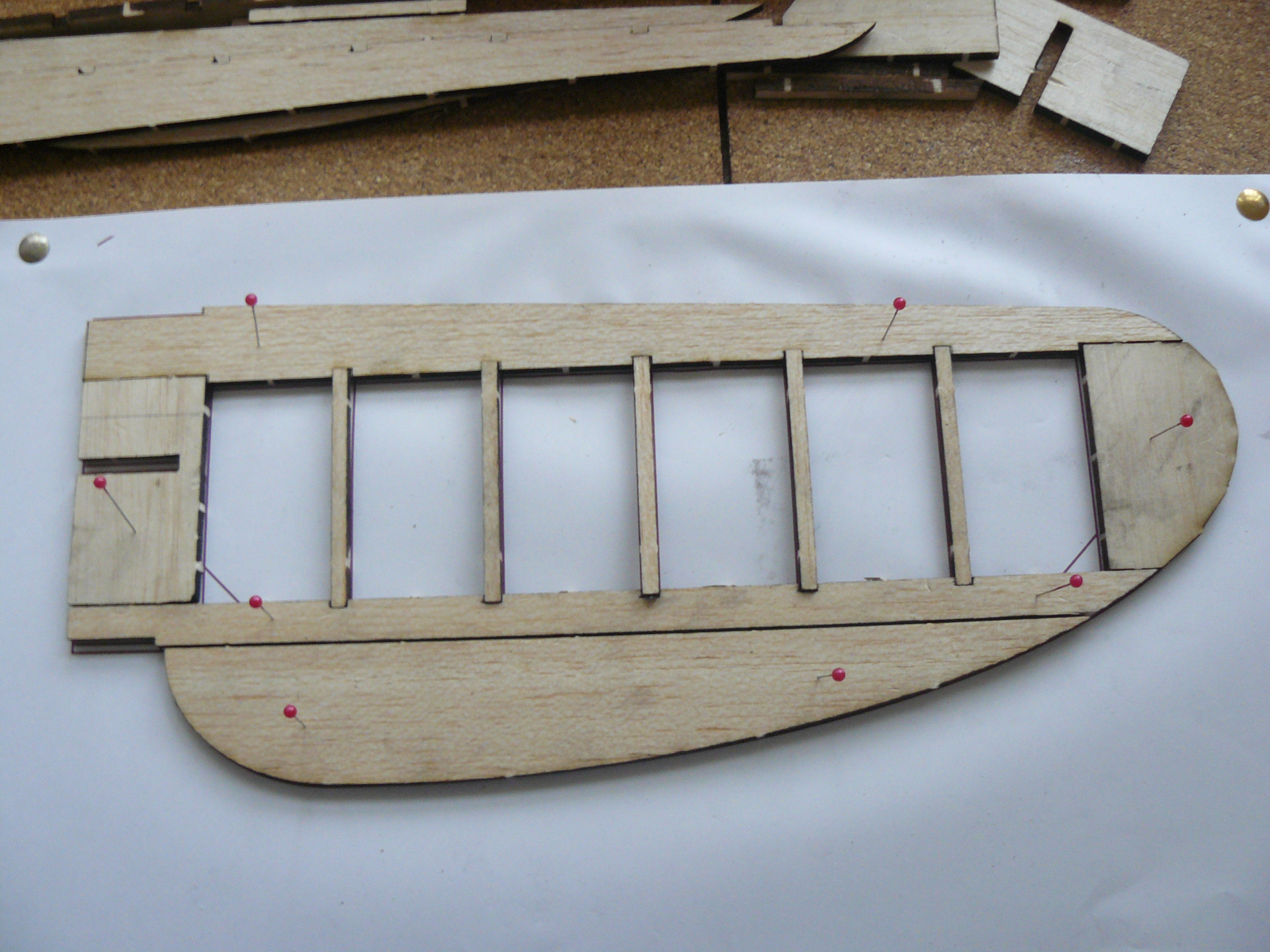
Been working on the drawings & got as far as the laser cuts for the tail & put it on the machine..
LaserGRBL sometimes throws wobblers on ellipses if they've been played with.SoI had to do the tail tips in a series of short lines which will sand round. I had a quick look on the internet but couldn't fine anything & I would have been on all day trying to work out why it happens.
Its in 5mm hard C-grain balsa, it cut nicely at S800 F350. I used 2mm break tabs which cut away easily. The parts even fit the drawing.
The top
The bottom
Pinned out
LaserGRBL sometimes throws wobblers on ellipses if they've been played with.SoI had to do the tail tips in a series of short lines which will sand round. I had a quick look on the internet but couldn't fine anything & I would have been on all day trying to work out why it happens.
Its in 5mm hard C-grain balsa, it cut nicely at S800 F350. I used 2mm break tabs which cut away easily. The parts even fit the drawing.
The top
The bottom
Pinned out
Last edit: 09 May 2026 17:43 by Magpie.
Thanks: Eric, Klipkopwildlife, Flytilbroke, Quorneng, THE BLACKBIRD, Ralpharr2001, jon.in.swansea
Please Log in or Create an account to join the conversation.
- Magpie
-
Topic Author
- Offline
- Elite Member
-
Less
More
- Posts: 587
- Thank you received: 1048
14 May 2026 14:39 #5
by Magpie
Replied by Magpie on topic The Spuggie
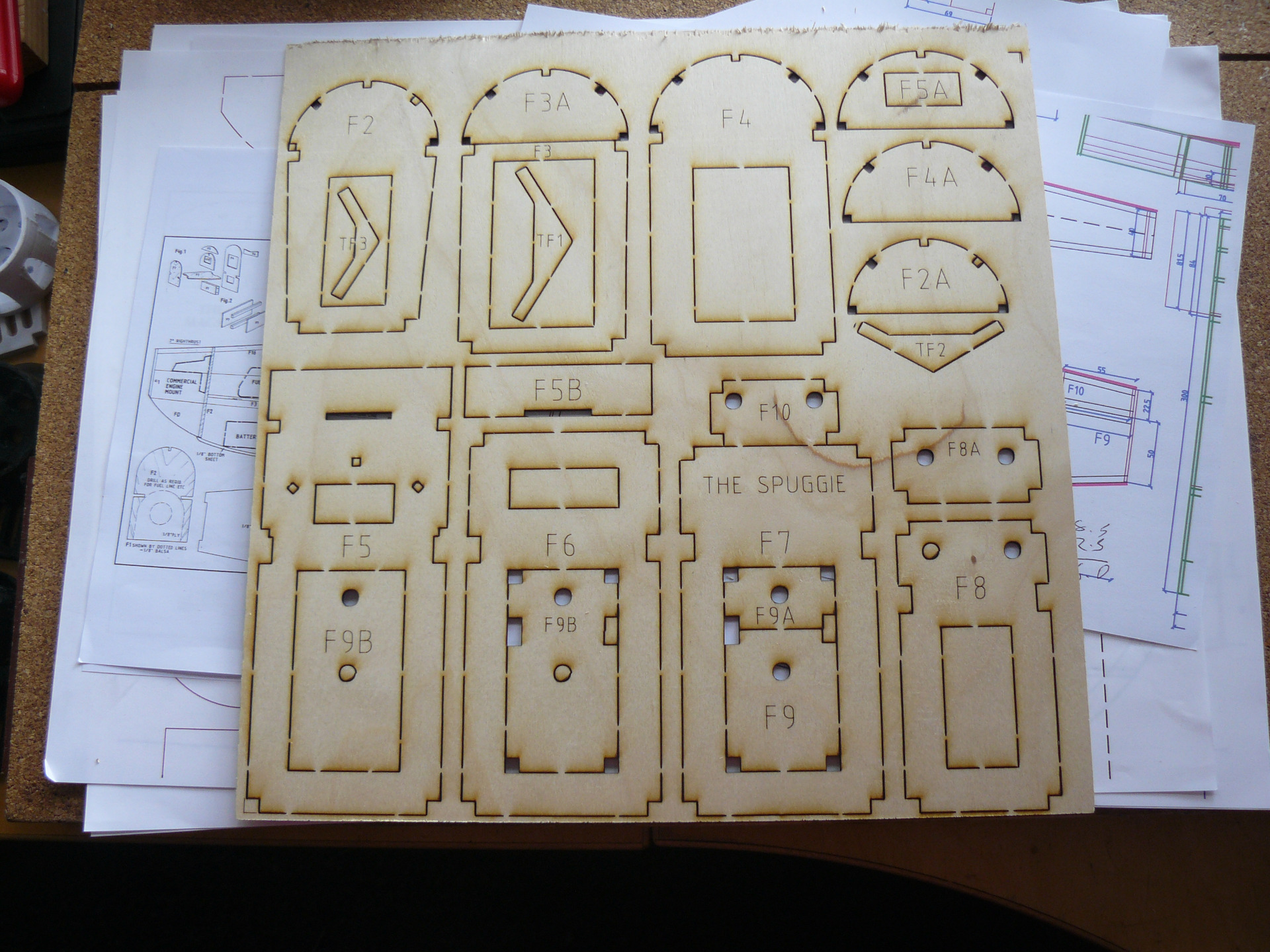
I've now cut the formers in 2mm ply.
I did the wing dihedral braces first as there were less of them so there would be less waste if there was a problem using F400 S800 but that wasn't enough heat so I had to do another pass with F200 S900. This slightly scorched the top but a single pass with those values has done the fuselage formers nicely.
There wasn't too much smoke either, it was visible but with the back door open it was OK.
I did the wing dihedral braces first as there were less of them so there would be less waste if there was a problem using F400 S800 but that wasn't enough heat so I had to do another pass with F200 S900. This slightly scorched the top but a single pass with those values has done the fuselage formers nicely.
There wasn't too much smoke either, it was visible but with the back door open it was OK.
Thanks: Klipkopwildlife, Flytilbroke, Quorneng
Please Log in or Create an account to join the conversation.
- Magpie
-
Topic Author
- Offline
- Elite Member
-
Less
More
- Posts: 587
- Thank you received: 1048
14 May 2026 15:50 #6
by Magpie
Replied by Magpie on topic The Spuggie
I've just spent an hour cutting the tabs to release the formers.
I'd definitely over-tabbed them. I used 2mm - 1mm and about half the number would heve easily been enough. Apart from that they came out cleanly, the heat settings were about right.
Most of the smaller bits without tabs hadn't fallen out & they only did when the ply was lifted off the table.
I'd definitely over-tabbed them. I used 2mm - 1mm and about half the number would heve easily been enough. Apart from that they came out cleanly, the heat settings were about right.
Most of the smaller bits without tabs hadn't fallen out & they only did when the ply was lifted off the table.
Thanks: Eric, Klipkopwildlife, Flytilbroke, Quorneng, THE BLACKBIRD, jon.in.swansea
Please Log in or Create an account to join the conversation.
- Magpie
-
Topic Author
- Offline
- Elite Member
-
Less
More
- Posts: 587
- Thank you received: 1048
20 May 2026 11:46 #7
by Magpie
Replied by Magpie on topic The Spuggie
The original Magpie had a shock absorber on the undercarriage formed by an elastic band just looped underneath the fuselage.
A bit primitive.
It wouldn't take much doing to make one on a 3D printer which would fit inside.
The big question is how to size the strength of the spring. It would need to have a compression range of 25mm & be about 8mm diameter.
I've looked around & cannot find this sort of information apart from very complex design charts, has anyone done this before?.
If the model weighed say 500g what sort of force would be forseeable on landing?
Thanks: Klipkopwildlife, THE BLACKBIRD
Please Log in or Create an account to join the conversation.
- Quorneng
-

- Offline
- Forum Master
-

Less
More
- Posts: 9436
- Thank you received: 19043
20 May 2026 16:53 #8
by Quorneng
Replied by Quorneng on topic The Spuggie
Rather a lot of variables like how smooth is the landing surface and how good the landing is!
The usual factor is the rate of descent of the plane when makes contact with the ground. It the rate of descent and the stroke of the undercarriage that determines the level of the forces involved. The longer the UC stroke the better.
Remember there is also a horizontal force when the wheel hits any bump in the landing surface. The horizontal element is directly proportional to the speed over the ground at contact and any nose down angle of the plane. The slower the actual touch down speed the better.
My simple test is can the undercarriage (and the plane!) when fully loaded withstand it being simply dropped from a height of 1 foot onto a hard surface? Under gravity this gives a vertical velocity at impact of 8 ft/sec.
The other static test is to load the plane up to twice its flying weight and see if the undercarriage travel has "bottomed out". If it has then a slightly stronger spring is required!
Using your figures suggests it would need a spring that compresses by 25 mm when a load of 1kg is applied. Even then the geometry of the undercarriage will have an effect on the spring strength required.
Guesses with trial and error?
Thanks: Eric, Klipkopwildlife, THE BLACKBIRD, jon.in.swansea
Please Log in or Create an account to join the conversation.
- Magpie
-
Topic Author
- Offline
- Elite Member
-
Less
More
- Posts: 587
- Thank you received: 1048
20 May 2026 20:15 #9
by Magpie
Replied by Magpie on topic The Spuggie
I dont know if you've looked at the pdf file on Outerzone but there are no horizontal forces or geometrical dimensions to the undercarriage other than the vertical. The model simply does a belly-flopper & the shock absorber is simply to reduce the amount of bounce - in a financial crash & recovery it is said that even a dead cat will show some bounce!
Thanks: Klipkopwildlife, THE BLACKBIRD
Please Log in or Create an account to join the conversation.
- Quorneng
-
- Offline
- Forum Master
-
Less
More
- Posts: 9436
- Thank you received: 19043
21 May 2026 00:07 - 21 May 2026 00:09 #10
by Quorneng
Replied by Quorneng on topic The Spuggie
The undercarriage shown on the Outerzone PDF is a direct crib of that used of the Fokker Triplane's undercarriage wing, even down to using elastic!!
Simple, light and robust. The number of bands used determines the spring rate.
Such a system would be a issue with IC power as the oil/fuel would quickly wreck the rubber bands but no problem with electric.
Big soft tyres would add to the "suspension"
It will depend on how original you want your Magpie to be.
Last edit: 21 May 2026 00:09 by Quorneng.
Thanks: THE BLACKBIRD
Please Log in or Create an account to join the conversation.
- Eric
-
- Offline
- Moderator
-
Less
More
- Posts: 13726
- Thank you received: 14467
21 May 2026 06:42 - 21 May 2026 06:46 #11
by Eric
if you are calm and collected when all about you are going berserk - you've missed something important!
Replied by Eric on topic The Spuggie
The horizontal forces on the undercarriage are when the aircraft that is moving forwards at flying speed causes the wheels to touch the not moving ground. Disregarding any bumps or ruts, the instant friction load tries to pull the wheels back relative to the aircraft's motion.
Then, if the aircraft isn't landing perfectly straight - ie a cross-wind - then there is a sideways load as well.
That is why tail-wheel aircraft try to trip over onto the nose.
-
The 'not-moving' ground - Yes, I know the planet is hurtling around the sun at a zillion miles an hour, and also rotating!
Everything is relative. It is assumed that the galaxy we are a mere speck on the edge of is moving, as well, but nobody has managed to measure it yet!
if you are calm and collected when all about you are going berserk - you've missed something important!
Last edit: 21 May 2026 06:46 by Eric. Reason: added a comment
Thanks: Klipkopwildlife, THE BLACKBIRD
Please Log in or Create an account to join the conversation.
- jon.in.swansea
-

- Offline
- Elite Member
-
Less
More
- Posts: 766
- Thank you received: 1192
21 May 2026 07:19 #12
by jon.in.swansea
Replied by jon.in.swansea on topic The Spuggie
I like the drop-it-from-one-foot test! Early warning about what bits of a mode that are prone to failure and/or need beefing up.
I suspect that it would also be a good test for models that do not have an undercarriage - but perhaps do it over a grass surface rather than concrete And start with a 6" drop and work up.
I suspect that it would also be a good test for models that do not have an undercarriage - but perhaps do it over a grass surface rather than concrete
And start with a 6" drop and work up.
Thanks: Klipkopwildlife, THE BLACKBIRD
Please Log in or Create an account to join the conversation.
- Eric
-
- Offline
- Moderator
-
Less
More
- Posts: 13726
- Thank you received: 14467
21 May 2026 10:35 #13
by Eric
if you are calm and collected when all about you are going berserk - you've missed something important!
Replied by Eric on topic The Spuggie
do it over a grass surface - - Makes it hard to find the bits, though!

if you are calm and collected when all about you are going berserk - you've missed something important!
Thanks: THE BLACKBIRD
Please Log in or Create an account to join the conversation.
- Quorneng
-
- Offline
- Forum Master
-
Less
More
- Posts: 9436
- Thank you received: 19043
21 May 2026 14:51 - 21 May 2026 14:52 #14
by Quorneng
Replied by Quorneng on topic The Spuggie
Be aware that a 1 foot drop test on a plane with no undercarriage is a good deal more severe than if the plane have some "give" in its undercarriage.
It all comes down to how quickly the 8ft/s vertical velocity is arrested. With no undercarriage the plane comes to rest almost instantly creating a shock force tens of time the weight of the plane but with say a !" progressive undercarriage travel the arresting force on the airframe would only generate an additional 1/3g. As the plane is already in a 1g environment such additional forces are unlikely to do any damage.
It follows that belly landings even on grass actually require more care than landing with an undercarriage.
Last edit: 21 May 2026 14:52 by Quorneng.
Thanks: Klipkopwildlife, THE BLACKBIRD, jon.in.swansea
Please Log in or Create an account to join the conversation.
Time to create page: 0.645 seconds