
- Posts: 10058
- Thank you received: 19043
V-2 with wings rebuild 2021
- Quorneng
-
 Topic Author
- Offline
- Forum Master
-

Less
More
12 Nov 2020 10:38 - 12 Nov 2020 10:40 #1
by Quorneng
V-2 with wings rebuild 2021 was created by Quorneng
After a bit of heart searching I have found a 'justification' to rebuild the V-2.
Although as an RC plane it flew far better than I had ever hoped it did torque roll significantly at take off, hence the need for a rapid non scale launch to attain sufficient airspeed as quickly as possible.
I had forgotten how old it was. The video is dated Jun 2016. Ignore the on screen date stamp that's the camera default!
Given the rather delicate nature of the airframe I just accepted the take off torque roll rather than explore ways to try to eliminate it.
So the object of the rebuild will be to set up the stab system and the control surfaces to contain the motor torque so even if it can't actually hover it can at least take off in a more scale manner and hopefully without upsetting its remarkably docile conventional flight characteristics.
At the same time I want to improve the launch system so it does not need an absolute flat calm to take off vertically. In the UK such days are just too rare.
We shall see.
p.s. As a project is has another important attribute. it shouldn't use very much 2 mm Depron!
Although as an RC plane it flew far better than I had ever hoped it did torque roll significantly at take off, hence the need for a rapid non scale launch to attain sufficient airspeed as quickly as possible.
I had forgotten how old it was. The video is dated Jun 2016. Ignore the on screen date stamp that's the camera default!
Given the rather delicate nature of the airframe I just accepted the take off torque roll rather than explore ways to try to eliminate it.
So the object of the rebuild will be to set up the stab system and the control surfaces to contain the motor torque so even if it can't actually hover it can at least take off in a more scale manner and hopefully without upsetting its remarkably docile conventional flight characteristics.
At the same time I want to improve the launch system so it does not need an absolute flat calm to take off vertically. In the UK such days are just too rare.
We shall see.
p.s. As a project is has another important attribute. it shouldn't use very much 2 mm Depron!
Last edit: 12 Nov 2020 10:40 by Quorneng.
Thanks: Eric, Klipkopwildlife, paul d, crash happy
Please Log in or Create an account to join the conversation.
- crash happy
-

- Offline
- Platinum Member
-

- Oops. did I say that out loud!
Less
More
- Posts: 1250
- Thank you received: 1203
12 Nov 2020 14:34 #2
by crash happy
Replied by crash happy on topic V-2 with wings rebuild 2021
That really is impressive ! I can't get over how stable it looks in the air ! I must have watched the take off a dozen times, with a stupid grin on my face. 
Thanks: Klipkopwildlife
Please Log in or Create an account to join the conversation.
- Quorneng
-
Topic Author
- Offline
- Forum Master
-
Less
More
- Posts: 10058
- Thank you received: 19043
12 Nov 2020 17:42 #3
by Quorneng
Replied by Quorneng on topic V-2 with wings rebuild 2021
It does of course have a stab but it was perfectly flyable with it switched off, however I never attempted a take off without it. 
It has only once flown with an 'audience' at a Doncaster 'fly in'. In fact I had to fly it twice. The first time the video camera man was standing too close and failed to follow the rapid take off in the view finder!
I have made a start on the rebuild. I have ordered a replacement EDF from China.
As the complete rear end is built up from the EDF not much is going to happen until it arrives - after Christmas?
It has only once flown with an 'audience' at a Doncaster 'fly in'. In fact I had to fly it twice. The first time the video camera man was standing too close and failed to follow the rapid take off in the view finder!
I have made a start on the rebuild. I have ordered a replacement EDF from China.
As the complete rear end is built up from the EDF not much is going to happen until it arrives - after Christmas?
Thanks: Klipkopwildlife, crash happy
Please Log in or Create an account to join the conversation.
- Quorneng
-
Topic Author
- Offline
- Forum Master
-
Less
More
- Posts: 10058
- Thank you received: 19043
15 Nov 2020 21:27 - 15 Nov 2020 21:31 #4
by Quorneng
Replied by Quorneng on topic V-2 with wings rebuild 2021
My initial thoughts on controlling the torque on take off suggested it would need relatively large area surfaces directly in the air stream.
A guy on one of the other sites has actually created a single EDF 'drone' that takes off vertically and hovers but it has huge surfaces controlled by a conventional quad control system.
My V-2 does did have small almost scale 'vanes' in the airstream.

They do work but more as a form of vectored thrust in flight than to overcome the motor torque on their own.
I suspect even if all four acted as ailerons they would still not be sufficient and at full deflection might start to effect the level of thrust.
With no obvious 'scale' solution I thought I had better have a plan 'B'.
Obviously the best solution would be to eliminate the motor torque at source so the limited effectiveness of the 'scale' vanes might be adequate.
A contra rotating EDF would be ideal.
However there are some good aerodynamic reasons why two fans in tandem only produce a thrust only marginally above that from one so I decided to find out what happens myself.
I have two spare racing drone motors with 4 blade props as I used on the AN 124 so I do know what they are capable of 'stand alone'.
A printed 'tandem' EDF.
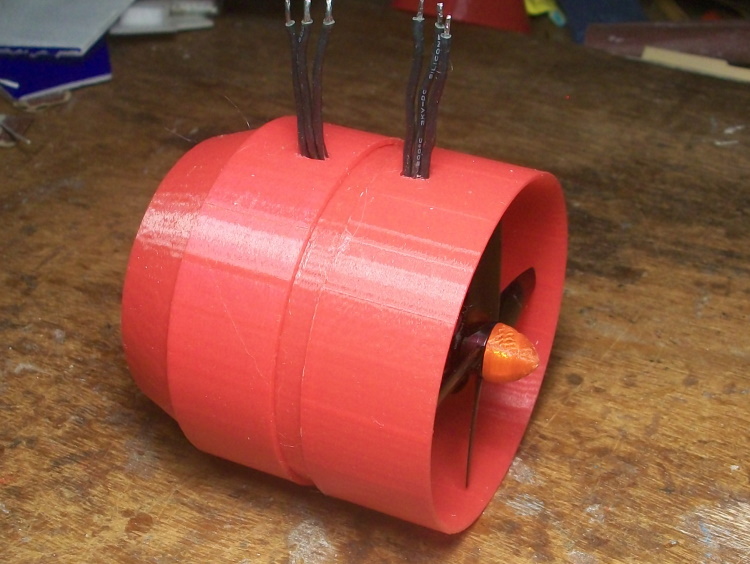
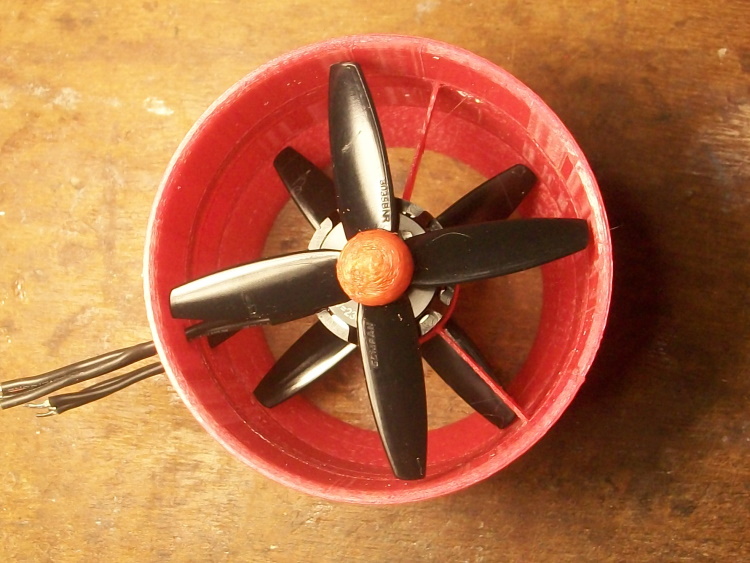
It is made up of 5 parts glued together. It has to be divided to actually 'bolt in' the motors.
With a constant bore it will not be very effective but the development will be to use different diameter and pitch props front to back with a tapered bore that gives the rear fan an inlet area of 85% FSA of the front one. There would then be a further 85% area reduction by the exhaust nozzle. My own experiments have shown an 85% area reduction gives the best static thrust even for a ducted prop.
That's all so far.
A guy on one of the other sites has actually created a single EDF 'drone' that takes off vertically and hovers but it has huge surfaces controlled by a conventional quad control system.
My V-2 does did have small almost scale 'vanes' in the airstream.
They do work but more as a form of vectored thrust in flight than to overcome the motor torque on their own.
I suspect even if all four acted as ailerons they would still not be sufficient and at full deflection might start to effect the level of thrust.
With no obvious 'scale' solution I thought I had better have a plan 'B'.
Obviously the best solution would be to eliminate the motor torque at source so the limited effectiveness of the 'scale' vanes might be adequate.
A contra rotating EDF would be ideal.
However there are some good aerodynamic reasons why two fans in tandem only produce a thrust only marginally above that from one so I decided to find out what happens myself.
I have two spare racing drone motors with 4 blade props as I used on the AN 124 so I do know what they are capable of 'stand alone'.
A printed 'tandem' EDF.
It is made up of 5 parts glued together. It has to be divided to actually 'bolt in' the motors.
With a constant bore it will not be very effective but the development will be to use different diameter and pitch props front to back with a tapered bore that gives the rear fan an inlet area of 85% FSA of the front one. There would then be a further 85% area reduction by the exhaust nozzle. My own experiments have shown an 85% area reduction gives the best static thrust even for a ducted prop.
That's all so far.
Last edit: 15 Nov 2020 21:31 by Quorneng.
Thanks: Klipkopwildlife, THE BLACKBIRD, Ralpharr2001, crash happy
Please Log in or Create an account to join the conversation.
- Quorneng
-
Topic Author
- Offline
- Forum Master
-
Less
More
- Posts: 10058
- Thank you received: 19043
16 Nov 2020 17:39 - 16 Nov 2020 17:41 #5
by Quorneng
Replied by Quorneng on topic V-2 with wings rebuild 2021
The "Contra" EDF set up on the test stand.
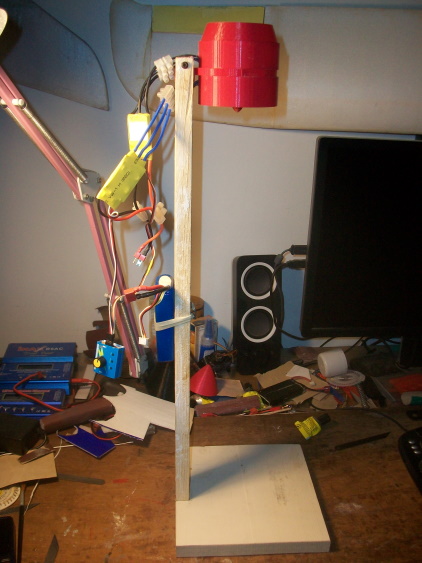
The initial results rather confirmed my initial expectation.
Running each fan alone (on 3S) with the other fan static gave the following thrust:-
Bottom fan 106 g
Top fan 100 g
This reduction was to be expected as the top fan was drawing its inlet through the other fan so the air would have been disturbed.
Running both together gave 176 g.
This suggests the top (downstream) fan was contributing a bit less than 50% of the additional thrust.
I did expect this sort of result given that the pitch of both props was the same.
The next step is to use a coarser pitch 4.5 instead of 3. on the downstream prop.
This will still not be ideal as with a constant area duct the downstream prop will still become 'starved' as it tries to accelerate further the fast moving air from the front prop.
My target is to get the tandem fans to produces a thrust as close as possible the sum of the individual fan thrust figures.
Of course if this avenue proves fruitless I could always use these two motors to build another twin jet airliner. A Boeing 737 Max?
The initial results rather confirmed my initial expectation.
Running each fan alone (on 3S) with the other fan static gave the following thrust:-
Bottom fan 106 g
Top fan 100 g
This reduction was to be expected as the top fan was drawing its inlet through the other fan so the air would have been disturbed.
Running both together gave 176 g.
This suggests the top (downstream) fan was contributing a bit less than 50% of the additional thrust.
I did expect this sort of result given that the pitch of both props was the same.
The next step is to use a coarser pitch 4.5 instead of 3. on the downstream prop.
This will still not be ideal as with a constant area duct the downstream prop will still become 'starved' as it tries to accelerate further the fast moving air from the front prop.
My target is to get the tandem fans to produces a thrust as close as possible the sum of the individual fan thrust figures.
Of course if this avenue proves fruitless I could always use these two motors to build another twin jet airliner. A Boeing 737 Max?
Last edit: 16 Nov 2020 17:41 by Quorneng.
Thanks: Klipkopwildlife, crash happy
Please Log in or Create an account to join the conversation.
- crash happy
-
- Offline
- Platinum Member
-
- Oops. did I say that out loud!
Less
More
- Posts: 1250
- Thank you received: 1203
16 Nov 2020 19:41 #6
by crash happy
Replied by crash happy on topic V-2 with wings rebuild 2021
Is the distance between the fans critical ? The reason I ask, & it's probably a dumb idea, but if you had room could you add extra angled air intakes between the fans to boost the airflow ?
Please Log in or Create an account to join the conversation.
- Quorneng
-
Topic Author
- Offline
- Forum Master
-
Less
More
- Posts: 10058
- Thank you received: 19043
16 Nov 2020 21:11 #7
by Quorneng
Replied by Quorneng on topic V-2 with wings rebuild 2021
Crash
That is of course how a pull/push plane works. The rear prop is free to draw in the air it requires so acts as a free standing unit.
I suspect it would be possible to draw in the extra air probably something along these lines.
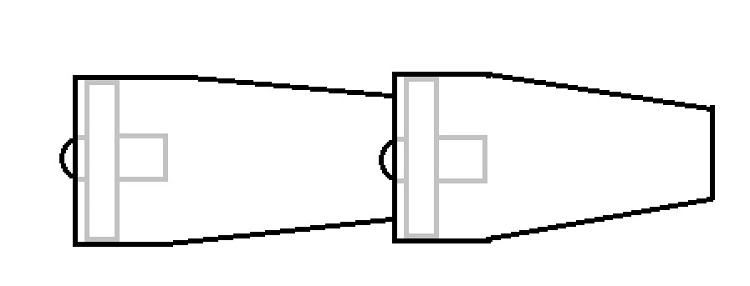
Due to the relatively low velocities involved I am sure the shape and positioning of the extra ducts would be very critical.
An interesting concept nonetheless.
The single EDF V-2 had 4 large equal air intakes between the fins.

It would in theory be possible to use 4 small (40 mm?) EDFs (2 counter rotating) each fed individually but there would be a significant penalty as the efficiency (thrust/watt and thrust/weight) reduces as the size come down. I am not sure a VTO would still be possible.
Think an answer may come by using a bigger 4" first prop feeding a 3" second. Even with two motors it will be no heavier than a 70 mm EDF and be electrically more efficient allowing a smaller battery which may make a lower thrust and slower speed take off acceptable, particularly if free from motor torque.
That is of course how a pull/push plane works. The rear prop is free to draw in the air it requires so acts as a free standing unit.
I suspect it would be possible to draw in the extra air probably something along these lines.
Due to the relatively low velocities involved I am sure the shape and positioning of the extra ducts would be very critical.
An interesting concept nonetheless.
The single EDF V-2 had 4 large equal air intakes between the fins.
It would in theory be possible to use 4 small (40 mm?) EDFs (2 counter rotating) each fed individually but there would be a significant penalty as the efficiency (thrust/watt and thrust/weight) reduces as the size come down. I am not sure a VTO would still be possible.
Think an answer may come by using a bigger 4" first prop feeding a 3" second. Even with two motors it will be no heavier than a 70 mm EDF and be electrically more efficient allowing a smaller battery which may make a lower thrust and slower speed take off acceptable, particularly if free from motor torque.
Thanks: Klipkopwildlife, crash happy
Please Log in or Create an account to join the conversation.
- Eric
-

- Offline
- Moderator
-

Less
More
- Posts: 15406
- Thank you received: 14305
16 Nov 2020 23:07 #8
by Eric
if you are calm and collected when all about you are going berserk - you've missed something important!
Replied by Eric on topic V-2 with wings rebuild 2021
Don't forget that the Fairey Gannet, the Avro Shackleton, and the Tupolev 'Bear' (and probably others) have contra-rotating props that are close together.
if you are calm and collected when all about you are going berserk - you've missed something important!
Thanks: Klipkopwildlife
Please Log in or Create an account to join the conversation.
- Quorneng
-
Topic Author
- Offline
- Forum Master
-
Less
More
- Posts: 10058
- Thank you received: 19043
16 Nov 2020 23:31 #9
by Quorneng
Replied by Quorneng on topic V-2 with wings rebuild 2021
They also have variable pitch props that can be different front to rear!
No one ever claimed a contra rotating prop was more efficient than a single. It was just a necessity to limit prop tip speed or for ground clearance.
No one ever claimed a contra rotating prop was more efficient than a single. It was just a necessity to limit prop tip speed or for ground clearance.
Thanks: Klipkopwildlife
Please Log in or Create an account to join the conversation.
- Quorneng
-
Topic Author
- Offline
- Forum Master
-
Less
More
- Posts: 10058
- Thank you received: 19043
17 Nov 2020 20:18 - 17 Nov 2020 20:37 #10
by Quorneng
Replied by Quorneng on topic V-2 with wings rebuild 2021
Did some sums so my brain hurts.
I have on order a coarse pitch 3 blade 3x4.5 prop. That would definitely overload the motor on 4s so it will rely on the front prop to 'off load' it.
I then calculated the front prop diameter that would provide the maximum thrust guessing at a 15 % greater area. It is a surprising little increase to just 3.25". I have a 5x3 3 blade which I will cut down.
So a 3.25x3 at the front which is just within the amp limit on 4s. The intention is it will off load the rear prop to keep its motor within limits.
So a few hours on CAD to create the casing and motor mount to match these props.

The really tricky bit was to calculate the taper required to smoothly reduce from 3.25" to 3" equally along the 3 duct sections.

The end nozzle reduces the rear prop swept area by another 15% to give the maximum static thrust.
Of course the fact you can fit the parts neatly together in CAD is no guarantee they will print that way.
I have on order a coarse pitch 3 blade 3x4.5 prop. That would definitely overload the motor on 4s so it will rely on the front prop to 'off load' it.
I then calculated the front prop diameter that would provide the maximum thrust guessing at a 15 % greater area. It is a surprising little increase to just 3.25". I have a 5x3 3 blade which I will cut down.
So a 3.25x3 at the front which is just within the amp limit on 4s. The intention is it will off load the rear prop to keep its motor within limits.
So a few hours on CAD to create the casing and motor mount to match these props.
The really tricky bit was to calculate the taper required to smoothly reduce from 3.25" to 3" equally along the 3 duct sections.
The end nozzle reduces the rear prop swept area by another 15% to give the maximum static thrust.
Of course the fact you can fit the parts neatly together in CAD is no guarantee they will print that way.
Last edit: 17 Nov 2020 20:37 by Quorneng.
Thanks: Klipkopwildlife, THE BLACKBIRD, Ralpharr2001, crash happy
Please Log in or Create an account to join the conversation.
- Quorneng
-
Topic Author
- Offline
- Forum Master
-
Less
More
- Posts: 10058
- Thank you received: 19043
19 Nov 2020 11:53 - 19 Nov 2020 11:54 #11
by Quorneng
Replied by Quorneng on topic V-2 with wings rebuild 2021
The twin size ducted prop casing printed but not yet glued together.
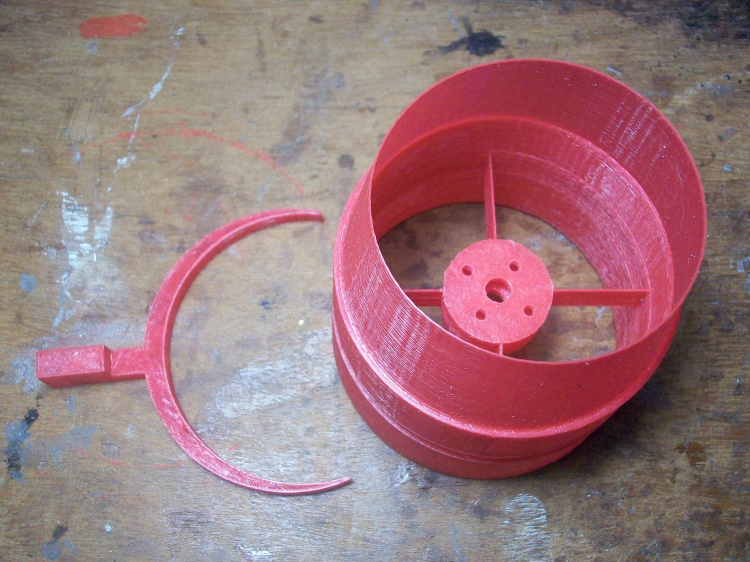
The 'horseshoe' is the test stand mount that clips around the middle of the casing.
An usual picture showing how thin the print walls are. The complete casing weighs 26.1 g
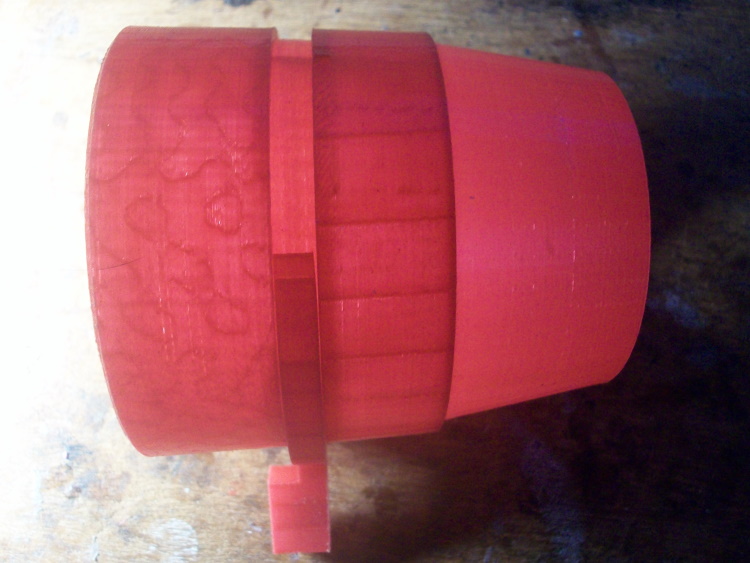
This casing follows the 85% rule.
The second fan has 85% of the area of the first and the exit nozzle has 85% of the second fan area.
This should mean the mass flow is constant through out the cowling with the result, In theory, that the total thrust from the combined props should be close to the sum of their 'free air' thrust figures, less of course any losses resulting from the disturbed flow off the first prop on the second.
When the prop arrives (from China!) we will find out.
The 'horseshoe' is the test stand mount that clips around the middle of the casing.
An usual picture showing how thin the print walls are. The complete casing weighs 26.1 g
This casing follows the 85% rule.
The second fan has 85% of the area of the first and the exit nozzle has 85% of the second fan area.
This should mean the mass flow is constant through out the cowling with the result, In theory, that the total thrust from the combined props should be close to the sum of their 'free air' thrust figures, less of course any losses resulting from the disturbed flow off the first prop on the second.
When the prop arrives (from China!) we will find out.
Last edit: 19 Nov 2020 11:54 by Quorneng.
Thanks: Klipkopwildlife, crash happy
Please Log in or Create an account to join the conversation.
- Eric
-
- Offline
- Moderator
-
Less
More
- Posts: 15406
- Thank you received: 14305
19 Nov 2020 12:01 #12
by Eric
if you are calm and collected when all about you are going berserk - you've missed something important!
Replied by Eric on topic V-2 with wings rebuild 2021
Your prop is probably in the container along with my motor! (in the very slow boat, going the long way around!)
if you are calm and collected when all about you are going berserk - you've missed something important!
Please Log in or Create an account to join the conversation.
- paul d
-
- Offline
- Forum Veteran
-

Less
More
- Posts: 2074
- Thank you received: 2292
19 Nov 2020 12:26 #13
by paul d
balsa is best.
Replied by paul d on topic V-2 with wings rebuild 2021
can't you print a prop/fan? That carbon loaded filament Barrie mentioned looks ideal.
balsa is best.
Thanks: Klipkopwildlife
Please Log in or Create an account to join the conversation.
- Quorneng
-
Topic Author
- Offline
- Forum Master
-
Less
More
- Posts: 10058
- Thank you received: 19043
19 Nov 2020 15:01 #14
by Quorneng
Replied by Quorneng on topic V-2 with wings rebuild 2021
It is possible to print a fan or prop but to do it properly would require a much better CAD package than I have to create the complex profiles used by the commercial ones.
I'm in no rush so I don't mind waiting.
If this principle works it might be possible to increase the diameter of both props to the maximum within the scale fuselage profile so the required thrust might be achievable without returning to an amp hungry EDF.
Having dug out my original V-2 plans it looks like the rear prop could be 110 mm rather than 76 mm. That represents a doubling of the area and, all other things being equal. thrust is directly proportional to area.
I'm in no rush so I don't mind waiting.
If this principle works it might be possible to increase the diameter of both props to the maximum within the scale fuselage profile so the required thrust might be achievable without returning to an amp hungry EDF.
Having dug out my original V-2 plans it looks like the rear prop could be 110 mm rather than 76 mm. That represents a doubling of the area and, all other things being equal. thrust is directly proportional to area.
Thanks: paul d, crash happy
Please Log in or Create an account to join the conversation.
- Quorneng
-
Topic Author
- Offline
- Forum Master
-
Less
More
- Posts: 10058
- Thank you received: 19043
20 Nov 2020 16:43 - 20 Nov 2020 16:45 #15
by Quorneng
Replied by Quorneng on topic V-2 with wings rebuild 2021
A bit more on trying to get the maximum possible fan/prop into the existing V-2 fusealge profile.
This shows how the 70 mm EDF was mounted in the VTO V-2 version.
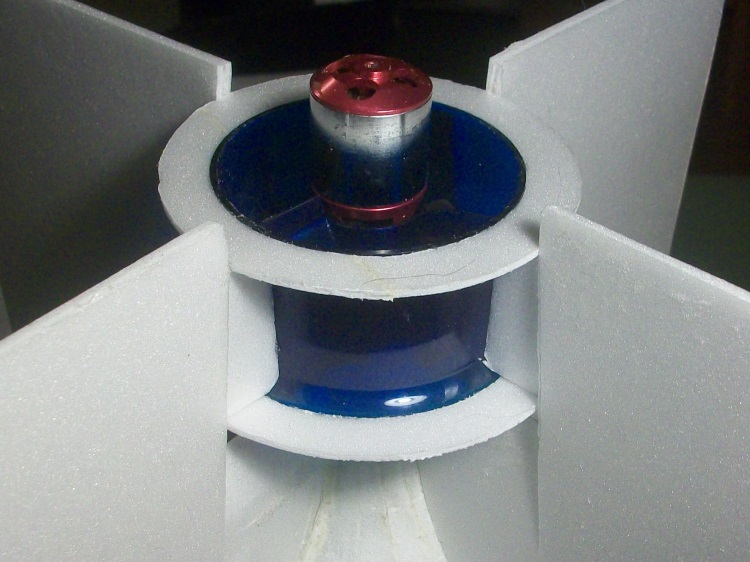
Note the fan is supported by just the four fins thus allowing the greatest possible inlet area with the fuselage truncated smoothly down to the diameter of the fan hub.

My proposal is to fit the largest possible rear prop and still keep the outlet nozzle within the scale fuselage profile.
It looks like the outlet could be 100 mm diameter, the rear prop 114 mm and the front prop 122 mm.
It would look something like this CAD 'mock up'.

Nothing made yet as the final prop dimensions will depend on the test results from the 'tapered duct' tandem prop version and to no small degree on the amount of thrust it delivers.
The tandem motor is a bit lighter than the 70 mm EDF (88 g against 140 g) a saving of 2 oz. All things being equal this would drop the all up weight of the V-2 to 21.5 oz and maybe a bit less if I use a smaller battery.
The original 70 mm EDF gave just over 42 oz thrust. With no torque I might get away with a lower excess thrust but I guess it would still need about 32 oz. (Sorry to mix the units)
Installing the new 70 mm EDF (it arrived this morning) and simply ignoring the torque roll on the VTO does seem a much simpler option.
This shows how the 70 mm EDF was mounted in the VTO V-2 version.
Note the fan is supported by just the four fins thus allowing the greatest possible inlet area with the fuselage truncated smoothly down to the diameter of the fan hub.
My proposal is to fit the largest possible rear prop and still keep the outlet nozzle within the scale fuselage profile.
It looks like the outlet could be 100 mm diameter, the rear prop 114 mm and the front prop 122 mm.
It would look something like this CAD 'mock up'.
Nothing made yet as the final prop dimensions will depend on the test results from the 'tapered duct' tandem prop version and to no small degree on the amount of thrust it delivers.
The tandem motor is a bit lighter than the 70 mm EDF (88 g against 140 g) a saving of 2 oz. All things being equal this would drop the all up weight of the V-2 to 21.5 oz and maybe a bit less if I use a smaller battery.
The original 70 mm EDF gave just over 42 oz thrust. With no torque I might get away with a lower excess thrust but I guess it would still need about 32 oz. (Sorry to mix the units)
Installing the new 70 mm EDF (it arrived this morning) and simply ignoring the torque roll on the VTO does seem a much simpler option.
Last edit: 20 Nov 2020 16:45 by Quorneng.
Thanks: Eric, Klipkopwildlife, crash happy
Please Log in or Create an account to join the conversation.
Time to create page: 0.867 seconds