
- Posts: 10058
- Thank you received: 19043
V-2 with wings rebuild 2021
- Quorneng
-
 Topic Author
- Offline
- Forum Master
-

Less
More
29 Nov 2020 11:54 - 29 Nov 2020 11:57 #31
by Quorneng
Replied by Quorneng on topic V-2 with wings rebuild 2021
Crash
i certainly could do that but as a vertical riser that is already short of thrust there is no real option to reduce the total power even if it improves the energy efficiency.
My first objective is to get both motors to draw the same power at full throttle so it will adding the maximum energy to the air stream. The thrust at low throttle is not really an issue, it will be plenty! I have two Watt meters so I can measure the amps in real time.
What I think is happening at the moment is at full power the rear prop tends to draw in more air than the front supplies. This allows the front to speed up. Unfortunately the power of a brushless motor falls away quite rapidly outside a fairly narrow speed band.
Now whether the same front to back power distribution remains the same on 4s rather than 3s is any bodies guess.
The problem is further complicated as apart from their relative pitch there is also their relative diameters. I have somewhat arbitrarily selected an 85% area ratio for the rear prop. This figure as the area of a nozzle does create maximum thrust (but not by much) on a single fan. I have no idea how sensitive the area ratio might be in a tandem arrangement.
Axial air compressor theory indicates that guide vanes play an important part in pressure generation but in a twin fan it is not pressure we are after but airflow speed.
All I can say for certain at the moment is the two motor tandem fan is creating the same thrust on 3s as a one motor fan does on 4s. A result that is not really good enough!
i certainly could do that but as a vertical riser that is already short of thrust there is no real option to reduce the total power even if it improves the energy efficiency.
My first objective is to get both motors to draw the same power at full throttle so it will adding the maximum energy to the air stream. The thrust at low throttle is not really an issue, it will be plenty! I have two Watt meters so I can measure the amps in real time.
What I think is happening at the moment is at full power the rear prop tends to draw in more air than the front supplies. This allows the front to speed up. Unfortunately the power of a brushless motor falls away quite rapidly outside a fairly narrow speed band.
Now whether the same front to back power distribution remains the same on 4s rather than 3s is any bodies guess.
The problem is further complicated as apart from their relative pitch there is also their relative diameters. I have somewhat arbitrarily selected an 85% area ratio for the rear prop. This figure as the area of a nozzle does create maximum thrust (but not by much) on a single fan. I have no idea how sensitive the area ratio might be in a tandem arrangement.
Axial air compressor theory indicates that guide vanes play an important part in pressure generation but in a twin fan it is not pressure we are after but airflow speed.
All I can say for certain at the moment is the two motor tandem fan is creating the same thrust on 3s as a one motor fan does on 4s. A result that is not really good enough!
Last edit: 29 Nov 2020 11:57 by Quorneng.
Thanks: Klipkopwildlife, THE BLACKBIRD, crash happy
Please Log in or Create an account to join the conversation.
- Quorneng
-
Topic Author
- Offline
- Forum Master
-
Less
More
- Posts: 10058
- Thank you received: 19043
01 Dec 2020 18:03 - 01 Dec 2020 18:06 #32
by Quorneng
Replied by Quorneng on topic V-2 with wings rebuild 2021
Still waiting for the new front props so I though I would look at a possible plan C!
Plan B is to use a replacement 70 mm EDF so the V-2 would behave as original.
Plan C is to use just one of the RS2205 drone motors with the largest ducted prop I can get into the available space.
According to the figures on the Emax web site the RS2205 with a 4x4.5 3 blade on 4s can produce 732 g (26 oz thrust) drawing 20 A. This might be enough given the considerable weight saving that would result from both the smaller motor and battery.
The issue is still the torque at what would be a relatively slow launch.
A bit of CAD work suggest I can print a suitable duct and include motor supports with appropriate counter torque curvature.
With a bit of experimentation I might be able to virtually eliminate the torque and if what I am told on other web sites is true it might actually increase the effective thrust at the same time. Yeah right!
Anyway it could look something like this with a 4 x 4.5 x 3 blade.

We shall see.
Plan B is to use a replacement 70 mm EDF so the V-2 would behave as original.
Plan C is to use just one of the RS2205 drone motors with the largest ducted prop I can get into the available space.
According to the figures on the Emax web site the RS2205 with a 4x4.5 3 blade on 4s can produce 732 g (26 oz thrust) drawing 20 A. This might be enough given the considerable weight saving that would result from both the smaller motor and battery.
The issue is still the torque at what would be a relatively slow launch.
A bit of CAD work suggest I can print a suitable duct and include motor supports with appropriate counter torque curvature.
With a bit of experimentation I might be able to virtually eliminate the torque and if what I am told on other web sites is true it might actually increase the effective thrust at the same time. Yeah right!
Anyway it could look something like this with a 4 x 4.5 x 3 blade.
We shall see.
Attachments:
Last edit: 01 Dec 2020 18:06 by Quorneng.
Thanks: Eric, Klipkopwildlife, crash happy
Please Log in or Create an account to join the conversation.
- paul d
-
- Offline
- Forum Veteran
-

Less
More
- Posts: 2074
- Thank you received: 2292
01 Dec 2020 18:39 #33
by paul d
balsa is best.
Replied by paul d on topic V-2 with wings rebuild 2021
Why don't you just shove a couple of Estes up it's bum and hang on?  I've still got the V1 itch to scratch and am thinking that may be the way to go...unless someone's got a 3" ( long..not diameter) pulse jet there not using!!!
I've still got the V1 itch to scratch and am thinking that may be the way to go...unless someone's got a 3" ( long..not diameter) pulse jet there not using!!! balsa is best.
Thanks: Klipkopwildlife, Ralpharr2001
Please Log in or Create an account to join the conversation.
- Quorneng
-
Topic Author
- Offline
- Forum Master
-
Less
More
- Posts: 10058
- Thank you received: 19043
02 Dec 2020 21:46 #34
by Quorneng
Replied by Quorneng on topic V-2 with wings rebuild 2021
At last my 20A 4s Little Bee ESCs arrived.
They are OPTO so they needs a separate BEC.
The wiring 'lash up' to test it all works on the Plan "A" 88 mm contra EDP.

Not tried it on a 4s yet.
One of the 2205 racing drone motors with a Plan "C" 4 blade 4x4 prop.

I tested this on on my thrust test rig. It generated 601 g (24 oz) thrust drawing 15.1 A on a not fully charged 4s, which is quite impressive. But after just a few seconds running it made a 'out of sync' squeal and stopped pretty quickly. After experimentation with a spare ESC and motor it proved to be the motor that had 'lost' a winding internally.
I have 4x4.5 3 blade on order which might actually generate a touch more thrust.
I am printing up the rest of the 4" (102 mm) EDP cowling.
Plan C will simply depend on how much weight is saved from the lighter components against the reduced thrust available.
They are OPTO so they needs a separate BEC.
The wiring 'lash up' to test it all works on the Plan "A" 88 mm contra EDP.
Not tried it on a 4s yet.
One of the 2205 racing drone motors with a Plan "C" 4 blade 4x4 prop.
I tested this on on my thrust test rig. It generated 601 g (24 oz) thrust drawing 15.1 A on a not fully charged 4s, which is quite impressive. But after just a few seconds running it made a 'out of sync' squeal and stopped pretty quickly. After experimentation with a spare ESC and motor it proved to be the motor that had 'lost' a winding internally.
I have 4x4.5 3 blade on order which might actually generate a touch more thrust.
I am printing up the rest of the 4" (102 mm) EDP cowling.
Plan C will simply depend on how much weight is saved from the lighter components against the reduced thrust available.
Attachments:
Thanks: Klipkopwildlife, THE BLACKBIRD, crash happy
Please Log in or Create an account to join the conversation.
- Quorneng
-
Topic Author
- Offline
- Forum Master
-
Less
More
- Posts: 10058
- Thank you received: 19043
03 Dec 2020 22:27 - 03 Dec 2020 22:33 #35
by Quorneng
Replied by Quorneng on topic V-2 with wings rebuild 2021
Still experimenting away.
I tested the contra EDF on a 4s

Loads of noise but not a huge amount of thrust - 430 g and drawing 15 A.
A bit disappointing as going up to from the contra's 3.25" and 3" to a single 4" prop achieves 600 g and using the same amps.
With a bit of development I may improve the Contra's thrust but it does look unlikely to reach 600 g let alone exceed it.
The completed 4" (102 mm) EDP.

It is of course quite a bit lighter, 63 g against 98 g for the 88mm Contra
It has a 'built in' 85% FSA nozzle.
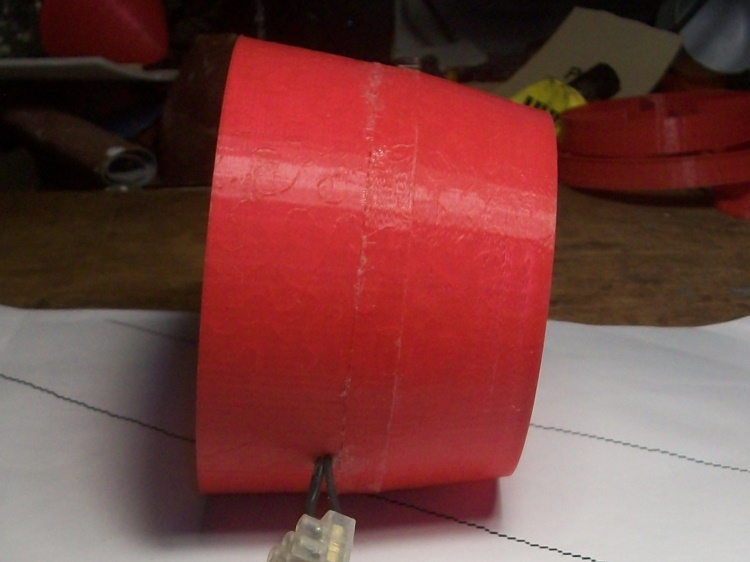
So it looks like the V-2 with Wings will get the 102 mm EDP.
There will be other weight savings from the V-2's original form.
1000 mAh 4s in place of an 1800 mAh.
A much lighter ESC even with additional BEC.
With only 1/3 the amps lighter ESC to motor wires. Significant as they are 1000 mm long!
A lighter gyro rx in place of its separate rx and gyro.
The reduced EDP weight over the original 70 mm EDF may allow smaller servos to be used and for them to be placed directly in the fins thus removing the need for four 600 mm long snakes.
Some checking of the actual airframe weight, or rather what's left of it, to see if it is in right ball park and I might start cutting some Depron soon.
For prop thrust there is no substitute for diameter!
I tested the contra EDF on a 4s
Loads of noise but not a huge amount of thrust - 430 g and drawing 15 A.
A bit disappointing as going up to from the contra's 3.25" and 3" to a single 4" prop achieves 600 g and using the same amps.
With a bit of development I may improve the Contra's thrust but it does look unlikely to reach 600 g let alone exceed it.
The completed 4" (102 mm) EDP.
It is of course quite a bit lighter, 63 g against 98 g for the 88mm Contra
It has a 'built in' 85% FSA nozzle.
So it looks like the V-2 with Wings will get the 102 mm EDP.
There will be other weight savings from the V-2's original form.
1000 mAh 4s in place of an 1800 mAh.
A much lighter ESC even with additional BEC.
With only 1/3 the amps lighter ESC to motor wires. Significant as they are 1000 mm long!
A lighter gyro rx in place of its separate rx and gyro.
The reduced EDP weight over the original 70 mm EDF may allow smaller servos to be used and for them to be placed directly in the fins thus removing the need for four 600 mm long snakes.
Some checking of the actual airframe weight, or rather what's left of it, to see if it is in right ball park and I might start cutting some Depron soon.
For prop thrust there is no substitute for diameter!
Attachments:
Last edit: 03 Dec 2020 22:33 by Quorneng.
Thanks: Eric, Klipkopwildlife, THE BLACKBIRD, old fart, Ralpharr2001, crash happy
Please Log in or Create an account to join the conversation.
- crash happy
-

- Offline
- Platinum Member
-

- Oops. did I say that out loud!
Less
More
- Posts: 1250
- Thank you received: 1203
04 Dec 2020 09:07 #36
by crash happy
Replied by crash happy on topic V-2 with wings rebuild 2021
I did a bit of digging around on the net, just to see if anyone else had tried something similar, & there have been many attempts, none of which have been successful. Most only reached a maximum of 80% the thrust of a single fan, which seems to be in-line with your results Simon. Very interesting experiment though, plus I learned something about Conada effect whilst researching it !
Thanks: Klipkopwildlife, Quorneng
Please Log in or Create an account to join the conversation.
- Quorneng
-
Topic Author
- Offline
- Forum Master
-
Less
More
- Posts: 10058
- Thank you received: 19043
04 Dec 2020 17:07 #37
by Quorneng
Replied by Quorneng on topic V-2 with wings rebuild 2021
The 4" EDP placed over the plan of the V-2 tail end to see how it might fit.
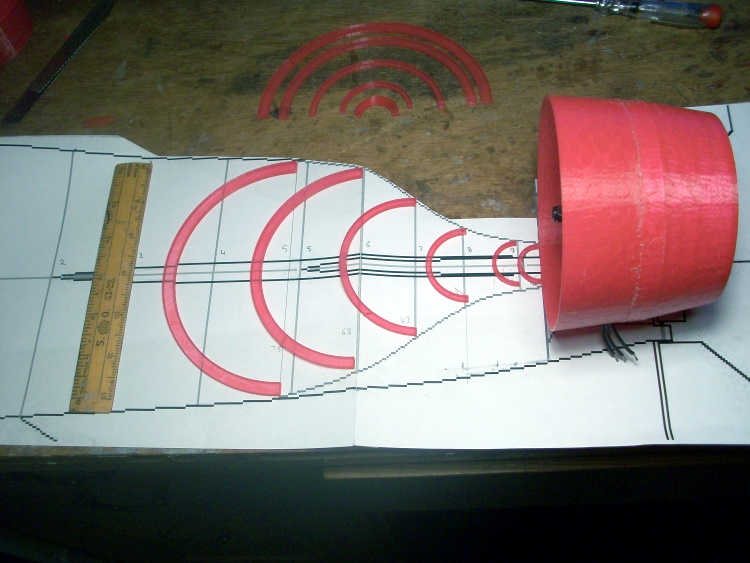
The entry duct to the EDP was damaged when the 70 mm EDF disintegrated so it will need to be replaced.
It carries no load and is purely an aerodynamic fairing. The EDP is supported and the thrust transmitted to the fuselage entirely by the four Depron fins.
The fairing will be built as a half shell over the plan so the appropriate 1/2 formers have been printed.
I seem to remember it was not an easy shape to plank.
The entry duct to the EDP was damaged when the 70 mm EDF disintegrated so it will need to be replaced.
It carries no load and is purely an aerodynamic fairing. The EDP is supported and the thrust transmitted to the fuselage entirely by the four Depron fins.
The fairing will be built as a half shell over the plan so the appropriate 1/2 formers have been printed.
I seem to remember it was not an easy shape to plank.
Attachments:
Thanks: Eric, Klipkopwildlife, paul d, crash happy
Please Log in or Create an account to join the conversation.
- Quorneng
-
Topic Author
- Offline
- Forum Master
-
Less
More
- Posts: 10058
- Thank you received: 19043
04 Dec 2020 23:26 - 04 Dec 2020 23:27 #38
by Quorneng
Replied by Quorneng on topic V-2 with wings rebuild 2021
I have extracted the 70 MM EDF from the V-2 and discovered something.
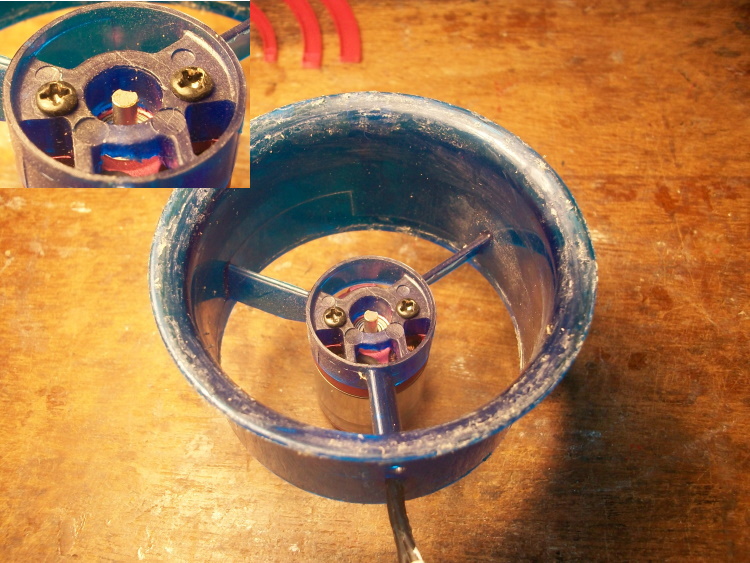
It did not just loose it blades but the fan and the driver. The shaft snapped and exactly at the beginning of the 'flat' in the shaft to locate the retaining grub screw.
Having examined the rear fuselage in detail it looks like I might be able to use the rear fuselage cone 'as is'.

A quick check shows the airframe (less the nose!) but including the heavy ESC, 4 'heavy' servos, 4 snakes and a separate gyro weighs 360 g. The 4" EDP is 61 g. The 100 mAh 4s is 110 g. That gives a total of 431 g.
If the EDP gets close to the 600g measured test thrust then it looks a possibility.
It did not just loose it blades but the fan and the driver. The shaft snapped and exactly at the beginning of the 'flat' in the shaft to locate the retaining grub screw.
Having examined the rear fuselage in detail it looks like I might be able to use the rear fuselage cone 'as is'.
A quick check shows the airframe (less the nose!) but including the heavy ESC, 4 'heavy' servos, 4 snakes and a separate gyro weighs 360 g. The 4" EDP is 61 g. The 100 mAh 4s is 110 g. That gives a total of 431 g.
If the EDP gets close to the 600g measured test thrust then it looks a possibility.
Attachments:
Last edit: 04 Dec 2020 23:27 by Quorneng.
Thanks: Eric, Klipkopwildlife, Ralpharr2001, paul d, crash happy
Please Log in or Create an account to join the conversation.
- paul d
-
- Offline
- Forum Veteran
-
Less
More
- Posts: 2074
- Thank you received: 2292
05 Dec 2020 07:49 #39
by paul d
balsa is best.
Replied by paul d on topic V-2 with wings rebuild 2021
Is that shaft that snapped brass Simon?
balsa is best.
Please Log in or Create an account to join the conversation.
- Klipkopwildlife
-

- Offline
- Administrator
-

- I'm supposed to be retired!
05 Dec 2020 08:04 #40
by Klipkopwildlife
Do it now, you may never get another chance
Replied by Klipkopwildlife on topic V-2 with wings rebuild 2021
It might be colour bleed over from the backdrop, some cameras will do that. And Simon has had problems in the past with colours showing differently in different light.
Do it now, you may never get another chance
Thanks: paul d
Please Log in or Create an account to join the conversation.
- Quorneng
-
Topic Author
- Offline
- Forum Master
-
Less
More
- Posts: 10058
- Thank you received: 19043
05 Dec 2020 12:01 #41
by Quorneng
Replied by Quorneng on topic V-2 with wings rebuild 2021
Brass?
No it is steel, probably a nickel steel and pretty hard. I suspect it is also surface chromed.
The fracture is a classic grey colour showing the fine grain structure.
I was thinking of buying a new 70 mm 12 blade fan but the shaft is now too short .
Made a start on removing the 'heavy' components from the airframe.
This is always the hard bit as you have to destroy more than crash actually did before you can start repairing anything.
The control surfaces removed prior to removing the snakes.

One of the fins is badly 'bent' so may have to be replaced.
The first bit of real weight saving. The old 60A ESC & heat sink alongside the Little Bee 20A ESC & 3A BEC.

This saving alone is likely to be more than the weight of the complete rebuilt nose.
No it is steel, probably a nickel steel and pretty hard. I suspect it is also surface chromed.
The fracture is a classic grey colour showing the fine grain structure.
I was thinking of buying a new 70 mm 12 blade fan but the shaft is now too short .
Made a start on removing the 'heavy' components from the airframe.
This is always the hard bit as you have to destroy more than crash actually did before you can start repairing anything.
The control surfaces removed prior to removing the snakes.
One of the fins is badly 'bent' so may have to be replaced.
The first bit of real weight saving. The old 60A ESC & heat sink alongside the Little Bee 20A ESC & 3A BEC.
This saving alone is likely to be more than the weight of the complete rebuilt nose.
Attachments:
Thanks: Eric, Klipkopwildlife, crash happy
Please Log in or Create an account to join the conversation.
- crash happy
-
- Offline
- Platinum Member
-
- Oops. did I say that out loud!
Less
More
- Posts: 1250
- Thank you received: 1203
05 Dec 2020 14:11 #42
by crash happy
Replied by crash happy on topic V-2 with wings rebuild 2021
Quorneng wrote, " This is always the hard bit as you have to destroy more than crash actually did before you can start repairing anything."
Don't blame me, I wasn't even in the country when it went down !

Don't blame me, I wasn't even in the country when it went down !
Thanks: Klipkopwildlife
Please Log in or Create an account to join the conversation.
- Eric
-

- Offline
- Moderator
-

Less
More
- Posts: 15406
- Thank you received: 14306
05 Dec 2020 14:18 #43
by Eric
if you are calm and collected when all about you are going berserk - you've missed something important!
Replied by Eric on topic V-2 with wings rebuild 2021
It WAS a scale 'landing'! 
if you are calm and collected when all about you are going berserk - you've missed something important!
Thanks: Klipkopwildlife, crash happy
Please Log in or Create an account to join the conversation.
- Ralpharr2001
-

- Offline
- Elite Member
-

Less
More
- Posts: 524
- Thank you received: 1476
05 Dec 2020 16:01 #44
by Ralpharr2001
I'm currently unsupervised. I know it freaks me out as well, but the possibilities are endless!!
Replied by Ralpharr2001 on topic V-2 with wings rebuild 2021
Q, have you seen the videos on YouTube for hovering rockets? This video uses an EDF for thrust
I'm currently unsupervised. I know it freaks me out as well, but the possibilities are endless!!
Thanks: Klipkopwildlife
Please Log in or Create an account to join the conversation.
- Quorneng
-
Topic Author
- Offline
- Forum Master
-
Less
More
- Posts: 10058
- Thank you received: 19043
05 Dec 2020 17:14 - 05 Dec 2020 17:21 #45
by Quorneng
Replied by Quorneng on topic V-2 with wings rebuild 2021
Thanks for the video. Very interesting.
I was not after hovering as such but more to make a scale rocket take off vertically and fly aerodynamically.
It does show that a single prop (6"?) can provide enough thrust and be controlled with vanes using a drone control unit.
I am bit surprised it did not have normal X & Y control which surely must have been available as it is in a racing drone.
With only a 70 mm EDF (2.75" dia) in my V-2 my vanes were too small to provide adequate control but did provide some vectored thrust assist in a tight aerobatic manoeuvre.
Still removing bits.
4 servo and their snakes, rx, gyro and redundant Depron support structures.

In total it weighs 63.6 g.
Of course some weight will go back in but likely no more than 25 g.
The first objective will be to get the printed 4" EDP installed into the rear of the airframe. It will the be possible to use the airframe to measure what the thrust actually is and to answer the question "Does it all hold together?"
I was not after hovering as such but more to make a scale rocket take off vertically and fly aerodynamically.
It does show that a single prop (6"?) can provide enough thrust and be controlled with vanes using a drone control unit.
I am bit surprised it did not have normal X & Y control which surely must have been available as it is in a racing drone.
With only a 70 mm EDF (2.75" dia) in my V-2 my vanes were too small to provide adequate control but did provide some vectored thrust assist in a tight aerobatic manoeuvre.
Still removing bits.
4 servo and their snakes, rx, gyro and redundant Depron support structures.
In total it weighs 63.6 g.
Of course some weight will go back in but likely no more than 25 g.
The first objective will be to get the printed 4" EDP installed into the rear of the airframe. It will the be possible to use the airframe to measure what the thrust actually is and to answer the question "Does it all hold together?"
Attachments:
Last edit: 05 Dec 2020 17:21 by Quorneng.
Thanks: Klipkopwildlife, Ralpharr2001, paul d, crash happy
Please Log in or Create an account to join the conversation.
Time to create page: 0.322 seconds