
- Posts: 15406
- Thank you received: 14306
The Model Barn - Slider
- Eric
-

- Offline
- Moderator
-

Less
More
20 Apr 2025 06:40 - 20 Apr 2025 06:43 #31
by Eric
if you are calm and collected when all about you are going berserk - you've missed something important!
Replied by Eric on topic The Model Barn - Slider
You say the central boss on the APC's is bigger than the others - - are you sure you have Electric APC's? An i/c prop DOES have a bigger central section, to cope with the oscillating stress of the reciprocating engine - where the prop is also acting as the flywheel. The blades are also thicker.
You can use an i/c prop on an electric motor, but DO NOT attempt to use an electric prop on an i/c engine. The prop will disintegrate and throw the blades in all directions!
You can use an i/c prop on an electric motor, but DO NOT attempt to use an electric prop on an i/c engine. The prop will disintegrate and throw the blades in all directions!
if you are calm and collected when all about you are going berserk - you've missed something important!
Last edit: 20 Apr 2025 06:43 by Eric. Reason: typo
Thanks: Klipkopwildlife
Please Log in or Create an account to join the conversation.
- Magpie
-
 Topic Author
- Offline
- Elite Member
-

Less
More
- Posts: 587
- Thank you received: 1047
20 Apr 2025 09:25 #32
by Magpie
Replied by Magpie on topic The Model Barn - Slider
They are definitely electric.
This is one of the things I have noticed when buying RC stuff, there is a pronounced lack of information & standardisation & its not until you get stuff in hand that you see the full story. The experienced will know what's what but the newcomer has to find out the hard way.
The difference in the boss sizes can be seen from this photo, if the 9" prop was put onto the 7" driver I don't think it would last long.
The X-mounts for the T2830 motors have different fixing centres from the A2212s for fixing back to the bulkhead. This isn't easily found when ordering.
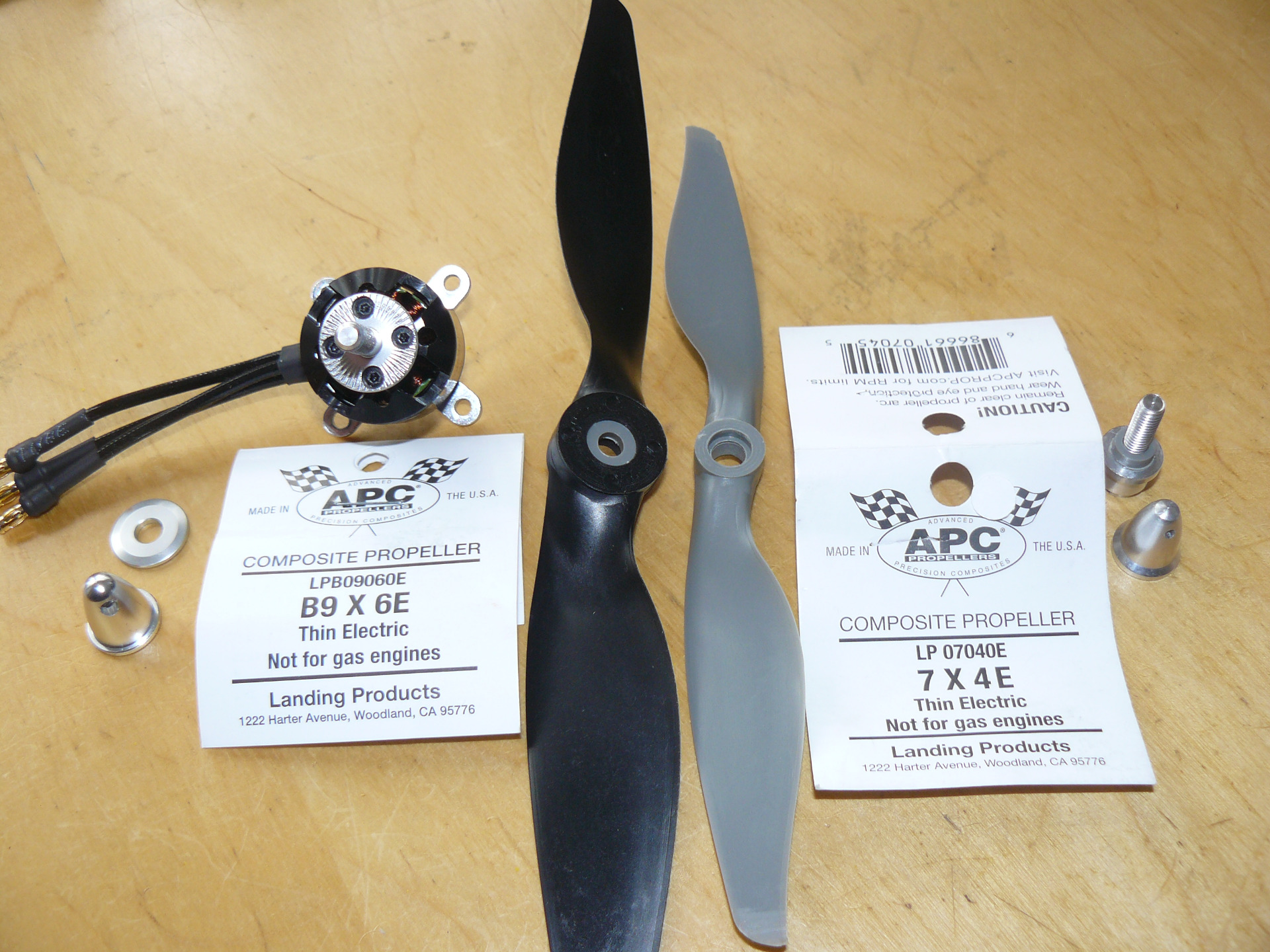
This is one of the things I have noticed when buying RC stuff, there is a pronounced lack of information & standardisation & its not until you get stuff in hand that you see the full story. The experienced will know what's what but the newcomer has to find out the hard way.
The difference in the boss sizes can be seen from this photo, if the 9" prop was put onto the 7" driver I don't think it would last long.
The X-mounts for the T2830 motors have different fixing centres from the A2212s for fixing back to the bulkhead. This isn't easily found when ordering.
Attachments:
Thanks: Klipkopwildlife, THE BLACKBIRD
Please Log in or Create an account to join the conversation.
- THE BLACKBIRD
-

- Offline
- Forum Master
-

Less
More
- Posts: 6781
- Thank you received: 10722
20 Apr 2025 10:03 #33
by THE BLACKBIRD
Replied by THE BLACKBIRD on topic The Model Barn - Slider
But there is always different inserts that come with the props that fit in the hole to fit different shafts,
Thanks: Klipkopwildlife
Please Log in or Create an account to join the conversation.
- Magpie
-
Topic Author
- Offline
- Elite Member
-
Less
More
- Posts: 587
- Thank you received: 1047
20 Apr 2025 11:51 - 20 Apr 2025 11:55 #34
by Magpie
Replied by Magpie on topic The Model Barn - Slider
Yes. And APC probably claim that each prop comes with full instructions.
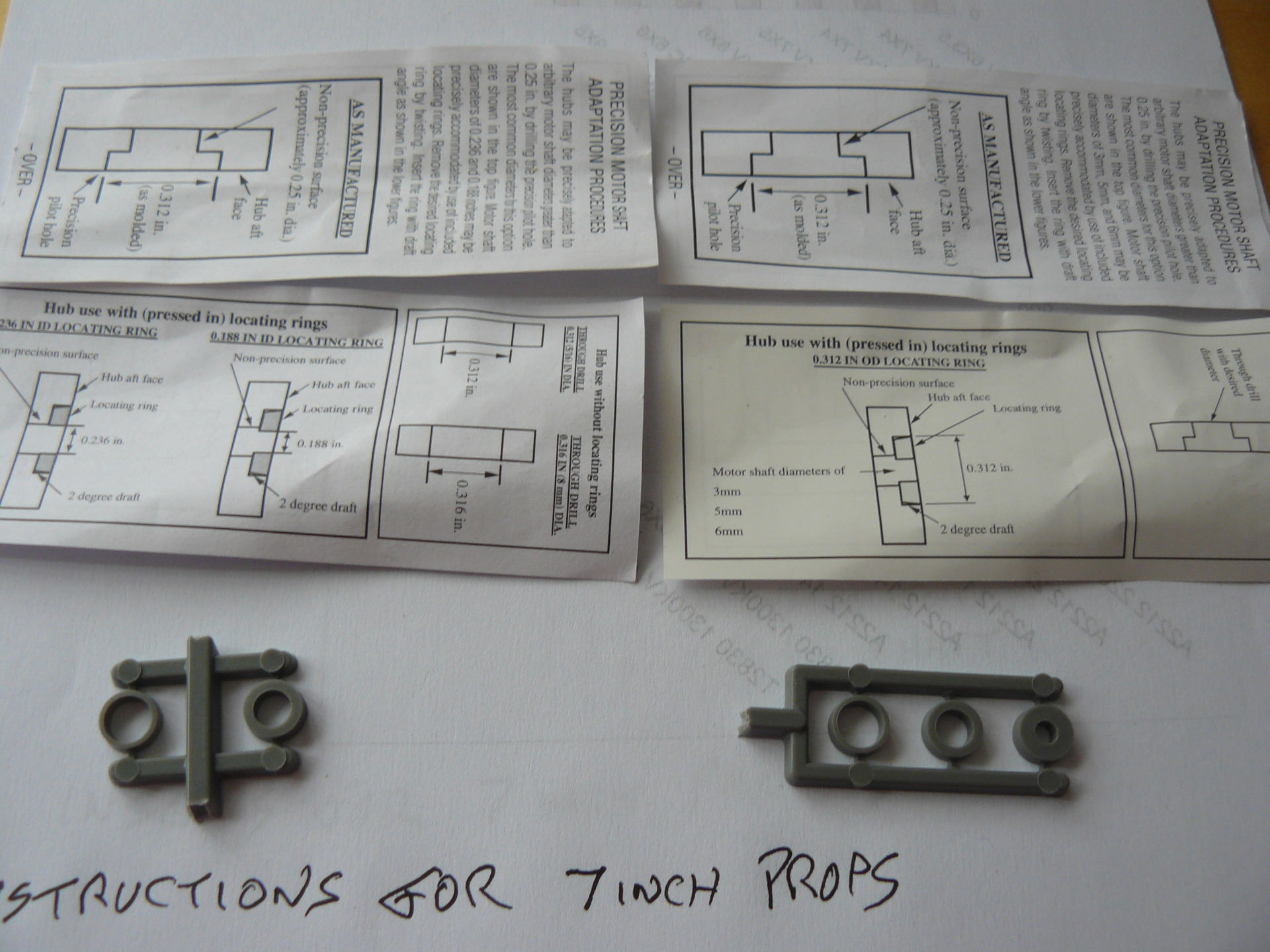
Each prop comes with two slips of paper.
This photo shows each side of the two slips. The upper pair relate to not using an insert at all.
The left lower is for inch dimension shafts. The pair of inserts below it are for these shafts.
The right lower is for 3mm, 5mm & 6mm shafts. The three inserts below it are for these metric shafts.
This took me much mental anguish to work out.

Each prop comes with two slips of paper.
This photo shows each side of the two slips. The upper pair relate to not using an insert at all.
The left lower is for inch dimension shafts. The pair of inserts below it are for these shafts.
The right lower is for 3mm, 5mm & 6mm shafts. The three inserts below it are for these metric shafts.
This took me much mental anguish to work out.
Attachments:
Last edit: 20 Apr 2025 11:55 by Magpie.
Thanks: Klipkopwildlife, Flytilbroke
Please Log in or Create an account to join the conversation.
- Magpie
-
Topic Author
- Offline
- Elite Member
-
Less
More
- Posts: 587
- Thank you received: 1047
20 Apr 2025 12:06 - 20 Apr 2025 12:10 #35
by Magpie
Replied by Magpie on topic The Model Barn - Slider
Both the A2212 & T2830 drivers have 5mm shafts so with the appropriate inserts either prop can be fitted to either motor.

9 inch prop on A2212 driver


7 inch prop on T2830 driver


I wouldn't be happy with either of these pairings..
9 inch prop on A2212 driver
7 inch prop on T2830 driver
I wouldn't be happy with either of these pairings..
Attachments:
Last edit: 20 Apr 2025 12:10 by Magpie.
Thanks: Klipkopwildlife
Please Log in or Create an account to join the conversation.
- Magpie
-
Topic Author
- Offline
- Elite Member
-
Less
More
- Posts: 587
- Thank you received: 1047
20 Apr 2025 13:50 - 20 Apr 2025 13:57 #36
by Magpie
Replied by Magpie on topic The Model Barn - Slider
The data sheet for the T2830 says a 20A ESC , a Power of 210W & prop size 9x6 to 10x6.
My results say a current of 23A for a 9x6 prop which wouldn't suit a 20A ESC - or would the calibration routine turn down the juice abit?
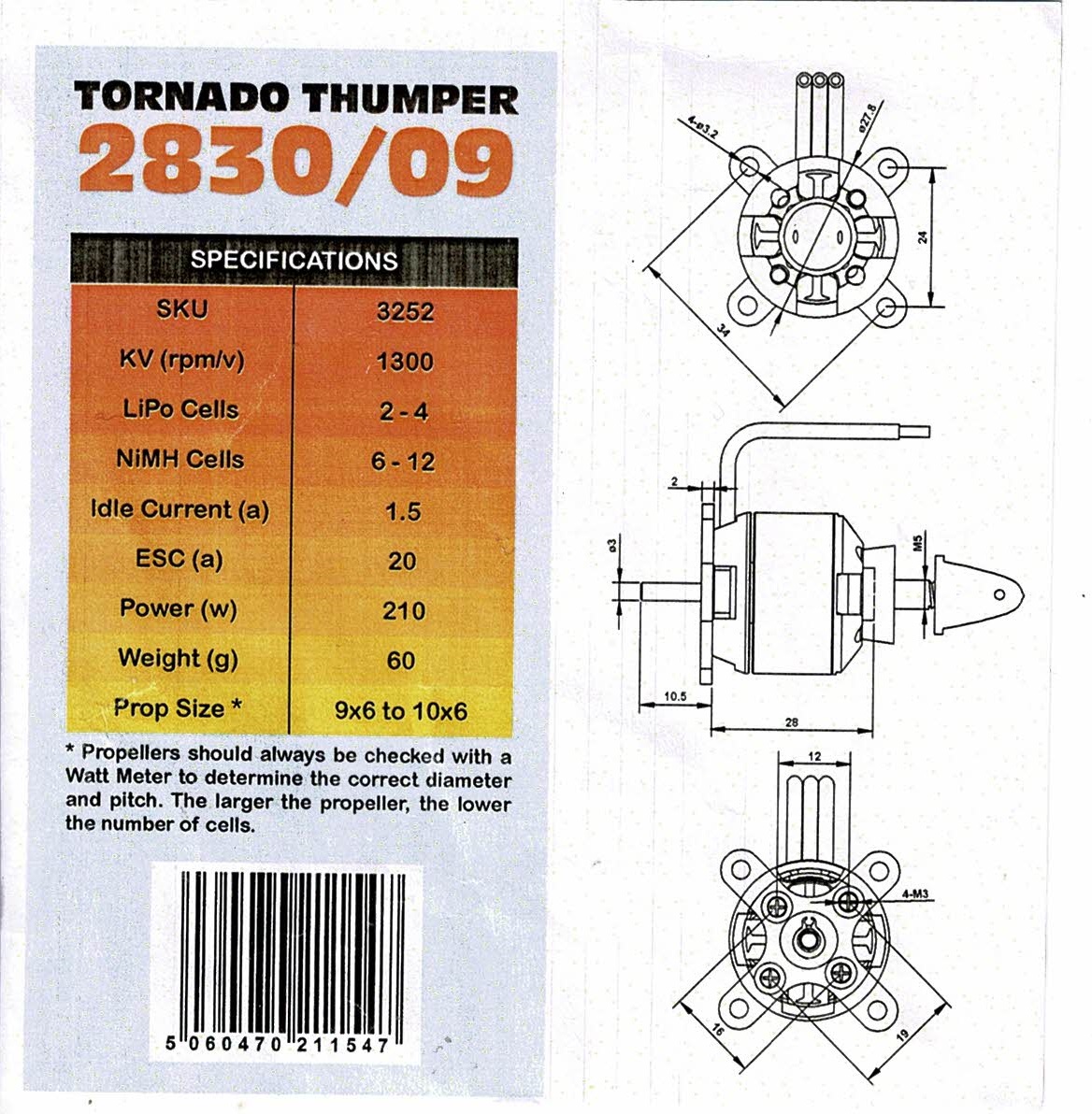
The disclaimer means don't trust these figures.
While we're here the drawing shows a pitch diameter of 34mm for the X-mount which matches the actual beast.
The A2212 X-mounts I have from 4-max & Ebay measure 33mm.
Neither gives a figure but searching the internet shows up several drawings showing 34mm, with one at 32.5mm.
My results say a current of 23A for a 9x6 prop which wouldn't suit a 20A ESC - or would the calibration routine turn down the juice abit?
The disclaimer means don't trust these figures.
While we're here the drawing shows a pitch diameter of 34mm for the X-mount which matches the actual beast.
The A2212 X-mounts I have from 4-max & Ebay measure 33mm.
Neither gives a figure but searching the internet shows up several drawings showing 34mm, with one at 32.5mm.
Attachments:
Last edit: 20 Apr 2025 13:57 by Magpie.
Thanks: Klipkopwildlife
Please Log in or Create an account to join the conversation.
- Magpie
-
Topic Author
- Offline
- Elite Member
-
Less
More
- Posts: 587
- Thank you received: 1047
20 Apr 2025 14:04 - 20 Apr 2025 14:14 #37
by Magpie
Replied by Magpie on topic The Model Barn - Slider
Reply to Qorneng's post on how much bang for your buck:
In the test I took readings at 25% intervals so this shows where the optimum efficiency will be depending on what thrust you need to stay in the air.
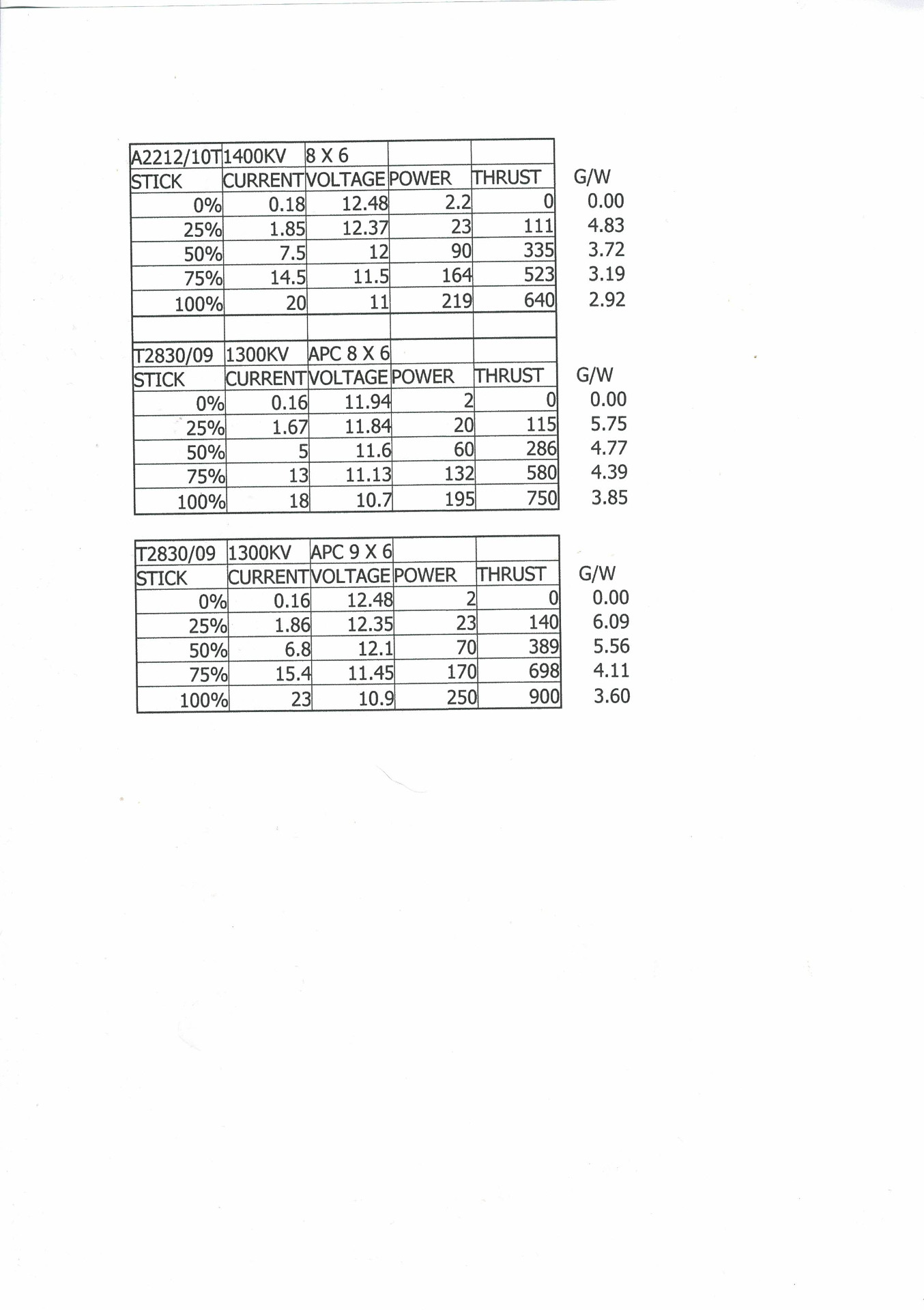
In the test I took readings at 25% intervals so this shows where the optimum efficiency will be depending on what thrust you need to stay in the air.
Attachments:
Last edit: 20 Apr 2025 14:14 by Magpie.
Thanks: Klipkopwildlife
Please Log in or Create an account to join the conversation.
- Eric
-
- Offline
- Moderator
-
Less
More
- Posts: 15406
- Thank you received: 14306
20 Apr 2025 20:14 - 20 Apr 2025 20:17 #38
by Eric
if you are calm and collected when all about you are going berserk - you've missed something important!
Replied by Eric on topic The Model Barn - Slider
You cannot get 23 Amps from a 20 amp speed controller. It simply will not deliver any more than 20 without going bang!
Always go for a speed controller that is at least 25% and preferrably 50% bigger than you need. (We call it headroom!) So look at a 30 or 35 amp controller.
-
That bottom photo with the grey prop - you don't seem to have the correct centreing ring fitted - or it isn't seated correctly - it doesn't look central to the the driver disk or the clamping nut.
Always go for a speed controller that is at least 25% and preferrably 50% bigger than you need. (We call it headroom!) So look at a 30 or 35 amp controller.
-
That bottom photo with the grey prop - you don't seem to have the correct centreing ring fitted - or it isn't seated correctly - it doesn't look central to the the driver disk or the clamping nut.
if you are calm and collected when all about you are going berserk - you've missed something important!
Last edit: 20 Apr 2025 20:17 by Eric. Reason: typo
Thanks: Klipkopwildlife
Please Log in or Create an account to join the conversation.
- Magpie
-
Topic Author
- Offline
- Elite Member
-
Less
More
- Posts: 587
- Thank you received: 1047
20 Apr 2025 21:33 #39
by Magpie
Replied by Magpie on topic The Model Barn - Slider
My phrase
"which wouldn't suit a 20A ESC"
is a diplomatic phrase meaning it would go bang.
The ESCs I am using are rated at 30A.
The centreing ring cannot be seen on the bottom photo, it is inside the prop boss on the opposite/backside of the prop against the driver face. The boss face at the front against the driving nut is un unmachined face of the prop.
That photo is meant to illustrate why I wouldn't put the 7inch props on the T2830 motor.
"which wouldn't suit a 20A ESC"
is a diplomatic phrase meaning it would go bang.
The ESCs I am using are rated at 30A.
The centreing ring cannot be seen on the bottom photo, it is inside the prop boss on the opposite/backside of the prop against the driver face. The boss face at the front against the driving nut is un unmachined face of the prop.
That photo is meant to illustrate why I wouldn't put the 7inch props on the T2830 motor.
Thanks: Eric, Klipkopwildlife
Please Log in or Create an account to join the conversation.
- Klipkopwildlife
-

- Offline
- Administrator
-

- I'm supposed to be retired!
21 Apr 2025 10:11 #40
by Klipkopwildlife
Do it now, you may never get another chance
Replied by Klipkopwildlife on topic The Model Barn - Slider
Personally I would go for the 250watt option, you can always reduce throttle! A bit extra is always useful, but make sure the ESC has good airflow over it.
Do it now, you may never get another chance
Thanks: Eric
Please Log in or Create an account to join the conversation.
- Magpie
-
Topic Author
- Offline
- Elite Member
-
Less
More
- Posts: 587
- Thank you received: 1047
22 Apr 2025 10:27 #41
by Magpie
Replied by Magpie on topic The Model Barn - Slider
I can see why you suggest that, throttling back would give a better efficiency than the smaller prop.
If I set the high end point down to say 75% I would get 700g thrust for only 15A which should be enough to lift a 1100g plane & keep it in the air assuming the drag isn't too high
When I ran it at the full whack for a few seconds neither the ESC or the motor seemed to get too hot. The problem is the specs are not clear or even non-existing and the outsides may be getting cooled whereas the insides where the heat is generated are not & there are no sensors to tell you.
The balsa nosepiece was knocked off so I could put the lead straight onto the former which would expose more of the motor.
There was no provision for ventilating the inside of the model in the kit, I added two louvres but I don't know how effective they are.
Over the weekend I have been using my Raspberry Pi to drive the motor on my test rig.
Again there is a complete lack of information on calibration. I have been able to work out what I need to program to sequence the ESC through a calibration & get it to turn the motor so I can repeat the tests.
Needless to say I have not been using a prop while I was playing around.
If I set the high end point down to say 75% I would get 700g thrust for only 15A which should be enough to lift a 1100g plane & keep it in the air assuming the drag isn't too high
When I ran it at the full whack for a few seconds neither the ESC or the motor seemed to get too hot. The problem is the specs are not clear or even non-existing and the outsides may be getting cooled whereas the insides where the heat is generated are not & there are no sensors to tell you.
The balsa nosepiece was knocked off so I could put the lead straight onto the former which would expose more of the motor.
There was no provision for ventilating the inside of the model in the kit, I added two louvres but I don't know how effective they are.
Over the weekend I have been using my Raspberry Pi to drive the motor on my test rig.
Again there is a complete lack of information on calibration. I have been able to work out what I need to program to sequence the ESC through a calibration & get it to turn the motor so I can repeat the tests.
Needless to say I have not been using a prop while I was playing around.
Thanks: Klipkopwildlife, THE BLACKBIRD
Please Log in or Create an account to join the conversation.
- Klipkopwildlife
-
- Offline
- Administrator
-
- I'm supposed to be retired!
22 Apr 2025 10:57 #42
by Klipkopwildlife
Do it now, you may never get another chance
Replied by Klipkopwildlife on topic The Model Barn - Slider
Sorry Magpie, you've sort of got the idea, don't reduce the available maximum revs, let you fingers do that, then you have extra if you should need it.
Do it now, you may never get another chance
Thanks: Eric, Flytilbroke, THE BLACKBIRD
Please Log in or Create an account to join the conversation.
- Eric
-
- Offline
- Moderator
-
Less
More
- Posts: 15406
- Thank you received: 14306
22 Apr 2025 18:06 - 22 Apr 2025 18:20 #43
by Eric
if you are calm and collected when all about you are going berserk - you've missed something important!
Replied by Eric on topic The Model Barn - Slider
As Klippy put, too much power can get you out of trouble, and you can throttle back for actual flying! Do you drive your car wih the go pedal crushed to the floor?
Inlets for cooling air are fine, but you need exhaust vents as well! Don't forget that hot air is 'bigger' than cold air!
For a given rpm, a bigger diameter prop will always be more efficient than a smaller one, simply because it shifts more air! The same applies with the pitch of the prop.
If you picture the prop as a screw (they are really called airscrews!) the pitch decides how far the thing would travel through a solid substance - so a 3" pitch prop would go 3" per rev, whilst a 7" pitch would go 7", but need more torque.
The combination of rpm's and pitch decides on the airspeed - if you ignore 'slippage' and drag, etc etc. (slippage - picture your car starting to move off from a patch of ice).
It's all a balancing act between rpm's, pitch, diameter, current draw, and battery capacity. - - and that is why you need a Wattmeter for initial testing and trials - so you can SEE how much power is being drawn from the battery - and thus decide on what pitch and diameter prop suits the motor best.
Inlets for cooling air are fine, but you need exhaust vents as well! Don't forget that hot air is 'bigger' than cold air!
For a given rpm, a bigger diameter prop will always be more efficient than a smaller one, simply because it shifts more air! The same applies with the pitch of the prop.
If you picture the prop as a screw (they are really called airscrews!) the pitch decides how far the thing would travel through a solid substance - so a 3" pitch prop would go 3" per rev, whilst a 7" pitch would go 7", but need more torque.
The combination of rpm's and pitch decides on the airspeed - if you ignore 'slippage' and drag, etc etc. (slippage - picture your car starting to move off from a patch of ice).
It's all a balancing act between rpm's, pitch, diameter, current draw, and battery capacity. - - and that is why you need a Wattmeter for initial testing and trials - so you can SEE how much power is being drawn from the battery - and thus decide on what pitch and diameter prop suits the motor best.
if you are calm and collected when all about you are going berserk - you've missed something important!
Last edit: 22 Apr 2025 18:20 by Eric. Reason: added a comment
Thanks: Klipkopwildlife, THE BLACKBIRD
Please Log in or Create an account to join the conversation.
- Magpie
-
Topic Author
- Offline
- Elite Member
-
Less
More
- Posts: 587
- Thank you received: 1047
25 Apr 2025 16:18 - 25 Apr 2025 16:24 #44
by Magpie
Replied by Magpie on topic The Model Barn - Slider
I ran the T2830/09 motor with an APC 9x6 prop this afternoon driving it from my Raspberry Pi.
I calibrated the ESC from 30 degrees to 180 degrees and programmed it in steps from 50 degrees. At 100 degrees I was starting to get nervous so pulled it back to check the battery. It was warm but not hot so I took it up to 150 degrees when I decided that was enough.
The supply voltage had dropped to 10.5v but after switching off the battery recovered to 11.45v.
To me 900g thrust in a 1100g plane is almost vertical take off so my conclusion is that I will set the high end point on the throttle to 75% which gives about 700g thrust & I can always increase it later when I get through the training & can fly it myself.

I calibrated the ESC from 30 degrees to 180 degrees and programmed it in steps from 50 degrees. At 100 degrees I was starting to get nervous so pulled it back to check the battery. It was warm but not hot so I took it up to 150 degrees when I decided that was enough.
The supply voltage had dropped to 10.5v but after switching off the battery recovered to 11.45v.
To me 900g thrust in a 1100g plane is almost vertical take off so my conclusion is that I will set the high end point on the throttle to 75% which gives about 700g thrust & I can always increase it later when I get through the training & can fly it myself.
Attachments:
Last edit: 25 Apr 2025 16:24 by Magpie.
Thanks: Klipkopwildlife, Flytilbroke, Quorneng
Please Log in or Create an account to join the conversation.
- Klipkopwildlife
-
- Offline
- Administrator
-
- I'm supposed to be retired!
25 Apr 2025 17:35 #45
by Klipkopwildlife
Do it now, you may never get another chance
Replied by Klipkopwildlife on topic The Model Barn - Slider
Let your fingers do the talking

Do it now, you may never get another chance
Please Log in or Create an account to join the conversation.
Time to create page: 0.579 seconds