
- Thank you received: 0
SAMS 30" Lacey M-10 - Pre-Production Kit
- Ex-Member
- Topic Author
- User
-

Less
More
02 Mar 2018 18:57 #1
by Ex-Member
SAMS 30" Lacey M-10 - Pre-Production Kit was created by Ex-Member
Well, the next project is now on the board, it's a check to make sure the new SAMS Lacey M-10 kit produces the required model. The first set of laser cut parts arrived just over a week ago, the fuselage plan was completed this morning.
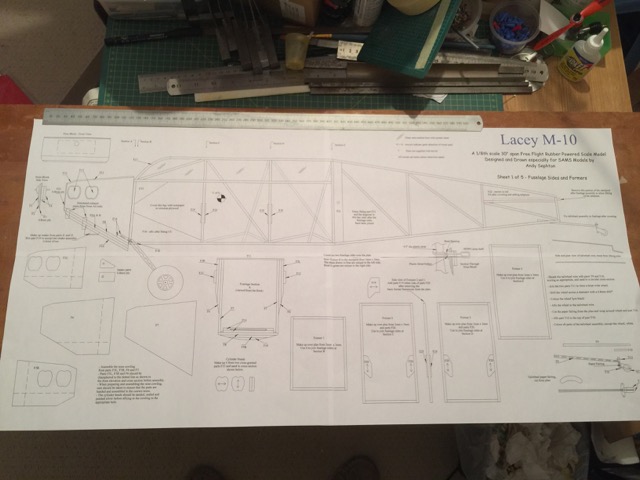
First impressions are good in that the parts match the plan! .

Accordingly, the first fuselage side was commenced this eve. The basic frame is 3mm (1/8") balsa, so I'm using jigging blocks of scrap 6mm (1/4") balsa to locate the various parts. A second set of parts was cut as the first side was built, so that side two may be laid down directly over side one with a fair probability that both will be the same size. This is as far as I got:

I'm aiming to get the model finished in time for the BMFA Scale Indoor Nats in April so that I can enter it in Open Rubber.
First impressions are good in that the parts match the plan!
.
Accordingly, the first fuselage side was commenced this eve. The basic frame is 3mm (1/8") balsa, so I'm using jigging blocks of scrap 6mm (1/4") balsa to locate the various parts. A second set of parts was cut as the first side was built, so that side two may be laid down directly over side one with a fair probability that both will be the same size. This is as far as I got:
I'm aiming to get the model finished in time for the BMFA Scale Indoor Nats in April so that I can enter it in Open Rubber.
Please Log in or Create an account to join the conversation.
- Squirrelnet
- Offline
- Elite Member
-

Less
More
- Posts: 754
- Thank you received: 2067
02 Mar 2018 19:18 #2
by Squirrelnet
Replied by Squirrelnet on topic SAMS 30" Lacey M-10 - Pre-Production Kit
Looks like a nicely done kit, looking forward to seeing progress
Thanks: Ex-Member
Please Log in or Create an account to join the conversation.
- Ex-Member
- Topic Author
- User
-
Less
More
- Thank you received: 0
03 Mar 2018 16:54 #3
by Ex-Member
Replied by Ex-Member on topic SAMS 30" Lacey M-10 - Pre-Production Kit
The build progresses. Side one is complete, the parts for side two rest adjacent:

Side two built over side one:

Fuselage formers off the board, wing band anchor hook doublers ready for fixing and wing ribs set in a block ready for a light sanding to remove the burn marks:
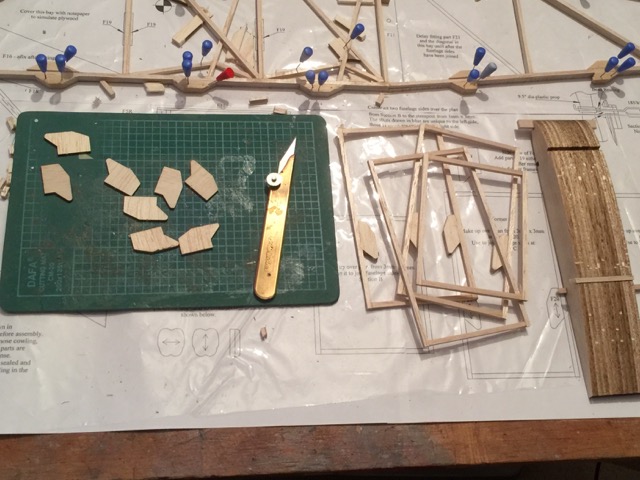
Side two built over side one:
Fuselage formers off the board, wing band anchor hook doublers ready for fixing and wing ribs set in a block ready for a light sanding to remove the burn marks:
Please Log in or Create an account to join the conversation.
- Mike Rolls
-

- Offline
- Elite Member
-
Less
More
- Posts: 634
- Thank you received: 573
03 Mar 2018 17:02 #4
by Mike Rolls
The older I get, the better I was!
Replied by Mike Rolls on topic SAMS 30" Lacey M-10 - Pre-Production Kit
Don't shoot me - but I have always thought that if somebody sat down to design the most boring aeroplane shape that he could imagine, the result would have been the Lacey
Mike
Mike
The older I get, the better I was!
Thanks: Squirrelnet
Please Log in or Create an account to join the conversation.
- Ex-Member
- Topic Author
- User
-
Less
More
- Thank you received: 0
03 Mar 2018 17:08 #5
by Ex-Member
Ah, another Lacey knocker! Beauty is in the eye of the beholder Mike.
Joking apart, while the Lacey has a simple form, it turns out to be a scale model that is easy to build, trim and operate. This makes it an ideal beginners kit for an intro into scale modelling. As well as allowing the beginner to gain confidence in building, trimming and flying a scale model, it should also be competitive in BMFA Kit Scale. In fact, the prototype for the kit won the BMFA Scale Rubber Powered Free Flight Nationals last year.
Replied by Ex-Member on topic SAMS 30" Lacey M-10 - Pre-Production Kit
Mike Rolls wrote: Don't shoot me - but I have always thought that if somebody sat down to design the most boring aeroplane shape that he could imagine, the result would have been the Lacey
Mike
Ah, another Lacey knocker! Beauty is in the eye of the beholder Mike.
Joking apart, while the Lacey has a simple form, it turns out to be a scale model that is easy to build, trim and operate. This makes it an ideal beginners kit for an intro into scale modelling. As well as allowing the beginner to gain confidence in building, trimming and flying a scale model, it should also be competitive in BMFA Kit Scale. In fact, the prototype for the kit won the BMFA Scale Rubber Powered Free Flight Nationals last year.
Please Log in or Create an account to join the conversation.
- Ex-Member
- Topic Author
- User
-
Less
More
- Thank you received: 0
05 Mar 2018 08:01 #6
by Ex-Member
Replied by Ex-Member on topic SAMS 30" Lacey M-10 - Pre-Production Kit
Not much to show today, but I did manage to complete the empennage and wing plans and get them printed and joined:

The fuselage sides were removed from the plan, trimmed and sanded so they now match exactly:
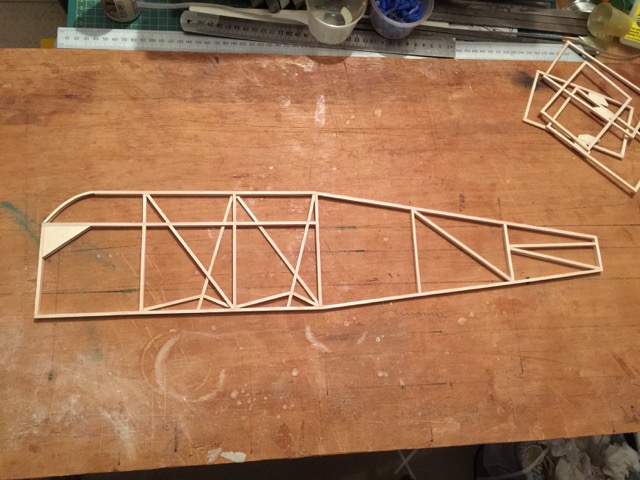
The two sides were then separated using a razor blade:
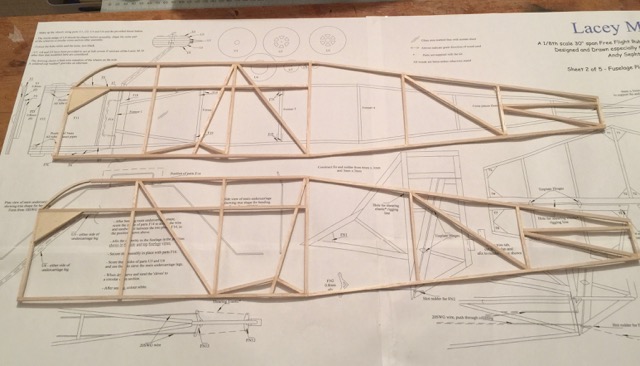
Joining the sides next!
The fuselage sides were removed from the plan, trimmed and sanded so they now match exactly:
The two sides were then separated using a razor blade:
Joining the sides next!
Please Log in or Create an account to join the conversation.
- Reach
-

- Offline
- Senior Member
-

Less
More
- Posts: 50
- Thank you received: 28
05 Mar 2018 18:54 #7
by Reach
Replied by Reach on topic SAMS 30" Lacey M-10 - Pre-Production Kit
There is no denying it....that's an ugly airplane! But it should be a super excellent flier, so there is a balance. I love your forum builds, always something to learn and your workmanship is superb. Thank you for taking the time and effort. 
Thanks: Ex-Member
Please Log in or Create an account to join the conversation.
- Ex-Member
- Topic Author
- User
-
Less
More
- Thank you received: 0
05 Mar 2018 19:38 #8
by Ex-Member
Replied by Ex-Member on topic SAMS 30" Lacey M-10 - Pre-Production Kit
Thanks for the kind words Reach, they're much appreciated.
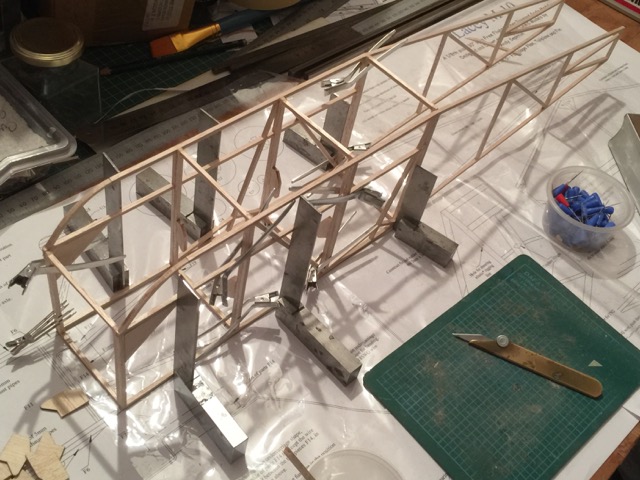
Today's efforts entered on joining the fuselage sides using the four made up formers:
..and laying down the tailplane, elevators, fin and rudder. I've pushed pins through the 6mm x 3mm (1/4" x 1/8") wood, but I've used scrap wood from the laser cut sheets to hold down the 3mm x 3mm (1/8" x 1/8").

Wings next, plus rear fuselage joining, cross pieces and nose cowl..
Today's efforts entered on joining the fuselage sides using the four made up formers:
..and laying down the tailplane, elevators, fin and rudder. I've pushed pins through the 6mm x 3mm (1/4" x 1/8") wood, but I've used scrap wood from the laser cut sheets to hold down the 3mm x 3mm (1/8" x 1/8").
Wings next, plus rear fuselage joining, cross pieces and nose cowl..
Please Log in or Create an account to join the conversation.
- Ex-Member
- Topic Author
- User
-
Less
More
- Thank you received: 0
09 Mar 2018 17:50 #9
by Ex-Member
Replied by Ex-Member on topic SAMS 30" Lacey M-10 - Pre-Production Kit
The wing ribs were removed from the laser cut panels, set into a block, spar slots checked with scrap pieces of spar and LE, and the laser burn lightly sanded to reduce the colour to that of dark balsa:

The wing was then laid down on the plan - the distinct advantage of the Lacey is that there is only one off them...

The empennage was removed from the plan a day or so ago, and the excess word removed:

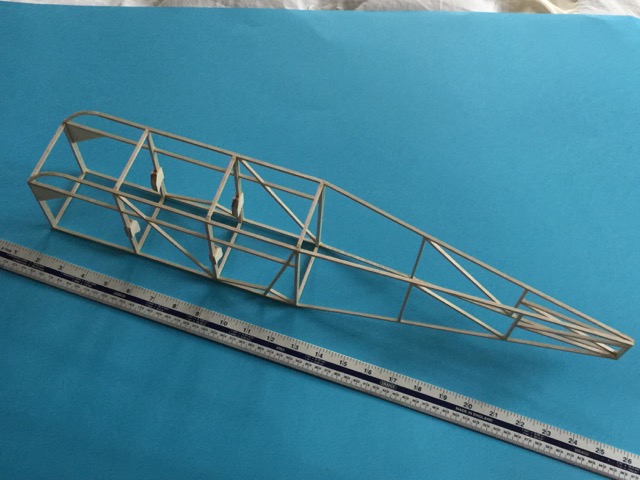
In the meantime, the rear fuselage was cracked behind the wing/cabin position and the sternposts brought together
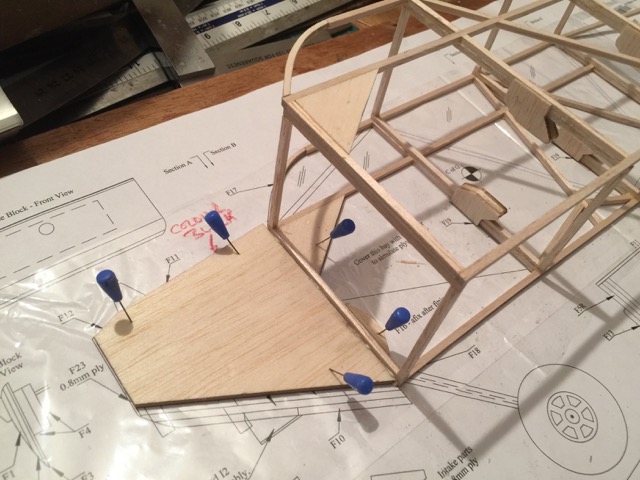
One side of the nose cowling added to the nose of the fuselage:
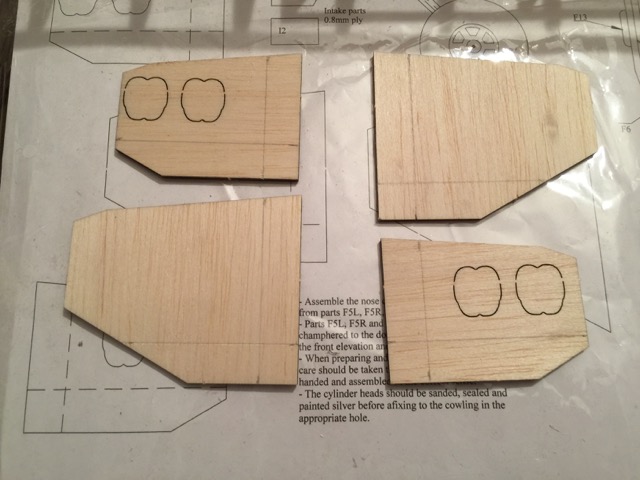
The rest of the cowling has been marked up for sanding, taking care that the orientaion of the parts was correct - the right hand cylinder heads are positioned slightly further back than those on the left.
and the four cylinder heads have been laminated from 3mm parts

Finally, the small strip doublers (to prevent the wing tips being pulled in by the covering) were added to the wing tip ribs:
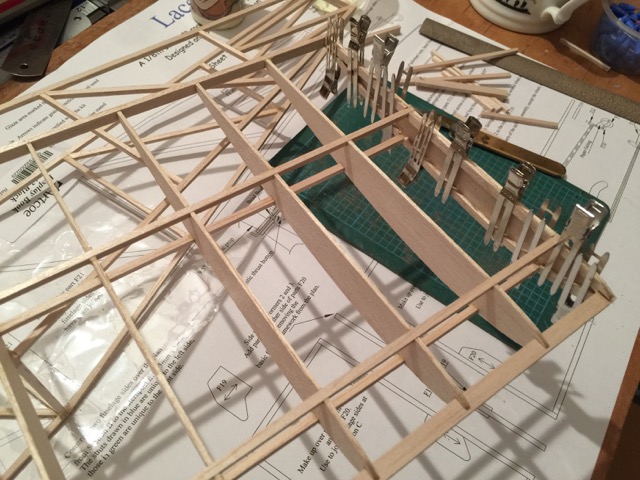
The wing was then laid down on the plan - the distinct advantage of the Lacey is that there is only one off them...
The empennage was removed from the plan a day or so ago, and the excess word removed:
In the meantime, the rear fuselage was cracked behind the wing/cabin position and the sternposts brought together
One side of the nose cowling added to the nose of the fuselage:
The rest of the cowling has been marked up for sanding, taking care that the orientaion of the parts was correct - the right hand cylinder heads are positioned slightly further back than those on the left.
and the four cylinder heads have been laminated from 3mm parts
Finally, the small strip doublers (to prevent the wing tips being pulled in by the covering) were added to the wing tip ribs:
Please Log in or Create an account to join the conversation.
- Reach
-
- Offline
- Senior Member
-
Less
More
- Posts: 50
- Thank you received: 28
09 Mar 2018 19:15 #10
by Reach
Replied by Reach on topic SAMS 30" Lacey M-10 - Pre-Production Kit
I'm surprised that the wing ribs don't have some lightening holes in them, specially since its a laser cut kit. Would be so simple and perhaps save a gram or two.
A question, are the curved lower, front fuse formers laser cut or formed?
A question, are the curved lower, front fuse formers laser cut or formed?
Please Log in or Create an account to join the conversation.
- one tenor
-

- Offline
- Forum Veteran
-

- johnpcalex@gmail.com
09 Mar 2018 21:26 #11
by one tenor
Anything will fly given enough power
Replied by one tenor on topic SAMS 30" Lacey M-10 - Pre-Production Kit
Lower front Reach?
Anything will fly given enough power
Please Log in or Create an account to join the conversation.
- Reach
-
- Offline
- Senior Member
-
Less
More
- Posts: 50
- Thank you received: 28
09 Mar 2018 23:01 #12
by Reach
Replied by Reach on topic SAMS 30" Lacey M-10 - Pre-Production Kit
Yeah....the lower front longeron takes a sharp curve upward. I was just wondering if that piece is formed or laser cut.
Please Log in or Create an account to join the conversation.
- Ex-Member
- Topic Author
- User
-
Less
More
- Thank you received: 0
10 Mar 2018 08:32 #13
by Ex-Member
Replied by Ex-Member on topic SAMS 30" Lacey M-10 - Pre-Production Kit
Taking the questions in order, Reach:
Holes in the ribs - The model is designed as a kit with the beginner in mind and therefore, it needs to be robust. The wing area of the model will take a lot of extra weight. Holes in the ribs would not significantly reduce the weight, but they would reduce the strength of the ribs. Ergo, we made the decision at the design stage to make the ribs solid. The prototype model was made up with solid ribs cut from medium weight balsa and achieved the second best flying score at the BMFA Scale Indoor Nationals last year and the best flying score at the BMFA Scale Outdoor Nationals, winning the latter contest outright. I'm content that the solid ribs will produce a practical flying model, but in the end, there's nothing stopping you from cutting your own holes.
Lower longeron - I'm not sure that I fully understand the question, but if you look back at the last two pictorial posts in the thread and the picture below you'll see that the lower longeron finishes at the front bulkhead and is straight. The nose cowl is a part laser cut from 3mm balsa that is glued directly onto the front of the fuselage.

I hope that answers the questions
Holes in the ribs - The model is designed as a kit with the beginner in mind and therefore, it needs to be robust. The wing area of the model will take a lot of extra weight. Holes in the ribs would not significantly reduce the weight, but they would reduce the strength of the ribs. Ergo, we made the decision at the design stage to make the ribs solid. The prototype model was made up with solid ribs cut from medium weight balsa and achieved the second best flying score at the BMFA Scale Indoor Nationals last year and the best flying score at the BMFA Scale Outdoor Nationals, winning the latter contest outright. I'm content that the solid ribs will produce a practical flying model, but in the end, there's nothing stopping you from cutting your own holes.
Lower longeron - I'm not sure that I fully understand the question, but if you look back at the last two pictorial posts in the thread and the picture below you'll see that the lower longeron finishes at the front bulkhead and is straight. The nose cowl is a part laser cut from 3mm balsa that is glued directly onto the front of the fuselage.
I hope that answers the questions
Please Log in or Create an account to join the conversation.
- Eric
-

- Offline
- Moderator
-

Less
More
- Posts: 13726
- Thank you received: 14467
10 Mar 2018 09:32 #14
by Eric
if you are calm and collected when all about you are going berserk - you've missed something important!
Replied by Eric on topic SAMS 30" Lacey M-10 - Pre-Production Kit
Going off-topic for a moment - (Mods can remove this after a couple of days if they wish)
For weird-looking real aircraft, have a look at the Tipsy Nipper, or the Clutton Fred! :evil:
For weird-looking real aircraft, have a look at the Tipsy Nipper, or the Clutton Fred! :evil:
if you are calm and collected when all about you are going berserk - you've missed something important!
Thanks: Ex-Member
Please Log in or Create an account to join the conversation.
- Ex-Member
- Topic Author
- User
-
Less
More
- Thank you received: 0
10 Mar 2018 11:37 #15
by Ex-Member
Replied by Ex-Member on topic SAMS 30" Lacey M-10 - Pre-Production Kit
No problem with that Eric, it's a good discussion point.
Eric Clutton is an aeromodeller who put his model design skills to building a model like full-size aircraft, the Clutton Fred. It also makes into a good flying model, as does the Tipsy Nipper.
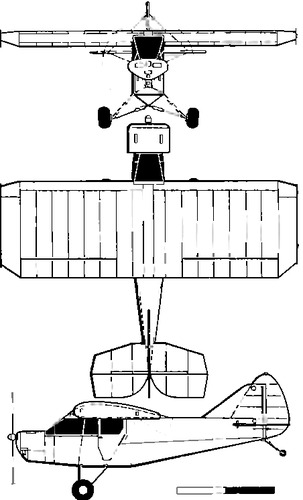
On a similar theme, the Lacey wing idea was developed into the experimental Fike 'E', which was essentially a Piper Cub fuselage with the largest practical low-aspect ratio wing. It also had appropriately modified tail surfaces and as with the Lacey, it makes up into a nice stable model:
Eric Clutton is an aeromodeller who put his model design skills to building a model like full-size aircraft, the Clutton Fred. It also makes into a good flying model, as does the Tipsy Nipper.
On a similar theme, the Lacey wing idea was developed into the experimental Fike 'E', which was essentially a Piper Cub fuselage with the largest practical low-aspect ratio wing. It also had appropriately modified tail surfaces and as with the Lacey, it makes up into a nice stable model:
Please Log in or Create an account to join the conversation.
Time to create page: 1.748 seconds