
- Posts: 10058
- Thank you received: 19043
A Depron Airbus A350 - 1000 for 76 mm EDFs
- Quorneng
-
 Topic Author
- Offline
- Forum Master
-

Less
More
12 Nov 2017 00:20 - 12 Nov 2017 00:21 #16
by Quorneng
Replied by Quorneng on topic A Depron Airbus A350 - 1000 for 76 mm EDFs
Andy
The props are for a 'racing' quad which from what I have seen go faster than I intend to fly! They are actually 3x3 which is quite a coarse pitch relative to the diameter.
My previous ducted props both used 4.5x4.5 which worked well enough.
Todays experiment was to mount one of the motors and fans to see what happened.
To make life easier I decided to mount it as a 'right at the back' pusher.
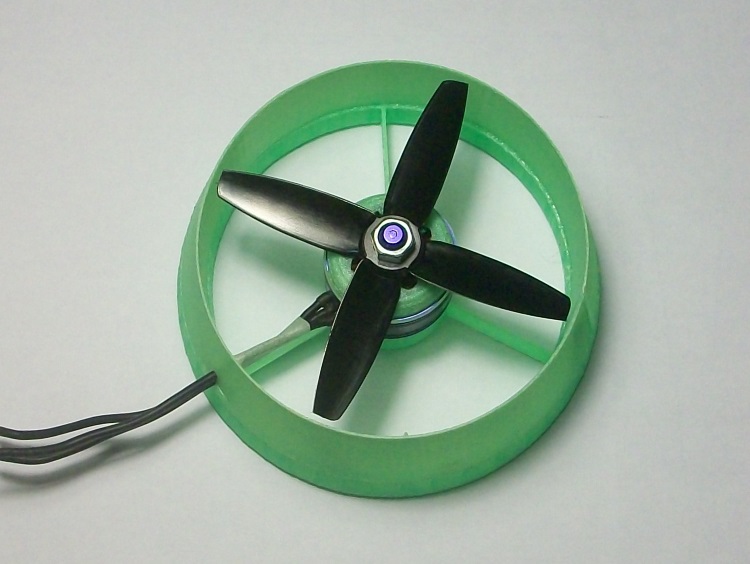
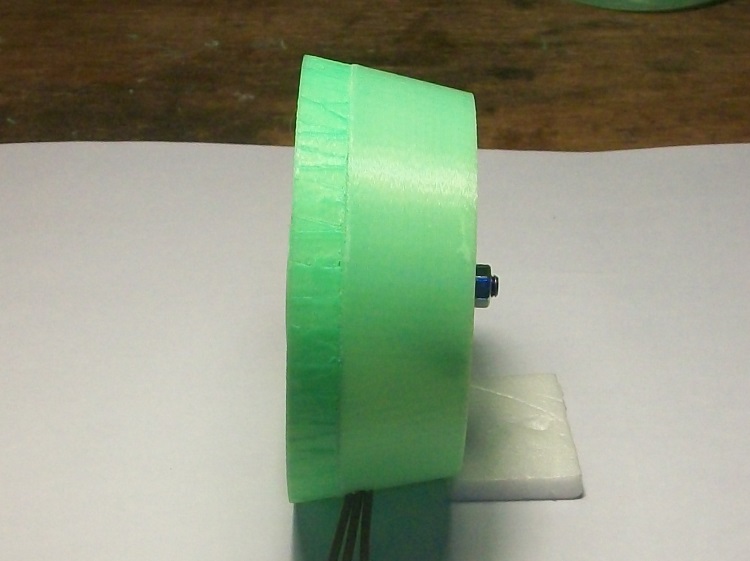
The duct is in two parts. The motor mount itself, printed as a particularly rigid structure and thus probably over strength and over weight and a lightweight cone glued on the back to cover the prop. Complete ready to run it weighs 45 g. The bare motor weighs 28 g.
I have run it on a 3S and it blows surprisingly hard drawing just 4A. I will build a stand so I can actually measure the thrust
.
A pair of 20A 4S ESCs are on order (also for a drone so cheap!) along with a drone BEC!
If it looks like the thrust will be adequate I will likely return to a 'tractor' arrangement (much of the design is common anyway) simply because it allows a Trent type tail cone for scale appearance.
The props are for a 'racing' quad which from what I have seen go faster than I intend to fly! They are actually 3x3 which is quite a coarse pitch relative to the diameter.
My previous ducted props both used 4.5x4.5 which worked well enough.
Todays experiment was to mount one of the motors and fans to see what happened.
To make life easier I decided to mount it as a 'right at the back' pusher.
The duct is in two parts. The motor mount itself, printed as a particularly rigid structure and thus probably over strength and over weight and a lightweight cone glued on the back to cover the prop. Complete ready to run it weighs 45 g. The bare motor weighs 28 g.
I have run it on a 3S and it blows surprisingly hard drawing just 4A. I will build a stand so I can actually measure the thrust
.
A pair of 20A 4S ESCs are on order (also for a drone so cheap!) along with a drone BEC!
If it looks like the thrust will be adequate I will likely return to a 'tractor' arrangement (much of the design is common anyway) simply because it allows a Trent type tail cone for scale appearance.
Last edit: 12 Nov 2017 00:21 by Quorneng.
Thanks: Klipkopwildlife, THE BLACKBIRD, boz
Please Log in or Create an account to join the conversation.
- Mike Rolls
-

- Offline
- Elite Member
-

Less
More
- Posts: 698
- Thank you received: 573
12 Nov 2017 05:35 #17
by Mike Rolls
The older I get, the better I was!
Replied by Mike Rolls on topic A Depron Airbus A350 - 1000 for 76 mm EDFs
Q
according to the Thrust HP site - which I have in the past found reasonably accurate, although to be fair, I have never used props as small as 3x3, to get 200g of static thrust on a four blade prop you need around 32,000 rpm.
Mike
according to the Thrust HP site - which I have in the past found reasonably accurate, although to be fair, I have never used props as small as 3x3, to get 200g of static thrust on a four blade prop you need around 32,000 rpm.
Mike
The older I get, the better I was!
Thanks: boz
Please Log in or Create an account to join the conversation.
- Ex-Member
- Visitor
-

12 Nov 2017 06:31 - 12 Nov 2017 06:33 #18
by Ex-Member
Replied by Ex-Member on topic A Depron Airbus A350 - 1000 for 76 mm EDFs
Q, a prop produces thrust by producing lift in the same way as a wing produces lift. If you do a vector diagram of a rotating prop with the forward and rotating velocities, you'll see that in order to produce thrust, the propeller needs to have positive incidence to the relative airflow. With low pitch, you need either low forward velocity or very high rotational velocity to get positive incidence on the propeller blade. If the rotating velocity is not fast enough or the forward velocity too fast, the incidence on the prop will be negative and it will produce negative thrust, or drag.
The fundamental difference between a drone and a conventional aircraft is that with the latter, the propeller axis is aligned with the forward velocity of the aircraft, with the drone, the propeller axis are aligned at about 90 degrees to the forward velocity of the aircraft. Whether it's a racing drone or not, the pitch required on the propeller blade of the drone will be a lot less than that required on the conventional aircraft. As you've said, the pitch on your ducted fan blade is 50% higher than that on the drone propeller, which is a significant difference.
I'm not saying that what you are doing won't work. What I am saying is that your drone propeller is optimised for operation with low forward speed along the axis of the propeller. By turning that axis through 90 degrees, you may find that the pitch on the blade is too low and may not produce the thrust that you require or expect.
The fundamental difference between a drone and a conventional aircraft is that with the latter, the propeller axis is aligned with the forward velocity of the aircraft, with the drone, the propeller axis are aligned at about 90 degrees to the forward velocity of the aircraft. Whether it's a racing drone or not, the pitch required on the propeller blade of the drone will be a lot less than that required on the conventional aircraft. As you've said, the pitch on your ducted fan blade is 50% higher than that on the drone propeller, which is a significant difference.
I'm not saying that what you are doing won't work. What I am saying is that your drone propeller is optimised for operation with low forward speed along the axis of the propeller. By turning that axis through 90 degrees, you may find that the pitch on the blade is too low and may not produce the thrust that you require or expect.
Last edit: 12 Nov 2017 06:33 by Ex-Member.
Please Log in or Create an account to join the conversation.
- Quorneng
-
Topic Author
- Offline
- Forum Master
-
Less
More
- Posts: 10058
- Thank you received: 19043
12 Nov 2017 13:45 #19
by Quorneng
Replied by Quorneng on topic A Depron Airbus A350 - 1000 for 76 mm EDFs
The motors are 2500 Kv and at 4s (say 14V) gives 35000 rpm with a pitch speed of 99 mph - if I have done the sums right!
Assuming the motor and prop can stand it its in the right ball park.
In fact with my 'guessed' flight speed of 30 mph it should manage on 3s - 27000 rpm & 78 mph pitch speed.
Static thrust test to follow.
Assuming the motor and prop can stand it its in the right ball park.
In fact with my 'guessed' flight speed of 30 mph it should manage on 3s - 27000 rpm & 78 mph pitch speed.
Static thrust test to follow.
Thanks: boz
Please Log in or Create an account to join the conversation.
- Mike Rolls
-
- Offline
- Elite Member
-
Less
More
- Posts: 698
- Thank you received: 573
12 Nov 2017 16:42 #20
by Mike Rolls
The older I get, the better I was!
Replied by Mike Rolls on topic A Depron Airbus A350 - 1000 for 76 mm EDFs
27,000 should give you around 136g static thrust - will that be OK?
Mike
Mike
The older I get, the better I was!
Thanks: boz
Please Log in or Create an account to join the conversation.
- Ex-Member
- Visitor
-
12 Nov 2017 19:22 #21
by Ex-Member
Replied by Ex-Member on topic A Depron Airbus A350 - 1000 for 76 mm EDFs
Mike: The static thrust is not really relevant. As soon as the model moves forwards, the incidence on the propeller blade will reduce, which will reduce the thrust. A low pitch will give a high static thrust, but the reduction in thrust with forward speed will be significant.
Q: For the same reason as above, treating the propeller as a screw thread is not relevant to estimating thrust. The thrust of the propeller depends on the angle of incidence of the relative airflow on the blade in the same way that a wing produces lift dependant on the angle of incidence of the relative airflow. In order to produce significant thrust, the angle of incidence needs to be high, which is why static thrust is normally high. As soon as the model moves forward the angle of incidence of the relative airflow on the propeller blade will reduce, reducing thrust. If you want to estimate the propellers thrust at certain speeds, you need to know the lift coefficient of the blade and the angle of the relative airflow. Notwithstanding, the result will be significantly less than assuming the blade is a simple screw thread.
Notwithstanding the above, I'm not saying that the prop will not work on your model Q, all I'm saying is that the propeller may not produce the thrust you want or the thrust you expect.
Q: For the same reason as above, treating the propeller as a screw thread is not relevant to estimating thrust. The thrust of the propeller depends on the angle of incidence of the relative airflow on the blade in the same way that a wing produces lift dependant on the angle of incidence of the relative airflow. In order to produce significant thrust, the angle of incidence needs to be high, which is why static thrust is normally high. As soon as the model moves forward the angle of incidence of the relative airflow on the propeller blade will reduce, reducing thrust. If you want to estimate the propellers thrust at certain speeds, you need to know the lift coefficient of the blade and the angle of the relative airflow. Notwithstanding, the result will be significantly less than assuming the blade is a simple screw thread.
Notwithstanding the above, I'm not saying that the prop will not work on your model Q, all I'm saying is that the propeller may not produce the thrust you want or the thrust you expect.
Please Log in or Create an account to join the conversation.
- Quorneng
-
Topic Author
- Offline
- Forum Master
-
Less
More
- Posts: 10058
- Thank you received: 19043
12 Nov 2017 22:46 #22
by Quorneng
Replied by Quorneng on topic A Depron Airbus A350 - 1000 for 76 mm EDFs
Andy
You are of course quite right, the question is going to be what thrust is available at the desired flying speed.
If nothing else the A350 is a pretty clean air frame so it should be able to maintain height on a thrust 1/4 its weight.
Hopefully the necessary thrust will be maintained to above the planes stall speed. It makes every gram vital.
I must be getting lazy as I 'printed' a thrust measuring test stand.'mushroom'.
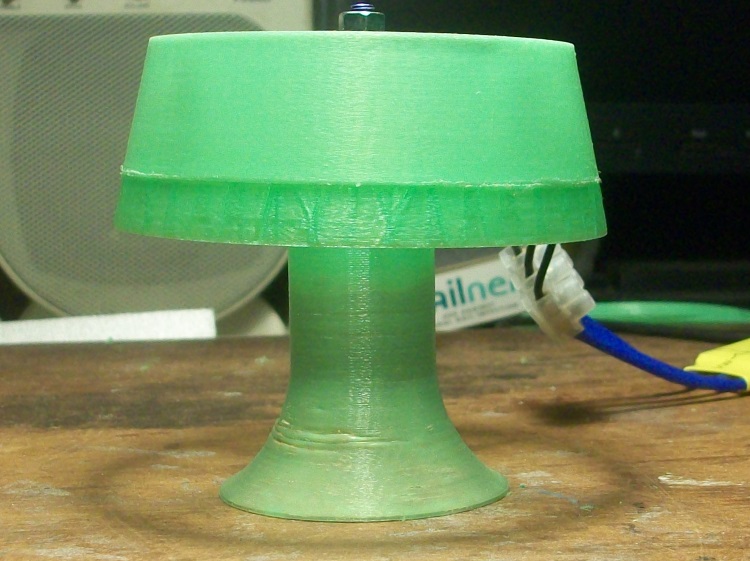
It exactly fits the motor mount and there was even a suitable shoulder for it to be glued to.
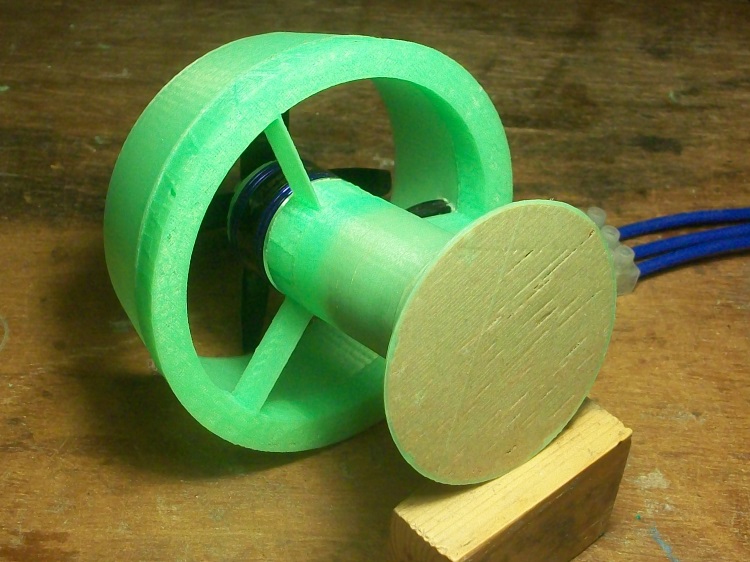
It is filled with plaster to give its thin walls additional support and it adds a bit of weight.
On a freshly charged 3s the 3x3 4 blade generates 121 g thrust drawing 4.15A (51W)
The 4s test will have to wait for the necessary ESC but it looks like 200 g is within reach and at a total current draw within the capability of just one modest (for a 66" scale twin EDF!) l000mAh battery.
We shall see.
.
You are of course quite right, the question is going to be what thrust is available at the desired flying speed.
If nothing else the A350 is a pretty clean air frame so it should be able to maintain height on a thrust 1/4 its weight.
Hopefully the necessary thrust will be maintained to above the planes stall speed. It makes every gram vital.
I must be getting lazy as I 'printed' a thrust measuring test stand.'mushroom'.
It exactly fits the motor mount and there was even a suitable shoulder for it to be glued to.
It is filled with plaster to give its thin walls additional support and it adds a bit of weight.
On a freshly charged 3s the 3x3 4 blade generates 121 g thrust drawing 4.15A (51W)
The 4s test will have to wait for the necessary ESC but it looks like 200 g is within reach and at a total current draw within the capability of just one modest (for a 66" scale twin EDF!) l000mAh battery.
We shall see.
.
Thanks: Klipkopwildlife, THE BLACKBIRD, boz, Squirrelnet
Please Log in or Create an account to join the conversation.
- Quorneng
-
Topic Author
- Offline
- Forum Master
-
Less
More
- Posts: 10058
- Thank you received: 19043
13 Nov 2017 16:07 #23
by Quorneng
Replied by Quorneng on topic A Depron Airbus A350 - 1000 for 76 mm EDFs
The initial pusher test duct was printed with a slightly 'generous' diameter over the prop to make installation less critical.
As it turned out the prop ended up pretty central so I glued a thin 0.3 mm ring inside the end of the duct to reduce the prop tip clearance.
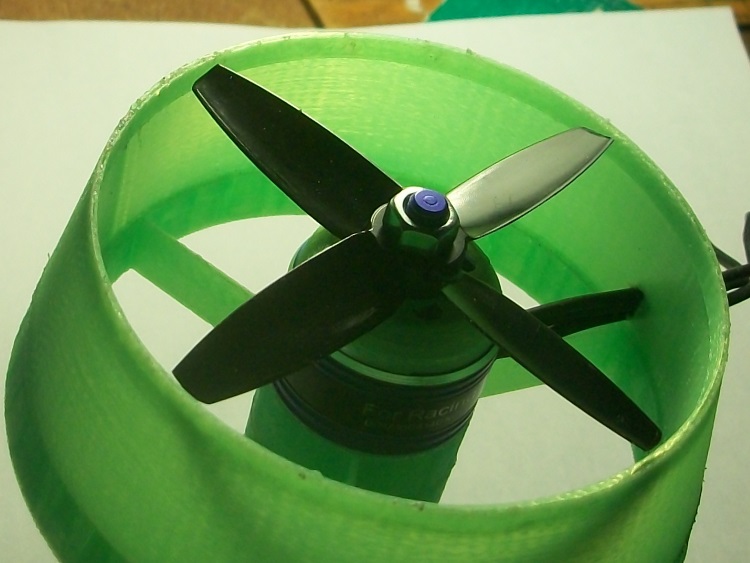
The prop tip clearance is now about 0.5 mm.
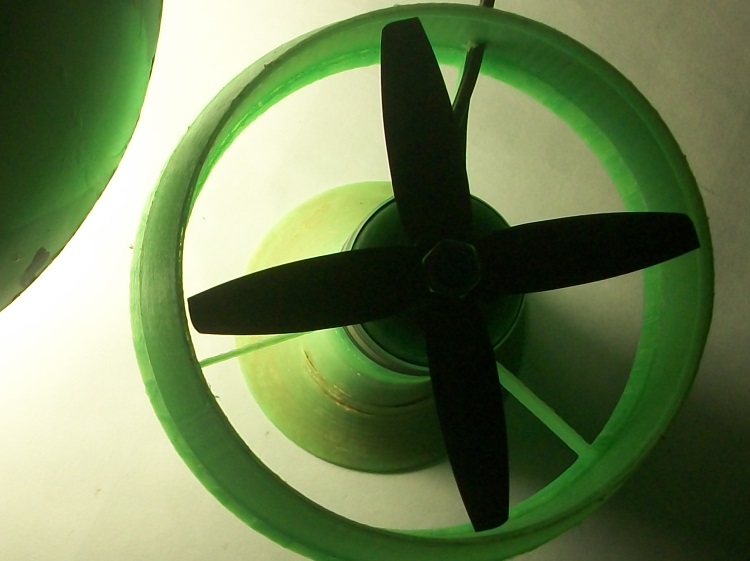
And it does make a difference! Still on a 3s the thrust has increased by 13g to 134g.
The next problem is to reduce the weight of the printed components. As it stands the complete nacelle is likely to weigh 75+g of which only 30 g is due to the motor and prop. Most of the weight comes from the printed parts rather than the Depron outer skin. My target is to get the complete 'bare' nacelle down to 30g - matching the motor and prop.
As it turned out the prop ended up pretty central so I glued a thin 0.3 mm ring inside the end of the duct to reduce the prop tip clearance.
The prop tip clearance is now about 0.5 mm.
And it does make a difference! Still on a 3s the thrust has increased by 13g to 134g.
The next problem is to reduce the weight of the printed components. As it stands the complete nacelle is likely to weigh 75+g of which only 30 g is due to the motor and prop. Most of the weight comes from the printed parts rather than the Depron outer skin. My target is to get the complete 'bare' nacelle down to 30g - matching the motor and prop.
Thanks: Klipkopwildlife, THE BLACKBIRD, Ex-Member, boz, Mike Rolls, Squirrelnet
Please Log in or Create an account to join the conversation.
- Quorneng
-
Topic Author
- Offline
- Forum Master
-
Less
More
- Posts: 10058
- Thank you received: 19043
14 Nov 2017 13:46 - 14 Nov 2017 13:52 #24
by Quorneng
Replied by Quorneng on topic A Depron Airbus A350 - 1000 for 76 mm EDFs
Today's task build a 'lightweight' version of the pusher test duct so the weights can be directly compared.
The lightweight uses a planked 2 mm Depron outer skin.
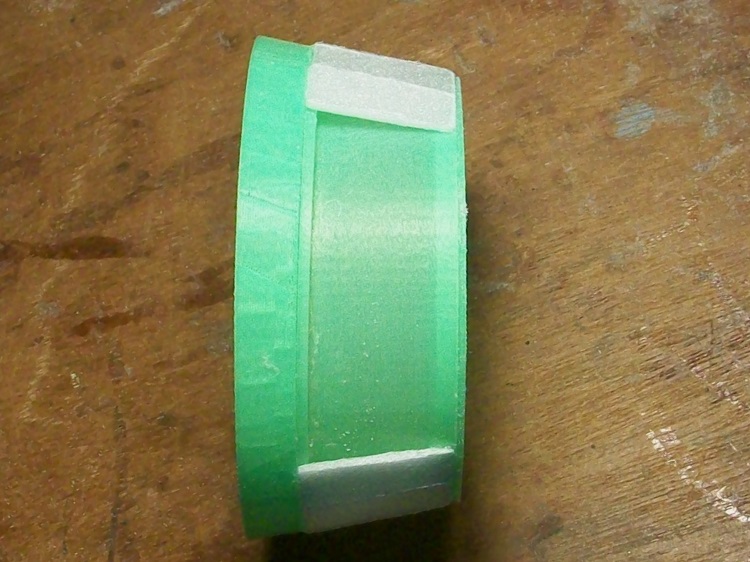
The lightweight and original.

10.0 g for the lightweight against 13.6.
A 3.6 g saving may sound trivial (and it is for all the work involved! ) but it is still 27%!
As long as such savings can be gained on the all the rest it will be significant.
The inner wall of the lightweight is also a slightly smaller diameter to give the same tip clearance as the 'improved' original.
The lightweight uses a planked 2 mm Depron outer skin.
The lightweight and original.
10.0 g for the lightweight against 13.6.
A 3.6 g saving may sound trivial (and it is for all the work involved!
) but it is still 27%!As long as such savings can be gained on the all the rest it will be significant.
The inner wall of the lightweight is also a slightly smaller diameter to give the same tip clearance as the 'improved' original.
Last edit: 14 Nov 2017 13:52 by Quorneng.
Thanks: Eric, Klipkopwildlife, THE BLACKBIRD, Ex-Member, boz, Mike Rolls
Please Log in or Create an account to join the conversation.
- Quorneng
-
Topic Author
- Offline
- Forum Master
-
Less
More
- Posts: 10058
- Thank you received: 19043
16 Nov 2017 00:00 #25
by Quorneng
Replied by Quorneng on topic A Depron Airbus A350 - 1000 for 76 mm EDFs
Started thinking about adding the nacelle pylon to the motor mount. It is relatively highly stressed being thin and carrying the nacelle ahead of the wing.
The pylon is printed at the same time as the motor mount so it takes nearly two hours!
The pylon with the pusher motor and its 'bullet' nose fairing.

Unfortunately the way it is designed gives it some badly supported areas so it does not print well and is structurally weak. Unfortunately I can;t see a way round it without loosing most of the weight I have managed to save!.
The tractor prop version does not have the same printing problem. At the cost of a few grams using a fully printed exhaust cone makes the pylon and motor mount assembly significantly more rigid.
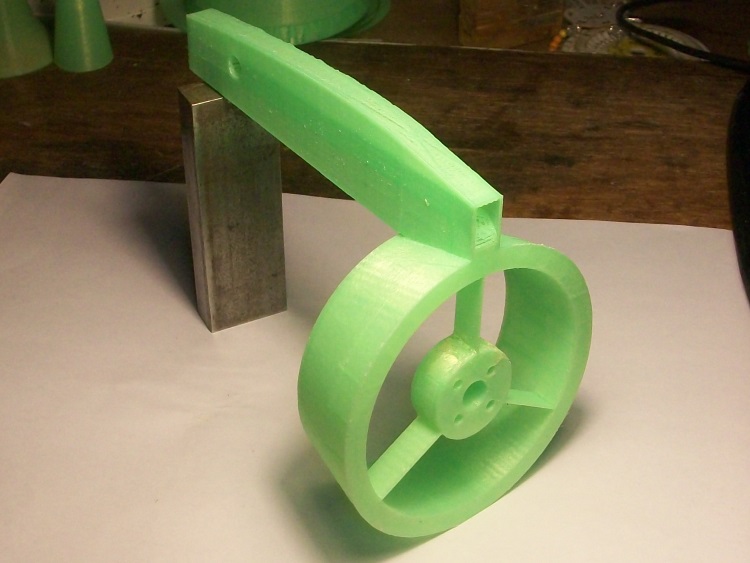
Also because the motor faces forward a 'representation' of the Trent tail cone can be added.

Well over 5 hours printing today!
The forward part of the nacelle (with 30 individually fitted Depron planks!) is slowly making progress.
The pylon is printed at the same time as the motor mount so it takes nearly two hours!
The pylon with the pusher motor and its 'bullet' nose fairing.
Unfortunately the way it is designed gives it some badly supported areas so it does not print well and is structurally weak. Unfortunately I can;t see a way round it without loosing most of the weight I have managed to save!.
The tractor prop version does not have the same printing problem. At the cost of a few grams
using a fully printed exhaust cone makes the pylon and motor mount assembly significantly more rigid.
Also because the motor faces forward a 'representation' of the Trent tail cone can be added.
Well over 5 hours printing today!
The forward part of the nacelle (with 30 individually fitted Depron planks!) is slowly making progress.
Thanks: Klipkopwildlife, THE BLACKBIRD, Ex-Member, boz
Please Log in or Create an account to join the conversation.
- one tenor
-

- Offline
- Forum Veteran
-

- johnpcalex@gmail.com
16 Nov 2017 00:30 #26
by one tenor
Anything will fly given enough power
Replied by one tenor on topic A Depron Airbus A350 - 1000 for 76 mm EDFs
Nice Simon
Anything will fly given enough power
Please Log in or Create an account to join the conversation.
- Quorneng
-
Topic Author
- Offline
- Forum Master
-
Less
More
- Posts: 10058
- Thank you received: 19043
16 Nov 2017 22:56 #27
by Quorneng
Replied by Quorneng on topic A Depron Airbus A350 - 1000 for 76 mm EDFs
Seemed to have spent most of the day doing something else but the 'tractor' 77 mm nacelle is finaly assembled - albeit temporarily alongside the 'all printed' nacelle for a 50 mm.EDF.

I did miss my target weight of 30g 'bare' as it weighs 36 g. but nevertheless it is proportionally much, much lighter for its size than the 50 mm one.
Design of the wing is next.
A 4s 'maximum thrust' test is the final hurdle - when the ESCs arrive from the Philippines.
If successful it will clear the way to actually build the wing and the other nacelle!
I did miss my target weight of 30g 'bare' as it weighs 36 g.
but nevertheless it is proportionally much, much lighter for its size than the 50 mm one. Design of the wing is next.
A 4s 'maximum thrust' test is the final hurdle - when the ESCs arrive from the Philippines.
If successful it will clear the way to actually build the wing and the other nacelle!
Thanks: Eric, Klipkopwildlife, boz, Mike Rolls
Please Log in or Create an account to join the conversation.
- Klipkopwildlife
-

- Offline
- Administrator
-

- I'm supposed to be retired!
17 Nov 2017 07:36 - 17 Nov 2017 07:39 #28
by Klipkopwildlife
Do it now, you may never get another chance
Replied by Klipkopwildlife on topic A Depron Airbus A350 - 1000 for 76 mm EDFs
Awesome work Q. Perhaps the tip shape is a candidate for 3d printing, even just the spar would help.
Do it now, you may never get another chance
Last edit: 17 Nov 2017 07:39 by Klipkopwildlife.
Please Log in or Create an account to join the conversation.
- Quorneng
-
Topic Author
- Offline
- Forum Master
-
Less
More
- Posts: 10058
- Thank you received: 19043
17 Nov 2017 14:20 - 17 Nov 2017 14:20 #29
by Quorneng
Replied by Quorneng on topic A Depron Airbus A350 - 1000 for 76 mm EDFs
Klippy
I fear 'printing' will be too heavy for the wing, particularly the tip which carries very little load, to the point that it won't even have need spar!
I have created modest curled up tips using 'formed' one piece Depron skins but 90 degrees is a challenge.
If the worst comes to the worst each skin could be created using pre formed planks over a plug.
I fear 'printing' will be too heavy for the wing, particularly the tip which carries very little load, to the point that it won't even have need spar!
I have created modest curled up tips using 'formed' one piece Depron skins but 90 degrees is a challenge.
If the worst comes to the worst each skin could be created using pre formed planks over a plug.
Last edit: 17 Nov 2017 14:20 by Quorneng.
Thanks: THE BLACKBIRD, boz
Please Log in or Create an account to join the conversation.
- Quorneng
-
Topic Author
- Offline
- Forum Master
-
Less
More
- Posts: 10058
- Thank you received: 19043
17 Nov 2017 22:59 #30
by Quorneng
Replied by Quorneng on topic A Depron Airbus A350 - 1000 for 76 mm EDFs
The 4 blade installed as a 'tractor' in the structurally complete 77 mm nacelle and pylon.

With some filling and a first thin coat of white acrylic paint on the Depron outer surface.
It currently weighs 69.9 g.
With some filling and a first thin coat of white acrylic paint on the Depron outer surface.
It currently weighs 69.9 g.
Thanks: Klipkopwildlife, Ex-Member, boz, Squirrelnet
Please Log in or Create an account to join the conversation.
Time to create page: 0.530 seconds