
- Posts: 9436
- Thank you received: 19043
Big Dragon 2
- Quorneng
-
 Topic Author
- Offline
- Forum Master
-

Less
More
26 Feb 2018 17:12 #31
by Quorneng
Replied by Quorneng on topic Big Dragon 2
For this particular application my thinking on a V tail goes something like this.
1 It is a pusher so the effective side area of the prop is behind the CofG so improving lateral stability.
2 The small span ailerons are at the wing tips and will have significant differential so reducing the aileron yaw and fin area required to keep it under control.
3 Compared to the wing span the boom length is relatively generous so requiring less fin and stab area.
4 V tail 'grass resistance' takes priority!
It will be an 'elevator only' V tail flown 'bank and yank' thus neatly avoiding the normal V tail drawback of poor rudder authority!
I have reluctantly decided not to proceed with a 'printed' tail, at least for the moment, as the total print time is very long, it is on the heavy side and success is by no means guaranteed. It will have balsa/Depron/ V tail instead, however its plan form will be similar. The braces both creating the V and securing it to the boom will however be printed.
Thanks: boz
Please Log in or Create an account to join the conversation.
- Eric
-

- Offline
- Moderator
-

Less
More
- Posts: 13726
- Thank you received: 14467
26 Feb 2018 18:50 - 26 Feb 2018 18:51 #32
by Eric
if you are calm and collected when all about you are going berserk - you've missed something important!
Replied by Eric on topic Big Dragon 2
effective side area of the prop is behind the CofG
What side area of the prop - it is negligible against the side area of the upper pod/pylon!
What side area of the prop - it is negligible against the side area of the upper pod/pylon!
if you are calm and collected when all about you are going berserk - you've missed something important!
Last edit: 26 Feb 2018 18:51 by Eric. Reason: added a word
Thanks: boz
Please Log in or Create an account to join the conversation.
- Quorneng
-
Topic Author
- Offline
- Forum Master
-
Less
More
- Posts: 9436
- Thank you received: 19043
26 Feb 2018 19:48 #33
by Quorneng
Replied by Quorneng on topic Big Dragon 2
I can only direct you to
this
war time NACA report titled "propellers in yaw".
The first line of which reads " It was realised as early as 1909 that a propeller in yaw develops a side force like that of a fin".
The first line of which reads " It was realised as early as 1909 that a propeller in yaw develops a side force like that of a fin".
Thanks: boz
Please Log in or Create an account to join the conversation.
- Mike Rolls
-

- Offline
- Elite Member
-

Less
More
- Posts: 634
- Thank you received: 573
26 Feb 2018 21:53 #34
by Mike Rolls
The older I get, the better I was!
Replied by Mike Rolls on topic Big Dragon 2
I've always assumed that comments such as that were referring to the gyroscopic and spiral airflow effects created by propellers rather than their physical area acting as a side force.
Mike
Mike
The older I get, the better I was!
Please Log in or Create an account to join the conversation.
- Eric
-
- Offline
- Moderator
-
Less
More
- Posts: 13726
- Thank you received: 14467
26 Feb 2018 22:57 - 26 Feb 2018 22:58 #35
by Eric
if you are calm and collected when all about you are going berserk - you've missed something important!
Replied by Eric on topic Big Dragon 2
I may be wrong, and often am, but I think that a non-rotating prop would have a small amount of side area, but a rotating one cancels itself out - disregarding the 'screw' action.
Picture the prop blades as being flat plates set at 90' to the rotation - ie stopped feathered position - but rotating, in a side wind, and with no forward motion, and ignoring torque reaction for now. The advancing blade will press against the wind, but the retreating blade will pull the wind.
A similar situation to a helicopter travelling forward. With a fixed pitch non-flapping blade, the advancing one creates more lift than the retreating one, causing a roll towards the retreating blade.
The more you contemplate the forces acting on a flying machine, the more complex they get! [badass]
if you are calm and collected when all about you are going berserk - you've missed something important!
Last edit: 26 Feb 2018 22:58 by Eric. Reason: added a word
Thanks: boz
Please Log in or Create an account to join the conversation.
- Quorneng
-
Topic Author
- Offline
- Forum Master
-
Less
More
- Posts: 9436
- Thank you received: 19043
27 Feb 2018 18:37 #36
by Quorneng
Replied by Quorneng on topic Big Dragon 2
I don't think it is anything to do with the prop blade side area but the effects of the prop forces when the direction of travel is not the same as the direction of approaching airflow.
As I understand it a propeller in yaw creates two effects. The advancing blade causes the centre of thrust to move sideways, the P effect. At the same time it also creates a smaller force at right angles to the direction of travel.
In a conventional 'tail down' take off the thrust line shift creates the swing, the smaller perpendicular force in this case is downward so has little impact.
Yaw in flight still creates the P effect although it is not so significant as the centre line of thrust moves vertically up or down depending on the direction of yaw and direction of prop rotation however the smaller perpendicular force is now horizontal and in the direction of the yaw so it acts like a fin. Although relatively small with a prop is ahead of the CofG it can eat into the lateral stability.
Did not the later Griffon engine Spifire need a larger fin to maintain adequate lateral stability as a result of its bigger diameter 5 blade prop?
Thanks: boz
Please Log in or Create an account to join the conversation.
- THE BLACKBIRD
-

- Offline
- Forum Master
-
Less
More
- Posts: 6368
- Thank you received: 10842
27 Feb 2018 19:59 #37
by THE BLACKBIRD
Replied by THE BLACKBIRD on topic Big Dragon 2
I think its all above my head so just chuck it and see
Please Log in or Create an account to join the conversation.
- boz
-

- Offline
- Platinum Member
-

Less
More
- Posts: 1176
- Thank you received: 1420
28 Feb 2018 06:08 #38
by boz
Replied by boz on topic Big Dragon 2
Very hi-tech, are the same forces in play from the full size aircraft, down to the scaled down model?
Non flyer question.
Non flyer question.
Please Log in or Create an account to join the conversation.
- Mike Rolls
-
- Offline
- Elite Member
-
Less
More
- Posts: 634
- Thank you received: 573
28 Feb 2018 09:01 #39
by Mike Rolls
The older I get, the better I was!
Replied by Mike Rolls on topic Big Dragon 2
Yes - although obviously the numbers can be vastly different. What we fly are really 'miniature' anodynes, subject to just the same types of forces as full size - although the full size don't have to worry about someone sticking their thumb through the covering!!
Mike
Mike
The older I get, the better I was!
Thanks: boz
Please Log in or Create an account to join the conversation.
- Eric
-
- Offline
- Moderator
-
Less
More
- Posts: 13726
- Thank you received: 14467
28 Feb 2018 09:26 #40
by Eric
if you are calm and collected when all about you are going berserk - you've missed something important!
Replied by Eric on topic Big Dragon 2
No, Mike - but people have been known to miss their step, and stick the size 14 through a wing covering when climbing in! :evil:
if you are calm and collected when all about you are going berserk - you've missed something important!
Thanks: boz, Mike Rolls
Please Log in or Create an account to join the conversation.
- Quorneng
-
Topic Author
- Offline
- Forum Master
-
Less
More
- Posts: 9436
- Thank you received: 19043
28 Feb 2018 13:18 #41
by Quorneng
Replied by Quorneng on topic Big Dragon 2
The simple Depron/balsa V tail complete.
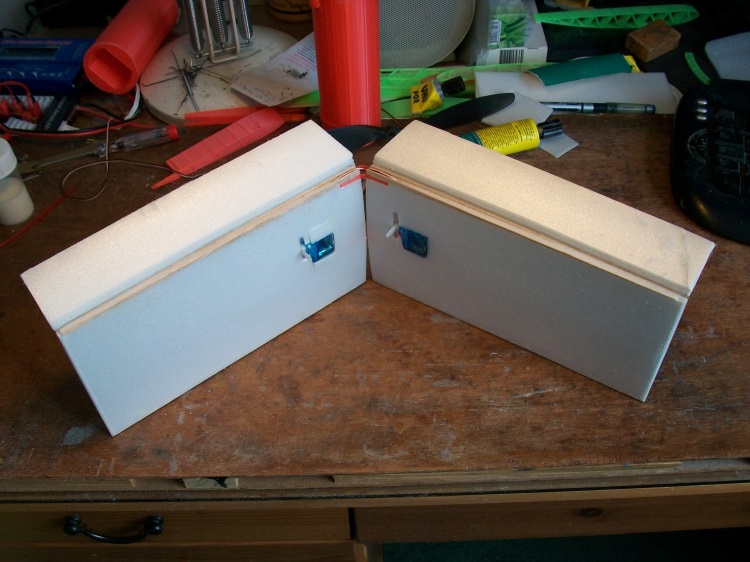
It weighs 27 g including two servos which is the same as the printed "half" without a servo!
In fact it is so light that I am worried the plane will end up slightly nose heavy. :ohmy:
At least the boom is long so it wont take much tail weight to cure it.
It weighs 27 g including two servos which is the same as the printed "half" without a servo!
In fact it is so light that I am worried the plane will end up slightly nose heavy. :ohmy:
At least the boom is long so it wont take much tail weight to cure it.
Thanks: Klipkopwildlife, boz
Please Log in or Create an account to join the conversation.
- Eric
-
- Offline
- Moderator
-
Less
More
- Posts: 13726
- Thank you received: 14467
28 Feb 2018 14:04 #42
by Eric
if you are calm and collected when all about you are going berserk - you've missed something important!
Replied by Eric on topic Big Dragon 2
I note you have put the servos the same way around, so you don't end up with tailerons! :woohoo:
if you are calm and collected when all about you are going berserk - you've missed something important!
Please Log in or Create an account to join the conversation.
- Quorneng
-
Topic Author
- Offline
- Forum Master
-
Less
More
- Posts: 9436
- Thank you received: 19043
28 Feb 2018 16:34 #43
by Quorneng
Replied by Quorneng on topic Big Dragon 2
Yes I had to make sure I was fully awake when I cut the skin to install the servos.
After all ailerons servos I have fitted it is all to easy to go 'symmetrical'. Even worse the Big Dragon 2 will be using 4 channel 35 meg and a non computer tx at that so I had to make sure the servos act in the same way as those on all my other 35 meg planes.
After all ailerons servos I have fitted it is all to easy to go 'symmetrical'. Even worse the Big Dragon 2 will be using 4 channel 35 meg and a non computer tx at that so I had to make sure the servos act in the same way as those on all my other 35 meg planes.
Thanks: Eric, boz
Please Log in or Create an account to join the conversation.
- Quorneng
-
Topic Author
- Offline
- Forum Master
-
Less
More
- Posts: 9436
- Thank you received: 19043
01 Mar 2018 17:29 #44
by Quorneng
Replied by Quorneng on topic Big Dragon 2
Today was a considerable panic! :woohoo:
With all the servo leads and ESC in place I set about installing the rx. A lightweight but full range Corona 35 meg synthesised job that is small enough to squeezed well back into the fuselage pod. As in the original Big Dragon the long aerial goes down inside the boom and out the back to ensure it cannot get in the way of the prop.
A bit of a fiddle as I has not really made the leads to the rx long enough. A quick test before pushing everything finally home and oh dear! Servos worked but the ESC only did the cell count but did not arm. As the servos worked it pointed to a problem with the ESC although it had been tested several times during installation and the motor ran perfectly.
I have a second synthesised rx (also set to the same channel) but that did exactly the same thing. Even stronger evidence of a faulty ESC. I was facing having to break open the pod and pylon to replace the ESC with likely a major or even a complete 'reprint'. :woohoo: :woohoo:
As a last resort I drove the ESC from a servo tester and it worked perfectly!
To explore further I used an Orange 2.4 rx and that worked fine as well but it was only a park fly type.
Finally I tried a Corona crystal rx, also full range, and that worked.fine too so that is what got got installed.

It down in there somewhere!
As you might imagine all this took quite some time, like most of the day!, but at least nothing had to be 'broken open' and it all works. The nose section can now be glued on.
It does raise a question why both the Corona 'synthesised' rx drive the servos no problem but appear to give an unsuitable signal (or none) for that particular ESC whereas the 'crystal' rx one does. Any thoughts?
With all the servo leads and ESC in place I set about installing the rx. A lightweight but full range Corona 35 meg synthesised job that is small enough to squeezed well back into the fuselage pod. As in the original Big Dragon the long aerial goes down inside the boom and out the back to ensure it cannot get in the way of the prop.
A bit of a fiddle as I has not really made the leads to the rx long enough. A quick test before pushing everything finally home and oh dear! Servos worked but the ESC only did the cell count but did not arm. As the servos worked it pointed to a problem with the ESC although it had been tested several times during installation and the motor ran perfectly.
I have a second synthesised rx (also set to the same channel) but that did exactly the same thing. Even stronger evidence of a faulty ESC. I was facing having to break open the pod and pylon to replace the ESC with likely a major or even a complete 'reprint'. :woohoo: :woohoo:
As a last resort I drove the ESC from a servo tester and it worked perfectly!
To explore further I used an Orange 2.4 rx and that worked fine as well but it was only a park fly type.
Finally I tried a Corona crystal rx, also full range, and that worked.fine too so that is what got got installed.
It down in there somewhere!
As you might imagine all this took quite some time, like most of the day!, but at least nothing had to be 'broken open' and it all works. The nose section can now be glued on.
It does raise a question why both the Corona 'synthesised' rx drive the servos no problem but appear to give an unsuitable signal (or none) for that particular ESC whereas the 'crystal' rx one does. Any thoughts?
Thanks: Klipkopwildlife, boz, Squirrelnet
Please Log in or Create an account to join the conversation.
- Eric
-
- Offline
- Moderator
-
Less
More
- Posts: 13726
- Thank you received: 14467
01 Mar 2018 20:29 #45
by Eric
if you are calm and collected when all about you are going berserk - you've missed something important!
Replied by Eric on topic Big Dragon 2
If I had a pound!!!
It's a fail-safe! Either the throttle wan't fully closed, or it's function is reversed, so if the esc had armed, the motor would have fired up!
Take the prop off, and try it again with the stick AND the trim fully down. If no joy, give full throttle, and try that! Keep your fingers out of the way!
It's a fail-safe! Either the throttle wan't fully closed, or it's function is reversed, so if the esc had armed, the motor would have fired up!
Take the prop off, and try it again with the stick AND the trim fully down. If no joy, give full throttle, and try that! Keep your fingers out of the way!
if you are calm and collected when all about you are going berserk - you've missed something important!
Thanks: boz
Please Log in or Create an account to join the conversation.
Time to create page: 1.490 seconds