
- Posts: 9272
- Thank you received: 2167
- Forum
- Forum Categories
- Construction Techniques & Aeromodelling Materials.
- Building Materials, Structures & Processes.
Building Materials, Structures & Processes.
- The Beard
-

- Offline
- Forum Master
-

Less
More
05 Feb 2012 15:16 #76
by The Beard
Replied by The Beard on topic Re: Building Materials, Structures & Processes.
Phydelis is such a nice sensible young man dont you find!!
Please Log in or Create an account to join the conversation.
- phydelis
- Visitor
-

15 Mar 2012 18:49 #77
by phydelis
Replied by phydelis on topic Re: Building Materials, Structures & Processes.
Sorry all for not coming regularly as am suppose to but the assignements n works of other courses at taking the best of my project time. Please i will like to know what ways to measure bending and torsion of an aircraft wing. One of the major issue should be the rig and ways of clamping it in other to take the above measurment.
Thanks as always.
Thanks as always.
Please Log in or Create an account to join the conversation.
- Eric
-

- Offline
- Moderator
-

Less
More
- Posts: 15406
- Thank you received: 14306
15 Mar 2012 20:33 - 15 Mar 2012 20:35 #78
by Eric
if you are calm and collected when all about you are going berserk - you've missed something important!
Replied by Eric on topic Re: Building Materials, Structures & Processes.
Measuring the bending force on a wing - that is tricky, because it is not linear along the span.
In real life, all the significant mass ( the fuselage and payload) is located at the centre of the wing. The lifting force, however, is spread out across the whole area of the wing.
So, obviously the strongest part of the wing has to be the centre section, which is where the fuselage, the undercarriage, etc, are all attached.
The shape of the wing is also important. A thick (deep) wing can be made stronger more easily than a thin (shallow) one.
Also the planform of the wing comes into play. Does the wing have any taper? (ie is the wing-tip chord smaller than the root chord)
If you are going to go down this line, it gets really complex, mathematically and mechanically. Full size aircraft designers spend millions of pounds per aircraft, designing and developing stress-testing rigs for this very purpose, and take up thousands of hours doing it! Because these tests have to be done in 'real time', a lot of modified wings are assumed to have the same 'life' as the original one, and once in a while, they find out to their cost, that it didn't!
In real life, all the significant mass ( the fuselage and payload) is located at the centre of the wing. The lifting force, however, is spread out across the whole area of the wing.
So, obviously the strongest part of the wing has to be the centre section, which is where the fuselage, the undercarriage, etc, are all attached.
The shape of the wing is also important. A thick (deep) wing can be made stronger more easily than a thin (shallow) one.
Also the planform of the wing comes into play. Does the wing have any taper? (ie is the wing-tip chord smaller than the root chord)
If you are going to go down this line, it gets really complex, mathematically and mechanically. Full size aircraft designers spend millions of pounds per aircraft, designing and developing stress-testing rigs for this very purpose, and take up thousands of hours doing it! Because these tests have to be done in 'real time', a lot of modified wings are assumed to have the same 'life' as the original one, and once in a while, they find out to their cost, that it didn't!
if you are calm and collected when all about you are going berserk - you've missed something important!
Last edit: 15 Mar 2012 20:35 by Eric. Reason: typo
Please Log in or Create an account to join the conversation.
- Quorneng
-

- Offline
- Forum Master
-
Less
More
- Posts: 10058
- Thank you received: 19043
16 Mar 2012 02:56 #79
by Quorneng
Replied by Quorneng on topic Re: Building Materials, Structures & Processes.
phydelis
Because a wing is not a simple beam as Eric says the stress calculation quickly becomes very, very complex and even in big full size they still have to actually test it to prove their sums were right.
For models the only real alternative is experience and actual testing. One benefit however is that as size reduces the relative strength of material increases so the weight penalty for building over strong is not that great.
However bending is not the only load a wing has to resist as there are torsion loads as well. If even a small twist develops as the load is applied it can have a significant effect on the bending forces.
I use a very simple test that works reasonably well up to say 6ft span. Lift the fully loaded plane up by its wing tips. This applies a bending load at the wing root equivalent to a 4G manoeuvre which, with care, is enough for even basic aerobatics.
Because a wing is not a simple beam as Eric says the stress calculation quickly becomes very, very complex and even in big full size they still have to actually test it to prove their sums were right.
For models the only real alternative is experience and actual testing. One benefit however is that as size reduces the relative strength of material increases so the weight penalty for building over strong is not that great.
However bending is not the only load a wing has to resist as there are torsion loads as well. If even a small twist develops as the load is applied it can have a significant effect on the bending forces.
I use a very simple test that works reasonably well up to say 6ft span. Lift the fully loaded plane up by its wing tips. This applies a bending load at the wing root equivalent to a 4G manoeuvre which, with care, is enough for even basic aerobatics.
Please Log in or Create an account to join the conversation.
- phydelis
- Visitor
-
16 Mar 2012 21:39 #80
by phydelis
Replied by phydelis on topic Re: Building Materials, Structures & Processes.
Thanks guys. but i need to know how to set up the rig and ways of clamping it in other to take the measurements. Because the university seem not to have the clamping devices so am ask to provide one.
Thanks as always.
Thanks as always.
Please Log in or Create an account to join the conversation.
- Phil Wood
-
 Topic Author
- Offline
- Inactivated User
-

20 Mar 2012 18:16 #81
by Phil Wood
There's no set formula for wing flexibility, that's down to the construction.
The simplest way to measure the flex in a wing is to anchor the root with any suitably heavy weight and lift the model by the wings ... see how much they bend.
You'll need to be more specific here Phydelis, please remember, you're doing degree level studies .... we just build & fly the buggers.
Pol.
I just own the forum .... you guys make it great thanks.
Replied by Phil Wood on topic Re: Building Materials, Structures & Processes.
Phydelis should be posting here soon, I've just spoken to him on the phone,.phydelis wrote: Sorry all for not coming regularly as am suppose to but the assignements n works of other courses at taking the best of my project time. Please i will like to know what ways to measure bending and torsion of an aircraft wing. One of the major issue should be the rig and ways of clamping it in other to take the above measurment.
Thanks as always.
There's no set formula for wing flexibility, that's down to the construction.
The simplest way to measure the flex in a wing is to anchor the root with any suitably heavy weight and lift the model by the wings ... see how much they bend.
You'll need to be more specific here Phydelis, please remember, you're doing degree level studies .... we just build & fly the buggers.
Pol.
I just own the forum .... you guys make it great thanks.
Please Log in or Create an account to join the conversation.
- Quorneng
-
- Offline
- Forum Master
-
Less
More
- Posts: 10058
- Thank you received: 19043
20 Mar 2012 20:43 - 20 Mar 2012 20:48 #82
by Quorneng
Replied by Quorneng on topic Re: Building Materials, Structures & Processes.
One way of testing a wing is to use sand bags!
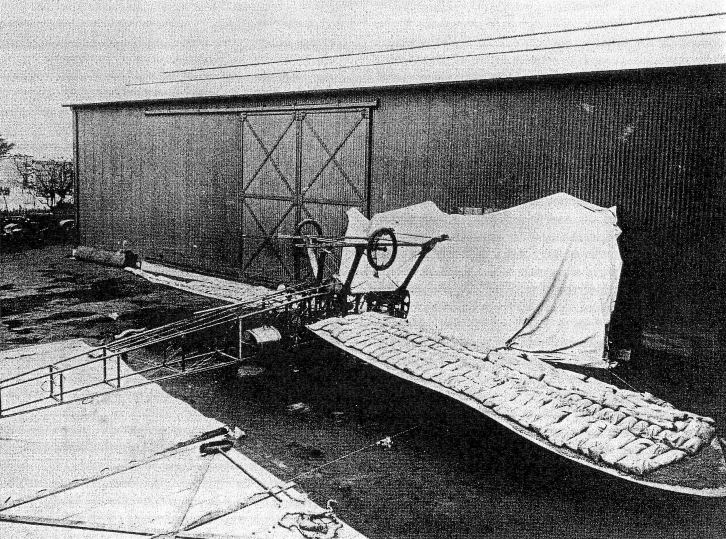
It is still a method used by homebuilds today!
It is still a method used by homebuilds today!
Last edit: 20 Mar 2012 20:48 by Quorneng.
Please Log in or Create an account to join the conversation.
- phydelis
- Visitor
-
21 Mar 2012 13:50 #83
by phydelis


Replied by phydelis on topic Re: Building Materials, Structures & Processes.
Please Log in or Create an account to join the conversation.
- phydelis
- Visitor
-
21 Mar 2012 13:53 #84
by phydelis
Replied by phydelis on topic Re: Building Materials, Structures & Processes.
The above were the samples i was asked to get my experiment from. But i have requested the university to get me a foam and a balsa in other to get a proper wing instead of the crashed wing. Hopefully they get it i will have to get a proper configuration for the wing.
Question:
Is there a proper or an idea configuration for a wing?
Thanks so so much.
Question:
Is there a proper or an idea configuration for a wing?
Thanks so so much.
Please Log in or Create an account to join the conversation.
- Quorneng
-
- Offline
- Forum Master
-
Less
More
- Posts: 10058
- Thank you received: 19043
21 Mar 2012 22:20 #85
by Quorneng
Replied by Quorneng on topic Re: Building Materials, Structures & Processes.
phydelis
Ideal wing?
Unfortunately the 'ideal' structure is different from the 'ideal' aerodynamics so it always has to be a comporomise.
The problem is the 'best' compromise depends on several things like the material it is made with, the speed it will be flown at, the loads it will put under and cost!
If you look at a high performance glider wing it is biased toward aerodynamic efficiency. Very spindly with a huge span but strict limits on the load it can carry, its speed and almost regardless of cost.
A simple homebuild is likely to have a 'chunky' wing with limited span and a thick section to make it strong, easy to build with simple materials so a lot cheaper.
In some respects it will come down to how much you want to spend in time and money!
Ideal wing?
Unfortunately the 'ideal' structure is different from the 'ideal' aerodynamics so it always has to be a comporomise.
The problem is the 'best' compromise depends on several things like the material it is made with, the speed it will be flown at, the loads it will put under and cost!
If you look at a high performance glider wing it is biased toward aerodynamic efficiency. Very spindly with a huge span but strict limits on the load it can carry, its speed and almost regardless of cost.
A simple homebuild is likely to have a 'chunky' wing with limited span and a thick section to make it strong, easy to build with simple materials so a lot cheaper.
In some respects it will come down to how much you want to spend in time and money!
Please Log in or Create an account to join the conversation.
- Phil Wood
-
Topic Author
- Offline
- Inactivated User
-
07 Apr 2012 11:28 #86
by Phil Wood
I just own the forum .... you guys make it great thanks.
Replied by Phil Wood on topic Re: Building Materials, Structures & Processes.
Phydelis popped into "Live chat" recently, but I missed him by minutes. He's got a load more questions so hopefully he'll get the e-mail notification of this post and come back & join us.
Pol.
Pol.
I just own the forum .... you guys make it great thanks.
Please Log in or Create an account to join the conversation.
- Phil Wood
-
Topic Author
- Offline
- Inactivated User
-
10 Apr 2012 02:17 #87
by Phil Wood
I just own the forum .... you guys make it great thanks.
Replied by Phil Wood on topic Re: Building Materials, Structures & Processes.
I've noticed that Phydelis has posted a lot in "Live Chat" so hopefully he'll repeat his questions here.
Phydelis, .... When you ask about wing "Calculations"... are you needing to go so far as to work out the stress factors involved?
This may be beyond the scope of most modellers.
For example ... if we look at a built up balsa wing then the skin or covering of that wing will be handling the bulk of the strain.
In level flight the bottom surface will be under tension & the top surface, or spar, will be under compression. ..... this situation will be the opposite way around in the case of inverted flight.
I know you are doing an engineering degree so you may have to understand tensile strength & strain calculations .... unfortunately most modellers won't go this far.
Most of us will simply use tried & tested methods that have served us well for years.
I know that I for one don't know how much tension I could put on a 1/4 inch square strip of balsa wood or hardwood before it will snap .... this is complicated stuff.
I think you'll have to be a bit more specific as to exactly how far the university expect you to go ? ....... give us more details please mate.
Phydelis, .... When you ask about wing "Calculations"... are you needing to go so far as to work out the stress factors involved?
This may be beyond the scope of most modellers.
For example ... if we look at a built up balsa wing then the skin or covering of that wing will be handling the bulk of the strain.
In level flight the bottom surface will be under tension & the top surface, or spar, will be under compression. ..... this situation will be the opposite way around in the case of inverted flight.
I know you are doing an engineering degree so you may have to understand tensile strength & strain calculations .... unfortunately most modellers won't go this far.
Most of us will simply use tried & tested methods that have served us well for years.
I know that I for one don't know how much tension I could put on a 1/4 inch square strip of balsa wood or hardwood before it will snap .... this is complicated stuff.
I think you'll have to be a bit more specific as to exactly how far the university expect you to go ? ....... give us more details please mate.
I just own the forum .... you guys make it great thanks.
Please Log in or Create an account to join the conversation.
- Eric
-
- Offline
- Moderator
-
Less
More
- Posts: 15406
- Thank you received: 14306
10 Apr 2012 03:20 #88
by Eric
if you are calm and collected when all about you are going berserk - you've missed something important!
Replied by Eric on topic Re: Building Materials, Structures & Processes.
how much tension I could put on a 1/4 inch square strip of balsa wood -
and THAT depends on the grain density and grain direction of that particular piece. Another, visually identical piece, would have a different 'fail' strength!
and THAT depends on the grain density and grain direction of that particular piece. Another, visually identical piece, would have a different 'fail' strength!
if you are calm and collected when all about you are going berserk - you've missed something important!
Please Log in or Create an account to join the conversation.
- Quorneng
-
- Offline
- Forum Master
-
Less
More
- Posts: 10058
- Thank you received: 19043
10 Apr 2012 18:14 #89
by Quorneng
Replied by Quorneng on topic Re: Building Materials, Structures & Processes.
That was one reason I rather like working with Depron. Each thickness of sheet has uniform physical characteristics.
It may not be an ideal material in all circumstances but its one less variable to worry about and its uniformity allows you to safely go closer to its structural limit.
For his thesis, rather than attempt stress calculations which are extraordinarily complex for even a simple airframe, would Phydelis not be better off physically load testing different wing construction samples in controlled conditions?
In the time he has available I doubt he could demonstrate to have found the lightest possible but it should prove it was at least strong enough!
This, in effect, is what experience has taught us over the years.
The only time I actually did a load test was on my first large span (60") Depron wing.
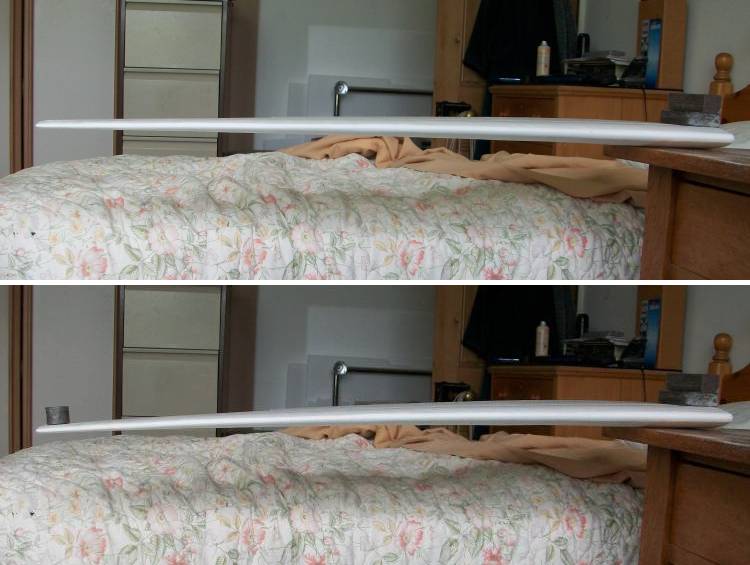
Neither a uniform load or to the limit (I didn't want to have to build another!) but with twice the total fuselage/motor/battery weight supported only at the wing tips my 'experience' told me this gave a bending load equivalent to pulling at least 4g. It hasn't broken yet!
It may not be an ideal material in all circumstances but its one less variable to worry about and its uniformity allows you to safely go closer to its structural limit.
For his thesis, rather than attempt stress calculations which are extraordinarily complex for even a simple airframe, would Phydelis not be better off physically load testing different wing construction samples in controlled conditions?
In the time he has available I doubt he could demonstrate to have found the lightest possible but it should prove it was at least strong enough!
This, in effect, is what experience has taught us over the years.
The only time I actually did a load test was on my first large span (60") Depron wing.
Neither a uniform load or to the limit (I didn't want to have to build another!) but with twice the total fuselage/motor/battery weight supported only at the wing tips my 'experience' told me this gave a bending load equivalent to pulling at least 4g. It hasn't broken yet!
Please Log in or Create an account to join the conversation.
- phydelis
- Visitor
-
10 Apr 2012 19:43 #90
by phydelis
Replied by phydelis on topic Re: Building Materials, Structures & Processes.
Thanks all,
Just very few system at the university has firefox so most times am not so fortunate to logged into one. I was told i most calculated the bending stress and torsional stress on the wing. I understood that you guys uses more of experience in doing yours with everything am learning on this forum i should be able to do that. What i need to know is the design itself as i have settle for one build with foam and another with Balsa. I need to know what distant between the core and the leading and dragging edge and i want to use the foam to form some ribs and spar but am also thinking of using it as a block. which is prefereable? And what calculation do i need to do in other to get the wing dimensions since am considering an arm length as its length. (In calculation i mean : drag, lift, angle of attack, coefficeient of lift e.t.c)
Just very few system at the university has firefox so most times am not so fortunate to logged into one. I was told i most calculated the bending stress and torsional stress on the wing. I understood that you guys uses more of experience in doing yours with everything am learning on this forum i should be able to do that. What i need to know is the design itself as i have settle for one build with foam and another with Balsa. I need to know what distant between the core and the leading and dragging edge and i want to use the foam to form some ribs and spar but am also thinking of using it as a block. which is prefereable? And what calculation do i need to do in other to get the wing dimensions since am considering an arm length as its length. (In calculation i mean : drag, lift, angle of attack, coefficeient of lift e.t.c)
Please Log in or Create an account to join the conversation.
- Forum
- Forum Categories
- Construction Techniques & Aeromodelling Materials.
- Building Materials, Structures & Processes.
Time to create page: 0.294 seconds