
- Posts: 6781
- Thank you received: 10722
freeCAD and fuselage creation
- THE BLACKBIRD
-

- Offline
- Forum Master
-

Less
More
13 Jul 2022 20:00 #106
by THE BLACKBIRD
Replied by THE BLACKBIRD on topic freeCAD and fuselage creation
Always use 2 separate channels for the ailerons when possible
Thanks: Klipkopwildlife, jon.in.swansea
Please Log in or Create an account to join the conversation.
- Eric
-

- Offline
- Moderator
-

Less
More
- Posts: 15406
- Thank you received: 14306
13 Jul 2022 20:38 - 13 Jul 2022 20:41 #107
by Eric
if you are calm and collected when all about you are going berserk - you've missed something important!
Replied by Eric on topic freeCAD and fuselage creation
For HUGE expensive scale models, yes, but why, for the typical club size small one? It's just adding complication.
You could take it to extremes, and have two flight packs (some already do) and have two receivers, each one controlling one side of the aircraft - or even even more extreme, two transmitters paired up simultaneously controlling half the aircraft's controls!![[badass]](/media/kunena/emoticons/bad_boys_20.gif "[badass]")
Which is effectively what frequency agile radio gear does anyway.
And you still have to use ONE control stick with two 'pots' on it, for your primary controls - so if the stick-pot decides to die mid-flight, you still have no control!
You could take it to extremes, and have two flight packs (some already do) and have two receivers, each one controlling one side of the aircraft - or even even more extreme, two transmitters paired up simultaneously controlling half the aircraft's controls!
Which is effectively what frequency agile radio gear does anyway.
And you still have to use ONE control stick with two 'pots' on it, for your primary controls - so if the stick-pot decides to die mid-flight, you still have no control!
if you are calm and collected when all about you are going berserk - you've missed something important!
Last edit: 13 Jul 2022 20:41 by Eric.
Thanks: Klipkopwildlife, jon.in.swansea
Please Log in or Create an account to join the conversation.
- Quorneng
-

- Offline
- Forum Master
-
Less
More
- Posts: 10058
- Thank you received: 19043
14 Jul 2022 01:13 - 14 Jul 2022 01:15 #108
by Quorneng
Replied by Quorneng on topic freeCAD and fuselage creation
jon
This shows a mechanical differential set up.

With the arm angled forward at say 45 degrees when the servo is in its mid position will give nearly twice the 'up' control surface travel compared to 'down'. It requires no additional parts to do it.
How much forward angle determines the degree of differential. Much over 45 degrees can result at maximum servo travel that the down aileron starts to reverse direction and reduce the amount of down.
Just a historical note.
This 'reverse' effect did actually happen on the down aileron at full control deflection on the full size Slingsby Skylark 4 glider. It had considerable aileron differential due to its huge wing span relative to the fuselage. For what was a high performance glider at the time it was very well mannered.
This shows a mechanical differential set up.
With the arm angled forward at say 45 degrees when the servo is in its mid position will give nearly twice the 'up' control surface travel compared to 'down'. It requires no additional parts to do it.
How much forward angle determines the degree of differential. Much over 45 degrees can result at maximum servo travel that the down aileron starts to reverse direction and reduce the amount of down.
Just a historical note.
This 'reverse' effect did actually happen on the down aileron at full control deflection on the full size Slingsby Skylark 4 glider. It had considerable aileron differential due to its huge wing span relative to the fuselage. For what was a high performance glider at the time it was very well mannered.
Attachments:
Last edit: 14 Jul 2022 01:15 by Quorneng.
Thanks: Klipkopwildlife, jon.in.swansea
Please Log in or Create an account to join the conversation.
- jon.in.swansea
-
 Topic Author
- Offline
- Elite Member
-

Less
More
- Posts: 757
- Thank you received: 1164
14 Jul 2022 08:04 #109
by jon.in.swansea
Replied by jon.in.swansea on topic freeCAD and fuselage creation
Thanks for the sketch. Before I saw this post I had looked and found some examples on the web. I am working up some adjustments to trial and see if I can get the down angle to be about half the up angle for a start. Will see about filming the movement and measure the angles....
Thanks: Klipkopwildlife
Please Log in or Create an account to join the conversation.
- Eric
-
- Offline
- Moderator
-
Less
More
- Posts: 15406
- Thank you received: 14306
14 Jul 2022 09:38 - 14 Jul 2022 09:43 #110
by Eric
if you are calm and collected when all about you are going berserk - you've missed something important!
Replied by Eric on topic freeCAD and fuselage creation
Ah, I see that Simon has produced exactly the same as I posted on the other thread - but with a better drawing! 
It isn't critical to have exactly half movement in one direction than the other, as long as the up-going is significantly larger than the down-going.
Re the Skylark - by having BOTH ailerons up at full stick deflection, it would also reduce the lift at the wing ouboards, reducing the chance of a tip-stall in the tight turn!
It isn't critical to have exactly half movement in one direction than the other, as long as the up-going is significantly larger than the down-going.
Re the Skylark - by having BOTH ailerons up at full stick deflection, it would also reduce the lift at the wing ouboards, reducing the chance of a tip-stall in the tight turn!
if you are calm and collected when all about you are going berserk - you've missed something important!
Last edit: 14 Jul 2022 09:43 by Eric.
Thanks: Klipkopwildlife
Please Log in or Create an account to join the conversation.
- Quorneng
-
- Offline
- Forum Master
-
Less
More
- Posts: 10058
- Thank you received: 19043
14 Jul 2022 15:39 #111
by Quorneng
Replied by Quorneng on topic freeCAD and fuselage creation
The Skylark 4 aileron only reduced the down movement at the last bit of full control movement.
Not everyone even noticed it and I never found out if it was done on purpose or was just a result of the substantial differential geometry it used.
Not everyone even noticed it and I never found out if it was done on purpose or was just a result of the substantial differential geometry it used.
Thanks: Klipkopwildlife
Please Log in or Create an account to join the conversation.
- Eric
-
- Offline
- Moderator
-
Less
More
- Posts: 15406
- Thank you received: 14306
14 Jul 2022 19:48 #112
by Eric
if you are calm and collected when all about you are going berserk - you've missed something important!
Replied by Eric on topic freeCAD and fuselage creation
My miskatke! I read - down aileron starts to reverse direction and reduce the amount of down - meant that at full stick deflection, you got a hint of UP ail on the outboard wing, reducing the effective aoa with a bit of extra washout!
if you are calm and collected when all about you are going berserk - you've missed something important!
Thanks: Klipkopwildlife
Please Log in or Create an account to join the conversation.
- jon.in.swansea
-
Topic Author
- Offline
- Elite Member
-
Less
More
- Posts: 757
- Thank you received: 1164
15 Jul 2022 18:30 #113
by jon.in.swansea
Replied by jon.in.swansea on topic freeCAD and fuselage creation
I posted a brief video of a test differential servo arm and horn arrangement on the 'widgets' thread. It kind of works, so many variables to try out.... Would appreciate comments. -Jon
Thanks: Klipkopwildlife
Please Log in or Create an account to join the conversation.
- jon.in.swansea
-
Topic Author
- Offline
- Elite Member
-
Less
More
- Posts: 757
- Thank you received: 1164
15 Jul 2022 18:32 #114
by jon.in.swansea
Replied by jon.in.swansea on topic freeCAD and fuselage creation
Interesting thing I noticed - the sketches are with the servo at the base of the wing and the linkage below. I seem to have a patter of the linkage above the wing - probably to keep it away from the wet grass. Perhaps it would work better if I went with a below linkage? -Jon
Please Log in or Create an account to join the conversation.
- Eric
-
- Offline
- Moderator
-
Less
More
- Posts: 15406
- Thank you received: 14306
15 Jul 2022 23:51 #115
by Eric
if you are calm and collected when all about you are going berserk - you've missed something important!
Replied by Eric on topic freeCAD and fuselage creation
That doesn't make any difference on a slow-flyer, Jon - the wing just looks tidier with all the 'bits' underneath, out of sight.
For a faster model, remember that the air OVER the wing is moving faster than the air below, (it has further to go!) so anything sticking out creates more turbulence and drag.
For a faster model, remember that the air OVER the wing is moving faster than the air below, (it has further to go!) so anything sticking out creates more turbulence and drag.
if you are calm and collected when all about you are going berserk - you've missed something important!
Thanks: Klipkopwildlife, Quorneng, jon.in.swansea
Please Log in or Create an account to join the conversation.
- jon.in.swansea
-
Topic Author
- Offline
- Elite Member
-
Less
More
- Posts: 757
- Thank you received: 1164
24 Jul 2022 17:12 #116
by jon.in.swansea
Replied by jon.in.swansea on topic freeCAD and fuselage creation
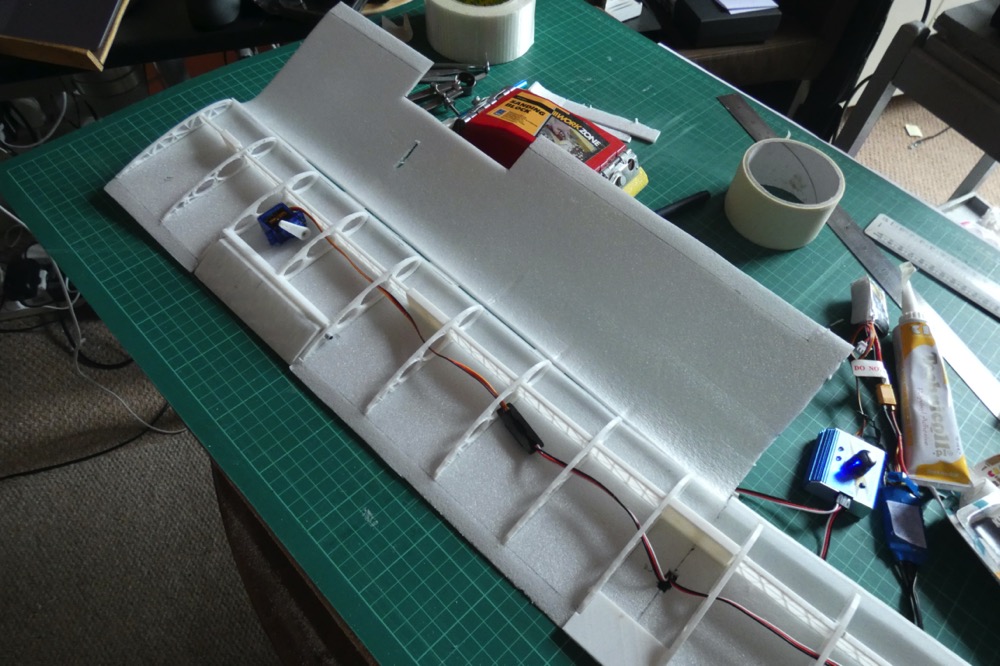
I have put almost all the final touches to my latest Clarke-Y wing - just the linkages to the ailerons left to do.
Here is it just before I glued on the top skin...
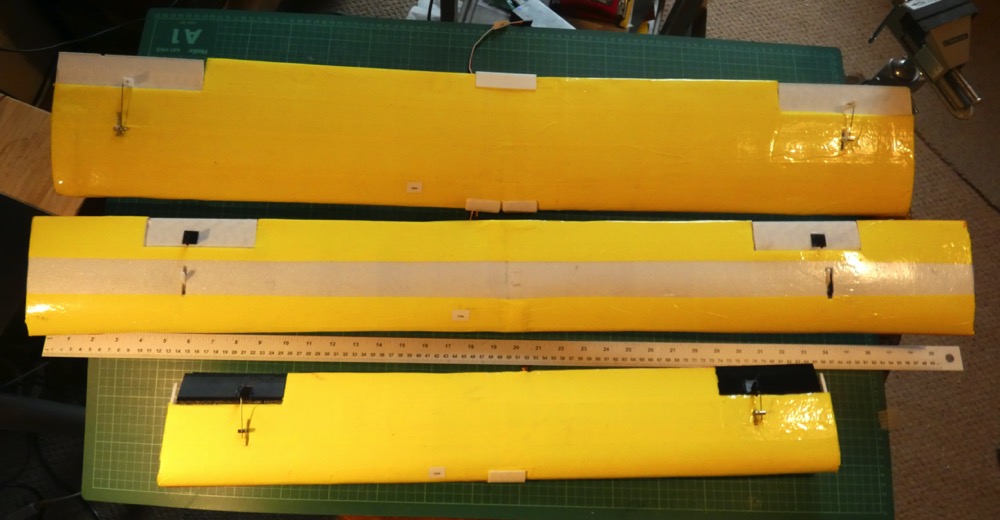
It has been a bit of a journey. I gathered the three Clarke-Y epochs in the image below.
The upper wing is the original attempt which turned out a bit heavy. Original Clarke-Y wing:
153mm chord x 960 span, 260g 9.171 oz (inc wiring & servos). area = 0.1468m^2 1.58 ft^2
wing (only) density 5.8 oz/ft2, aspect ratio 6.27, constant rib section.
The bottom wing in the photo is the 2nd iteration which is considerably lighter:
115mm chord x 700mm 123g 4.338 oz (including wiring & servos). area = 0.0805m^2 0.866 ft^2
wing (only) density 5.01 oz/ft2, aspect ratio 6.08, constant rib section. Yesterday I tweaked the
aileron horns to give a bit of mechanical differential (it uses a Y harness and thus I can't use
the transmitter functions for this).
In the middle is my 3rd iteration which has several rib depths:
123mm chord x 1000mm span, 178g 6.278 oz (inc wiring & servos). area = 0.123 m^2 1.324 ft^2
wing (only) density 4.742 oz/ft2, aspect ratio 8.13, rib section varies. The ailerons are (as previously
commented a bit small but workable). I have setup a mechanical differential.
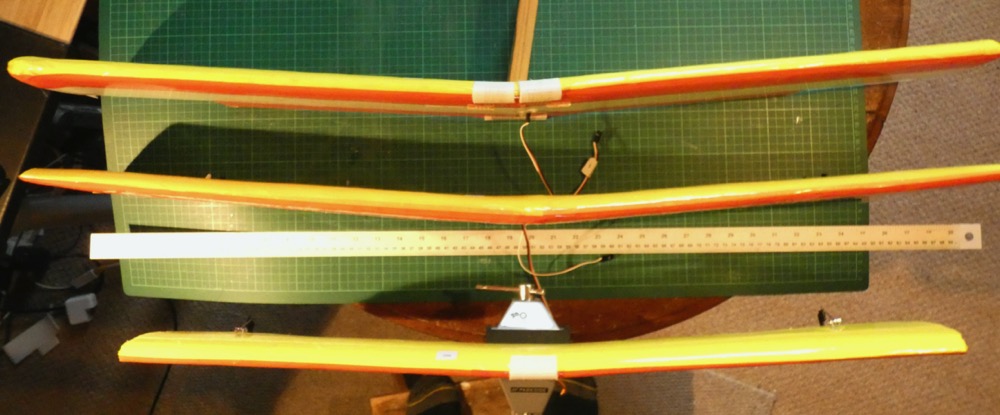
From the front the changing depth of the wing from the root to the tip is slightly apparent. It has a bit more dihedral than the 2nd iteration.
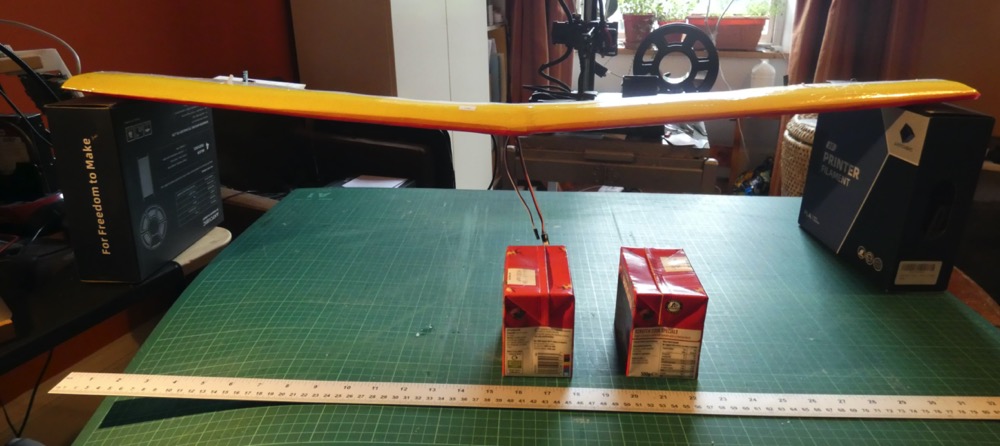
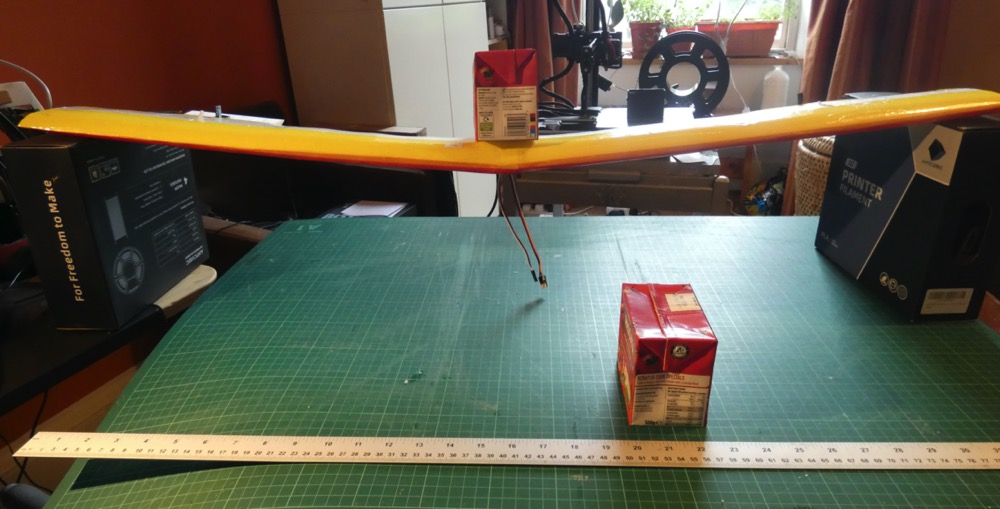
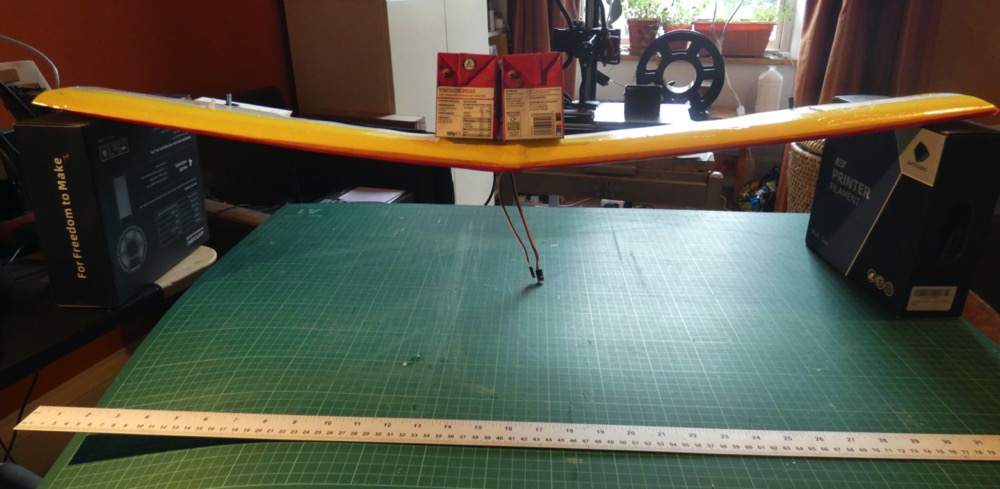
I remember Simon showed a strength test. I did a quick one - with no load, 500g in the centre and 1kg in the centre.
I did a calculations to compare the 1st, 2nd and 3rd iterations vs the oval fuselage. My last flight with the 2nd generation wing indicated it was not quite the slow flyer I was hoping for:
Oval fuselage with 3cell 650mAhr battery, 2206 motor, 155mm slow prop (216g for everything but the wing)
orig large wing 476g 16.79 oz / 1.58 ft2 = 10.62 oz/ft2, cube loading 8.45
2nd generation small wing 334g 11.781 oz / 0.866 ft2 = 13.6 oz/ft2, cube loading 14.6
3rd generation medium wing 394g 13.897 oz / 1.324 ft2 = 10.496 oz/ft2, cube loading 9.122
The cube loading for the small wing reflects the need for speed.
The 3rd generation (medium) wing has a much better loading. Interesting that the 1st generation (heavier) wing has a slightly better loading - but not quite the aspect ratio.
Really, to get a decent loading with the 2nd generation small wing I will need to go to a 'stick' fuselage with a smaller motor and battery. If I can get the weight down somewhat here is what I am looking at:
small wing + light front non-wing 279 g 9.841 oz / 0.866 ft2 = 11.36 oz/ft2, cube loading 12.21
If I can find a lighter ESC and perhaps shift from the 8mm carbon fibre boom (30g) and pay through the nose for a 3 or 4g servos for the aileron and a skinned rather than printed aileron the small wing might begin to be a bit more of a floater. I have ordered some lighter servos.
I still need to see what tweaks are needed to get an initial COG for this new wing on the oval. Given that the field is likely to be sodden and thus a risk of a muddy motor if the landing spot is unlucky. . -Jon
Here is it just before I glued on the top skin...
It has been a bit of a journey. I gathered the three Clarke-Y epochs in the image below.
The upper wing is the original attempt which turned out a bit heavy. Original Clarke-Y wing:
153mm chord x 960 span, 260g 9.171 oz (inc wiring & servos). area = 0.1468m^2 1.58 ft^2
wing (only) density 5.8 oz/ft2, aspect ratio 6.27, constant rib section.
The bottom wing in the photo is the 2nd iteration which is considerably lighter:
115mm chord x 700mm 123g 4.338 oz (including wiring & servos). area = 0.0805m^2 0.866 ft^2
wing (only) density 5.01 oz/ft2, aspect ratio 6.08, constant rib section. Yesterday I tweaked the
aileron horns to give a bit of mechanical differential (it uses a Y harness and thus I can't use
the transmitter functions for this).
In the middle is my 3rd iteration which has several rib depths:
123mm chord x 1000mm span, 178g 6.278 oz (inc wiring & servos). area = 0.123 m^2 1.324 ft^2
wing (only) density 4.742 oz/ft2, aspect ratio 8.13, rib section varies. The ailerons are (as previously
commented a bit small but workable). I have setup a mechanical differential.
From the front the changing depth of the wing from the root to the tip is slightly apparent. It has a bit more dihedral than the 2nd iteration.
I remember Simon showed a strength test. I did a quick one - with no load, 500g in the centre and 1kg in the centre.
I did a calculations to compare the 1st, 2nd and 3rd iterations vs the oval fuselage. My last flight with the 2nd generation wing indicated it was not quite the slow flyer I was hoping for:
Oval fuselage with 3cell 650mAhr battery, 2206 motor, 155mm slow prop (216g for everything but the wing)
orig large wing 476g 16.79 oz / 1.58 ft2 = 10.62 oz/ft2, cube loading 8.45
2nd generation small wing 334g 11.781 oz / 0.866 ft2 = 13.6 oz/ft2, cube loading 14.6
3rd generation medium wing 394g 13.897 oz / 1.324 ft2 = 10.496 oz/ft2, cube loading 9.122
The cube loading for the small wing reflects the need for speed.
The 3rd generation (medium) wing has a much better loading. Interesting that the 1st generation (heavier) wing has a slightly better loading - but not quite the aspect ratio.
Really, to get a decent loading with the 2nd generation small wing I will need to go to a 'stick' fuselage with a smaller motor and battery. If I can get the weight down somewhat here is what I am looking at:
small wing + light front non-wing 279 g 9.841 oz / 0.866 ft2 = 11.36 oz/ft2, cube loading 12.21
If I can find a lighter ESC and perhaps shift from the 8mm carbon fibre boom (30g) and pay through the nose for a 3 or 4g servos for the aileron and a skinned rather than printed aileron the small wing might begin to be a bit more of a floater. I have ordered some lighter servos.
I still need to see what tweaks are needed to get an initial COG for this new wing on the oval. Given that the field is likely to be sodden and thus a risk of a muddy motor if the landing spot is unlucky.
. -Jon Attachments:
Thanks: Eric
Please Log in or Create an account to join the conversation.
- Eric
-
- Offline
- Moderator
-
Less
More
- Posts: 15406
- Thank you received: 14306
24 Jul 2022 17:35 #117
by Eric
if you are calm and collected when all about you are going berserk - you've missed something important!
Replied by Eric on topic freeCAD and fuselage creation
That looks good, but as you have already stated, those ailerons are 100% too small - they need to be twice that span for that chord depth and wing-span, or their effect will be minimal.
if you are calm and collected when all about you are going berserk - you've missed something important!
Thanks: jon.in.swansea
Please Log in or Create an account to join the conversation.
- Klipkopwildlife
-

- Offline
- Administrator
-

- I'm supposed to be retired!
24 Jul 2022 17:48 #118
by Klipkopwildlife
Do it now, you may never get another chance
Replied by Klipkopwildlife on topic freeCAD and fuselage creation
About 28 to 30% of chord Jon. Make sure you have plenty of aileron movement 30o up and be prepared to use rudder in the turns.
Do it now, you may never get another chance
Thanks: jon.in.swansea
Please Log in or Create an account to join the conversation.
- jon.in.swansea
-
Topic Author
- Offline
- Elite Member
-
Less
More
- Posts: 757
- Thank you received: 1164
24 Jul 2022 18:37 #119
by jon.in.swansea
Replied by jon.in.swansea on topic freeCAD and fuselage creation
I measured and the up angle is 30 degrees. -Jon
Thanks: Klipkopwildlife
Please Log in or Create an account to join the conversation.
- Quorneng
-
- Offline
- Forum Master
-
Less
More
- Posts: 10058
- Thank you received: 19043
24 Jul 2022 20:47 #120
by Quorneng
Replied by Quorneng on topic freeCAD and fuselage creation
jon
Nice load test!
At 1kg at the centre for a 9 oz model suggest the wing is considerably stronger (heavier) that it really need be. Your test would suggest the wing is good for pulling a 12g manoeuvre. That's up in company with the Euro fighter!
No harm in being plenty strong but if you are looking for a slow flyer then every little helps.
Nice load test!
At 1kg at the centre for a 9 oz model suggest the wing is considerably stronger (heavier) that it really need be. Your test would suggest the wing is good for pulling a 12g manoeuvre. That's up in company with the Euro fighter!
No harm in being plenty strong but if you are looking for a slow flyer then every little helps.
Thanks: Klipkopwildlife, jon.in.swansea
Please Log in or Create an account to join the conversation.
Time to create page: 0.339 seconds